When it comes to modern meteorology, AI climate prediction is fundamentally shifting how scientists forecast weather patterns and ocean dynamics. Back in August 1975, the European Centre for Medium-Range Weather Forecasts (ECMWF) successfully generated its first meteorological forecast model using a supercomputer, taking 12 days to predict 10 days into the future. Three years later, a 50 times faster supercomputer reduced that calculation time to five hours, marking a milestone in operational medium-range forecasting.
Dr. Syukuro Manabe of Princeton University, a 2021 Nobel Laureate in Physics, also pioneered the path of computing Earth’s climate. His 1969 coupled atmosphere-ocean climate model laid the groundwork for today’s climate change projections. Atmospheric movements are governed by physical laws. Scholars have traditionally used ‘dynamical models’—dividing the Earth into countless grid cells to calculate physical equations determining how temperature, pressure, humidity, and wind change over time. There are also ‘statistical models’ that seek statistical relationships between variables from past observational data. Climate science has long advanced by mathematically expressing and calculating natural phenomena. However, in the late 2010s, a new challenger emerged: artificial intelligence (AI).
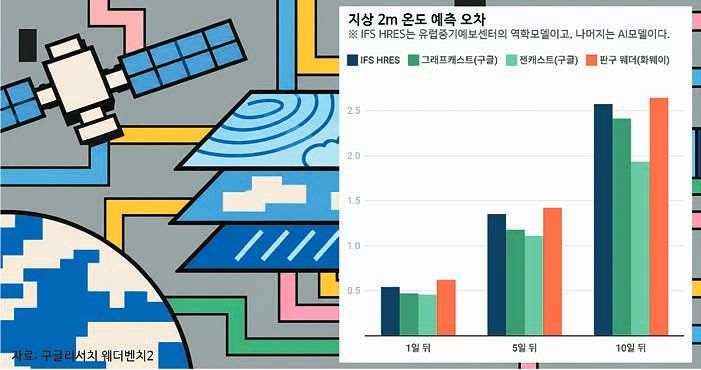
The predictive method of AI resembles an experienced grandmother who accurately guesses tomorrow’s weather without knowing physics, relying on years of intuition. By learning patterns from massive datasets, AI predicts the future without solving complex equations. The serious application of AI in climate science began in the late 2010s. Over this short span of just a decade, AI prediction technology has advanced rapidly. For instance, Google DeepMind’s ‘GraphCast,’ unveiled in 2023, calculated global 10-day weather in under a minute, outperforming top-tier dynamical models across multiple metrics.
Dr. Daehyun Kang from the Korea Institute of Science and Technology (KIST) explained that while it was once considered impossible to predict complex Earth systems without physical equations, AI trained purely on data began attracting attention after outperforming existing models.