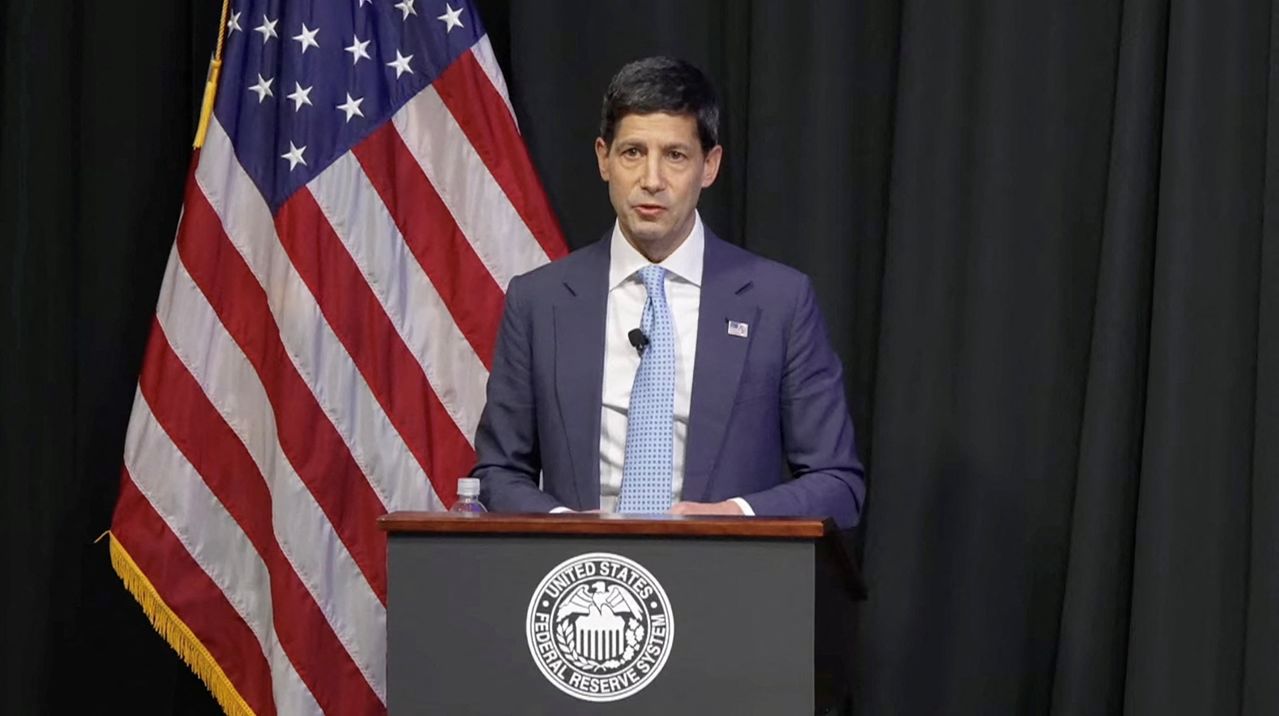
The U.S. Federal Reserve is reviewing three distinct economic scenarios driven by artificial intelligence, ranging from high growth to increased unemployment and falling stock prices. Federal Reserve Chair Kevin Warsh stated that while AI could support growth significantly above long-term averages, the anticipated productivity leap has not yet clearly manifested.
Speaking on the 16th (local time) at a Productivity and Jobs Task Force conference in San Francisco, Warsh emphasized that the Fed’s mission is to prepare for any eventuality, noting that Fed staff have begun using economic models to analyze the spillover effects of AI. These scenarios examine how much AI actually boosts productivity, whether those gains translate into worker jobs and incomes, and if expectations driving up investments and stock prices will yield actual returns. This event marks the first public disclosure of one of five task forces formed by Warsh to review the Fed’s policy and research methods following his inauguration.
From High Growth and Employment to Automation Layoffs and Slumping Investment
The most optimistic first scenario involves companies and workers sharing the benefits of AI. If the same time and workforce can produce more goods and services, corporate profits will rise and worker incomes will improve. Warsh explained that in this case, real gross domestic product (GDP) growth rates will consistently exceed long-term averages, and the U.S. will maintain a state close to full employment.
The second scenario occurs when output increases but a large number of people lose their jobs. Companies can automate tasks with AI to increase production with fewer personnel, but displaced workers need time to learn new skills and transition to other jobs. If automation outpaces this adaptation speed, it is possible for the unemployment rate to rise even as overall economic output increases. Warsh warned that while growth rates would exceed long-term averages, significant turmoil could hit the labor market.
The third scenario involves a deterioration of profit outlooks relative to heavy investments poured into AI. As the conviction spreads that it is difficult to earn as much money as expected despite massive spending on data centers and semiconductors, stock prices that rose on future earnings expectations could fall. Furthermore, if companies cut new investment and households suffering stock losses reduce consumption, the shock will spread across the entire economy. Warsh’s pessimistic diagnosis is that economic growth could slow and unemployment could rise even further.
The New York Times (NYT) also highlighted financial market concerns surrounding AI. According to the Fed’s Financial Stability Report released on the 13th, a survey of 23 representatives from banks, securities firms, and investment funds conducted by the Federal Reserve Bank of New York in September and October showed that about 90% cited AI-related risks as the most frequently discussed hazard.
Growth Expectations Remain High as AI Fuels Superpower Ambitions
The Fed’s expectations for AI are closely tied to America’s superpower status. Warsh stated, “The Fed’s position is neither pro nor con, but can we be a superpower without superintelligence (SI, the Trump administration’s term for AI)? We cannot remain completely neutral on American leadership during this period of challenges and possibilities.”
Warsh noted in particular that AI could accelerate the speed at which new ideas are generated, contributing to long-term U.S. growth. The Wall Street Journal (WSJ) pointed out that Warsh repeatedly explained AI as an issue of national power, a subject past Fed chairs generally did not delve into deeply. Nevertheless, Warsh evaluated that while recent quarterly productivity growth has been relatively strong, a clear leap sufficient to change long-term trends has not yet been confirmed.
Rising Semiconductor Prices and the Threat of Rate Hikes to AI Investments
An important observation is that related expectations are driving up semiconductor prices even before they become reality. Building and operating data centers to run AI requires massive amounts of semiconductors and electricity, and as companies stepped up efforts, memory semiconductor supply failed to keep pace with demand. Federal Reserve Vice Chair Philip Jefferson noted on the 13th that data center investments are driving up overall prices for this exact reason.
Inflation pushed up by AI could influence interest rate decisions, potentially resulting in slowed investments. Although Warsh did not mention rate projections during the event, the NYT reported that with inflation rates hovering above the Fed’s 2% target, an interest rate hike of 0.25 percentage points is expected at the upcoming Federal Open Market Committee (FOMC) meeting on December 8-9. If rates rise, the AI industry building data centers could face heavier interest burdens, raising the possibility of reduced investments and adverse effects on AI economic impact and growth.