As artificial intelligence continues to solve various mathematical challenges in rapid succession, the global mathematical community is in an uproar. Following OpenAI’s announcement last month that it found a solution to the Navier-Stokes equation—one of the seven Millennium Prize Problems—the company released 722 papers covering over 300 unresolved problems.
The Disruption of the Mathematical Ecosystem
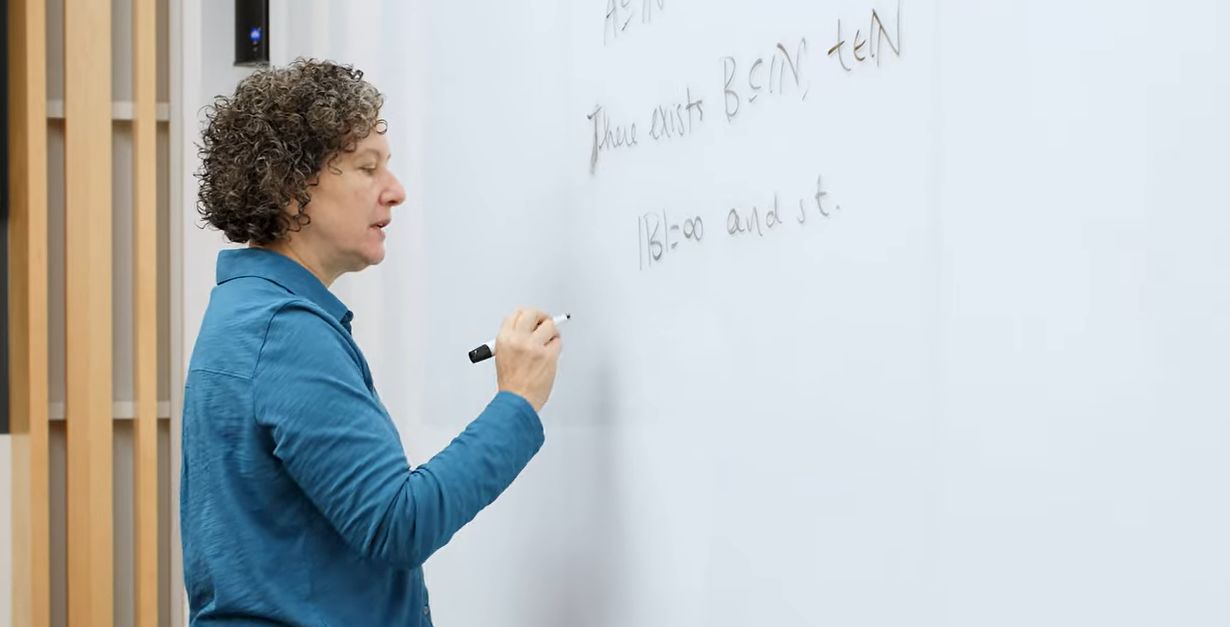
In a written interview with the JoongAng Ilbo on the 10th, Bryna Kra, a distinguished professor of mathematics at Northwestern University, evaluated this latest paper release as a "AI math challenges" tectonic shift in the field. However, she warned that "AI companies, in the process of improving their models, are destroying the mathematical ecosystem that allowed them to grow in the first place." The former president of the American Mathematical Society also attended an OpenAI-invited AI and mathematics symposium in August.
What concerns Kra most is the absence of a process to understand and debate new solutions. "Mathematicians share questions, conjectures, and proof ideas and discuss them together," she said, expressing frustration that "even if you get stuck reading a proof in a paper published by OpenAI, there is no one to ask." Pointing out OpenAI’s inadequate explanations and the subsequent retraction of some manuscripts, she added, "If my student had been planning this kind of announcement, I would have told them to take more time and be more careful." OpenAI retracted three manuscripts and modified 14 just one day after releasing the papers.
Backlash from Mathematicians and Fields Medalists
Backlash from the mathematical community has persisted since OpenAI’s solution to the Navier-Stokes equation was announced. Last month, 25 Fields Medalists issued a joint statement criticizing the competition to solve difficult problems merely to showcase AI model performance as harmful to the mathematical community. Concerns also poured out on the mathematicians’ joint blog, 'Proofs and Prompts.'
While acknowledging AI's novel ideas, Fields Medalist and UCLA Professor Terence Tao wrote that he felt "deep frustration" over the lack of human counterparts to answer questions and teach students. This contrasts sharply with OpenAI, which has been celebrating its AI's achievements. Sam Altman, CEO of OpenAI, evaluated on the 6th that "a new era of discovery has opened," while OpenAI researcher Su Weibin noted a "Copernican shift in the perspective on intelligence."
Regarding this, Kra pointed out that "the goals of OpenAI and the mathematical community do not align." For corporations, math challenges are a training ground for models, but for mathematicians, such challenges are like "lighthouses" guiding research directions, where "the methods and ideas discovered in the process of solving them are also achievements." She diagnosed that flooding hundreds of papers at once means "the community cannot digest them, and the motivation to research even disappears," adding that "now is the time to re-examine and change doctoral education in mathematics, faculty recruitment, and publication criteria."
Concerns Over Unreleased Ideas and the Future
Concerns have also been raised that AI may have unlawfully utilized unpublished ideas. Tristan Buckmaster, a professor at New York University, has raised suspicions that his research may have been used without authorization in OpenAI's Navier-Stokes solution. After researching the relevant equations with a colleague for about a year, he suspects that drafts entered into ChatGPT might have been used to train the model. In a CNBC interview on the 8th, Buckmaster stated, "This mass release has ruined the careers of young mathematicians and completely destroyed their research plans." In response, OpenAI maintains that his inputs did not influence the problem-solving process.
Nevertheless, Kra believes that the role of mathematicians could become even greater in the future. She emphasized, "As AI systems become more complex, the importance of mathematics education—which helps understand complex problems and find solutions—grows," adding that "mathematicians are also essential for creating safe AI."