Canadian ultra-runner and mother of a toddler, Stephanie Case, 43, made history on December 8 by becoming the first woman to complete the Antarctic Ice Ultra, a grueling 100-mile (approx. 160 km) race in Antarctica. For her, this extreme challenge was not only a test of her physical limits against freezing temperatures but also a journey to prove that a woman can continue pursuing her dreams after becoming a mother.
The race takes place on a 4.2 km trail set up on the snowfields of the Schirmacher Oasis in eastern Antarctica, roughly 70 degrees south. According to organizers, temperatures plummeted to a bitter -35°C during the event, with runners occasionally passing by groups of penguins.
Speaking with the BBC after the race, Case noted, “Spending about 20 minutes in that kind of environment is manageable, but exposure for over 17 hours requires an incredible amount of energy just to maintain core body temperature.”
Her finishing time was 17 hours, 31 minutes, and 39 seconds. She claimed second place overall, trailing only Chinese ultra-runner Ni Weisheng, who took the top spot. Among the four women who started the race, Case was the only one to cross the finish line—a feat unmatched since the event’s inception in 2024.
Surviving Extreme Cold and Logistics
Maintaining body temperature is crucial for athletes running long distances in severe cold. In particular, getting sweat trapped in clothing can cause body heat to drop rapidly, requiring strategies to minimize sweating.
Even for Case, an experienced ultra-runner who refers to herself as a “mountain goat” due to her familiarity with rugged terrain, the Antarctic race presented unexpected hurdles. One of the most difficult challenges was using the restroom in extreme sub-zero temperatures.
Antarctica adheres to strict “biosecurity” principles prohibiting waste from being left behind. While a container-style portable toilet was set up about 2 km from the starting line, runners had to minimize time spent relieving themselves to avoid severe frostbite. Case explained, “Just pulling your hands out of your gloves for five seconds can lead to frostbite, and leaving bare skin exposed for 10 seconds with your pants down can take 20 minutes to recover your body temperature.”
Despite these harsh conditions, Case engaged in a fierce battle with the men’s leader. Although Ni Weisheng shaved 5 hours and 38 minutes off his previous year’s winning time, Case—competing in the race for the first time—finished just 29 minutes behind him. She recalled that whenever she closed the gap to within a minute, Ni would look back and pick up the pace, adding that this competitive drive helped her deliver her best performance.
Challenging Stereotypes About Motherhood
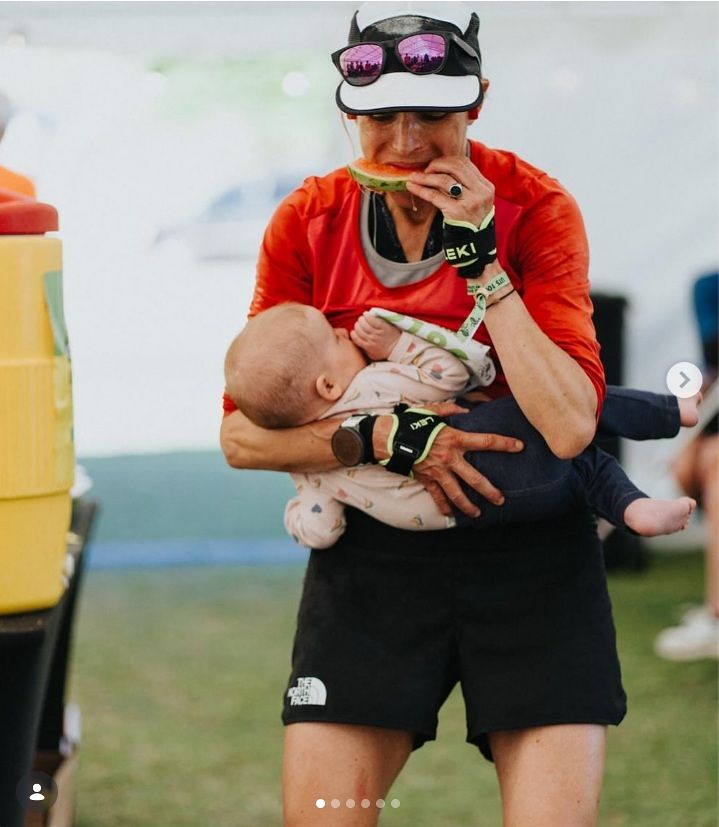
An international human rights lawyer and professional ultra-runner, Case previously made headlines last year by breastfeeding her six-month-old daughter three times during a 100 km ultramarathon in Snowdonia, Wales.
While reactions were largely positive, she also faced criticism. Detractors argued that leaving a young toddler behind for long-distance races was selfish, and that such feats pressure mothers to ‘have it all’ by balancing intense athletic training with childcare.
Case stated that such criticisms served as the backdrop for her decision to tackle the Antarctic Ice Ultra. “Motherhood is not a finish line,” she emphasized, adding that the best way to push back against the notion that mothers should stay strictly at home is to chase ambitious goals in the most extreme places on Earth.
“When I do things that bring me joy and allow me to be my authentic self, I become a better mother,” she said. “When I return home, I can show my daughter firsthand what women are truly capable of and inspire her to pursue whatever she dreams of doing in the future.”
Following a runner-up finish at the Hardrock 100 in Colorado in 2022, Case suffered the heartbreak of a miscarriage before welcoming her daughter via IVF. She resumed running just six weeks after giving birth in November 2024, and went on to win the Snowdonia race the following May.