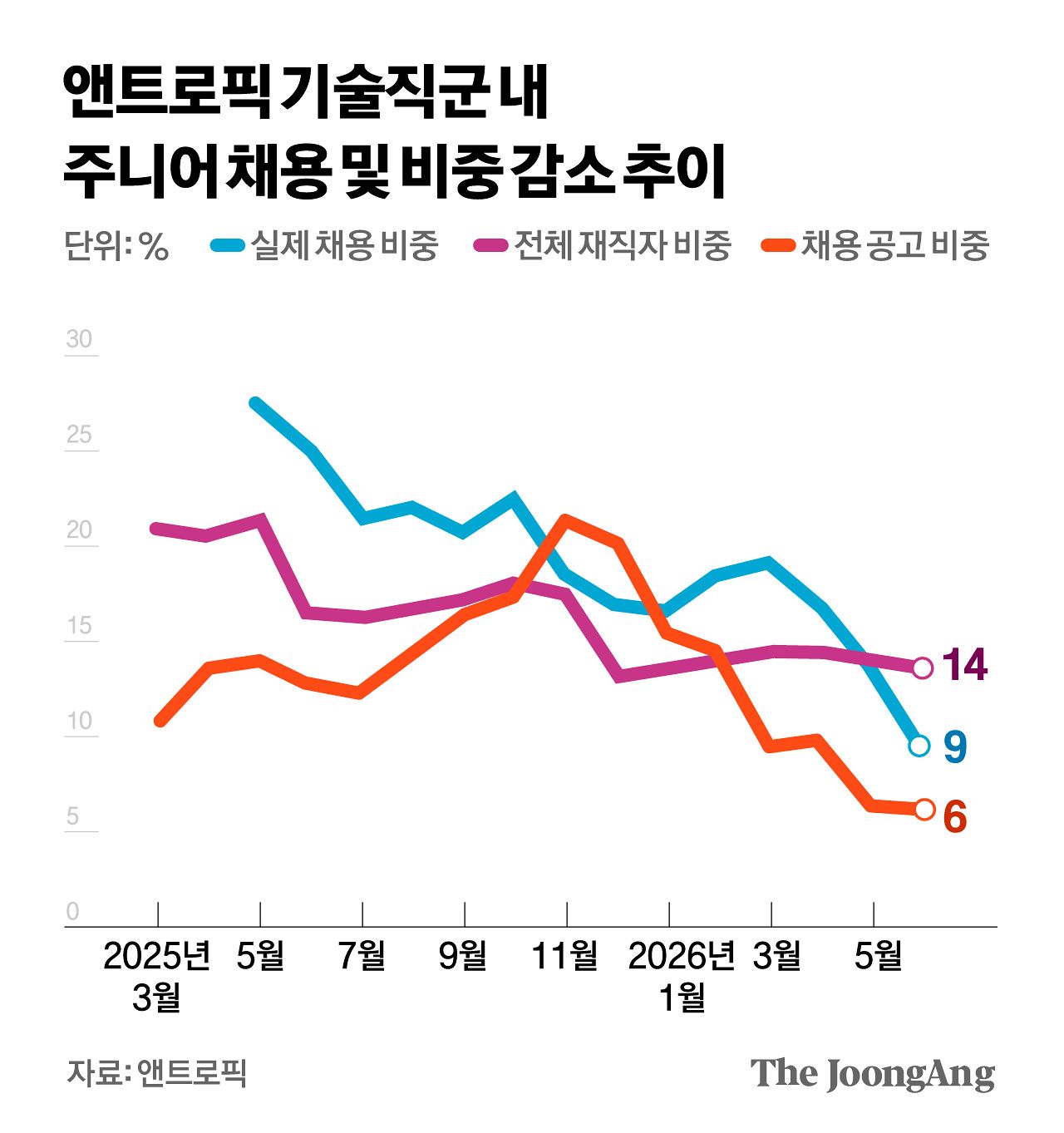
Even Anthropic AI, sitting at the very forefront of artificial intelligence technology, has not been immune to the employment shocks of the technology it created. This year, the working hours of AI agents have exceeded six times those of human employees, while junior developer hiring has plummeted to one-third of last year’s level. Amid this situation, Anthropic has decided to allocate 5% of its company equity to a public interest fund designed to address the social and economic impacts of AI on jobs. It is, in effect, a remedy proposed by the developer itself against the tidal wave of its self-created AI.
Anthropic announced on the 18th (local time) that while AI can generate massive economic value, it can also cause instability for many workers. To address this, the company established the ‘Anthropic Public Interest Fund’ and committed 5% of its equity. Whenever the company’s valuation grows by 50% above an internally set benchmark, an additional 2% of equity will be transferred at the discretion of the board of directors. The fund will be utilized by reviewing various measures, including supporting programs to resolve the impact of AI on workers and direct distribution targeting specific groups affected by AI.
The rapid evolution of AI has led to labor market instability and job shocks, which Anthropic cited as the rationale for the public interest fund, and these changes are already progressing rapidly within the company itself. According to an internal employment environment report released by Anthropic on the 16th, junior positions in the technical department are rapidly decreasing as tasks such as writing code and finding bugs (errors) can now be handed over to AI.
The proportion of junior new hires among technical positions dropped from about 27% in early last year to 9% in May of this year. The proportion of junior employees among the entire technical staff also decreased from 21% to 14%.
Administrative staff, who naturally tend to increase as the company grows, have barely increased. Instead, those roles have been filled by AI agents. An executive secretary at Anthropic noted that simple administrative tasks are already being replaced by Claude, allowing them to move up to higher-level tasks equivalent to a ‘chief of staff.’
The working hours of AI agents within Anthropic surpassed those of human employees in March of this year. By August, based solely on working hours, AI worked six times more than humans. Among these dynamics, a phenomenon was discovered where humans spent more than half of their weekly working hours simply reading the results poured out by agents, leading ‘human attention’ to be pointed out as a major bottleneck in AI adoption.
The Anthropic Research Institute, the internal research organization that authored the report directly, pointed out that Anthropic employees expect AI to replace 75% of their work by 2030. Existing incumbents are protected by creating higher added value through AI, but a structural problem is arising where youth and new entrants who must newly enter the market are unable to secure employment at all.