“Food security is national security.”
U.S. Agriculture Secretary Brooke Rollins argued that America’s ability to produce its own food and maintain agricultural competitiveness is a core pillar of national security.
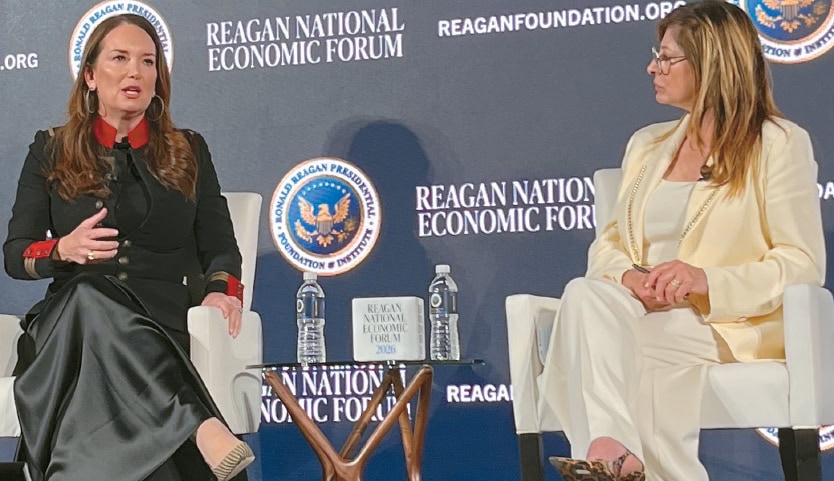
Speaking during a conversation at the Reagan National Economic Forum at the Ronald Reagan Presidential Library in Simi Valley on May 29, Rollins said, “Food security is national security,” adding that if the United States cannot “feed, fuel and clothe ourselves,” it cannot preserve the meaning of freedom.
Rollins said U.S. agriculture has lost competitiveness amid deepening foreign dependence, supply chain instability and rising production costs. She noted that while the United States produced most of its fertilizer domestically two decades ago, it now depends on China, Russia and other foreign suppliers for roughly half of its fertilizer.
Reliance on foreign sources for key agricultural inputs such as fertilizer, fuel and seeds, she said, is not merely an agricultural concern but a national security issue.
Referring to recent tensions in the Middle East and disruptions around the Strait of Hormuz, Rollins said the volatility in fertilizer and energy prices shows how vulnerable agricultural supply chains can immediately burden American farmers and consumers when international conflicts escalate.
She said fertilizer and fuel prices would likely come down once the strait reopens, but stressed that the larger goal must be to rebuild domestic production capacity in the United States.
Rollins said the Trump administration is working to expand fertilizer production facilities in the U.S. and shorten permitting timelines. She cited plans for what she described as the world’s largest ammonia plant, saying the administration’s goal is to lower input costs for farmers and ensure that America can once again feed, fuel and clothe itself.
The conversation also focused heavily on Chinese ownership of U.S. farmland. Rollins said China owned about 2,000 acres of American farmland in 1983, compared with nearly 300,000 acres today.
She criticized the fact that some Chinese-owned farmland is located near military bases, saying such a scenario would be unimaginable in many other countries but has been allowed to happen in the United States.
Rollins also pointed to Chinese corporate ownership in the seed, fertilizer and pork industries, as well as Brazilian control in parts of the beef processing sector. As foreign capital and large corporations consolidate agricultural supply chains, she warned, family farms are disappearing.
Reinforcing food production, processing and distribution within the United States, she said, is not just an economic policy but a national strategic priority.
Rollins also argued that food safety and public health should be viewed through the lens of national security. She cited school meals and nutrition assistance programs, saying the Agriculture Department spends about $400 million a day on nutrition programs, yet many schools do not even have ovens needed to prepare real meals.
She said the rise in chronic illness among children is also tied to military readiness, framing the issue as one that extends beyond public health.
Rollins also emphasized the importance of agricultural technology. She cited examples of drones and artificial intelligence being used to precisely monitor crop conditions, pests and water use, saying technology can transform farm productivity and profitability.
She also discussed innovation in potato farming, saying new methods could help farmers recover after years of poor profitability.
Rollins also underscored the need to rebuild the U.S. cotton industry. She said American cotton production has fallen to about 15% of the level seen 20 to 30 years ago, a decline she linked to outsourcing, cheap synthetic fibers and what she described as harmful government policies.
By rebuilding domestic agricultural production and supply chains, Rollins said, the United States can protect farmers and ranchers, strengthen national security and preserve what she called America’s pioneering way of life.