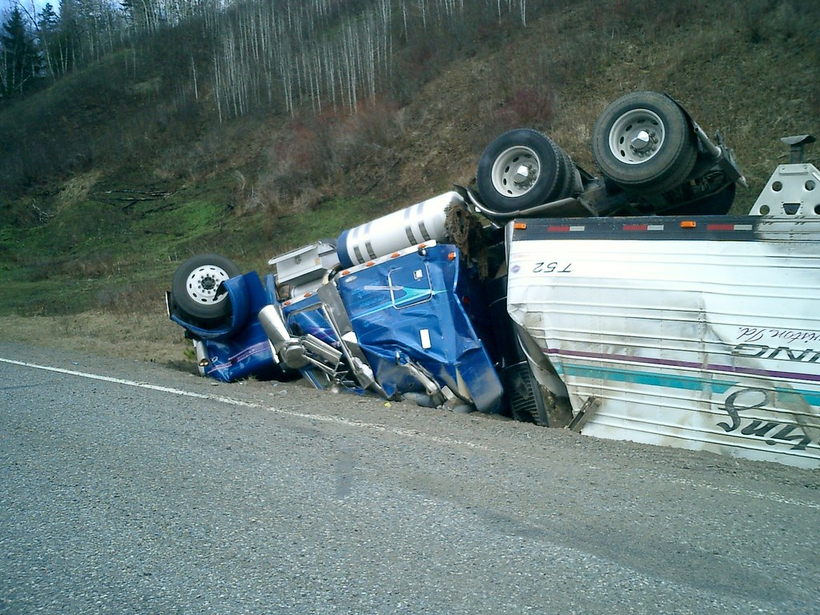
A significant number of commercial drivers in California who caused fatal traffic accidents have been allowed to keep their licenses and continue driving. Controversy has arisen as the Department of Motor Vehicles (DMV) failed to take appropriate action even when some of these drivers continued to violate traffic laws, such as speeding, following their crashes.
An analysis of court records and DMV data by the nonprofit news organization CalMatters revealed that from 2019 to early 2024, about 130 commercial driver’s license holders were charged with vehicular manslaughter. Nearly half of them still held valid licenses as of late May. These individuals hold Class A or B licenses, which permit them to operate large trucks and buses.
Notably, 12 of these drivers were caught violating traffic laws like speeding while operating commercial vehicles even after fatal accidents. Some were found to have renewed their licenses despite causing multiple crashes.
Under California law, truck drivers convicted of vehicular manslaughter have their commercial driving privileges revoked for one year. Convictions for felonies generally result in a three-year driver’s license suspension.
The issue is that drivers can continue operating vehicles if legal proceedings stretch on for years. Critics point out that the DMV has the authority to investigate fatal accidents and suspend licenses even before a criminal conviction, but it has failed to properly exercise this power.
For instance, in June 2022 near Fresno, a large truck plowed into an SUV, killing Jenny Chow. The truck driver, Baljit Singh, was traveling at 65 mph and failed to avoid slowed traffic.
Eleven months prior, in July 2021, Singh had also crossed the center line in Kern County, killing a 26-year-old motorcyclist. At the time, the California Highway Patrol (CHP) determined that Singh was fatigued from exceeding driving hours and recommended vehicular manslaughter charges.
The DMV did not suspend his license despite knowing about the first accident. Singh did not lose his license until he was convicted of both incidents in 2024. The victim’s husband, Loren Chow, stated that if the DMV had suspended his license, his wife would still be alive today.
Similarly, in 2018 in Riverside County, truck driver Marco Rodriguez struck and killed tow truck driver John Israel, who was on the shoulder of the 10 Freeway.
Following his vehicular manslaughter conviction, Rodriguez was caught speeding three times and lane-violating once while driving commercial vehicles. Despite this, the DMV renewed his license in March of this year. His driving privileges were only revoked in July, after media inquiries regarding the case.
CalMatters also pointed out flaws in the DMV’s point management system. While commercial vehicle drivers committing vehicular manslaughter should receive 3 points, most investigation records only assessed 2 points, the standard for regular drivers. The DMV explained that it can only apply accurate points upon receiving related notifications from the court.
After receiving a list of problematic drivers from the media, the DMV took actions such as suspending licenses or revoking commercial driving privileges for about 12 individuals. The DMV stated that it has been uncovering and processing cases that were not previously reviewed while improving its operational procedures.
Meanwhile, according to federal statistics, approximately 4,000 people died in large truck-related traffic accidents in California between 2015 and 2024.