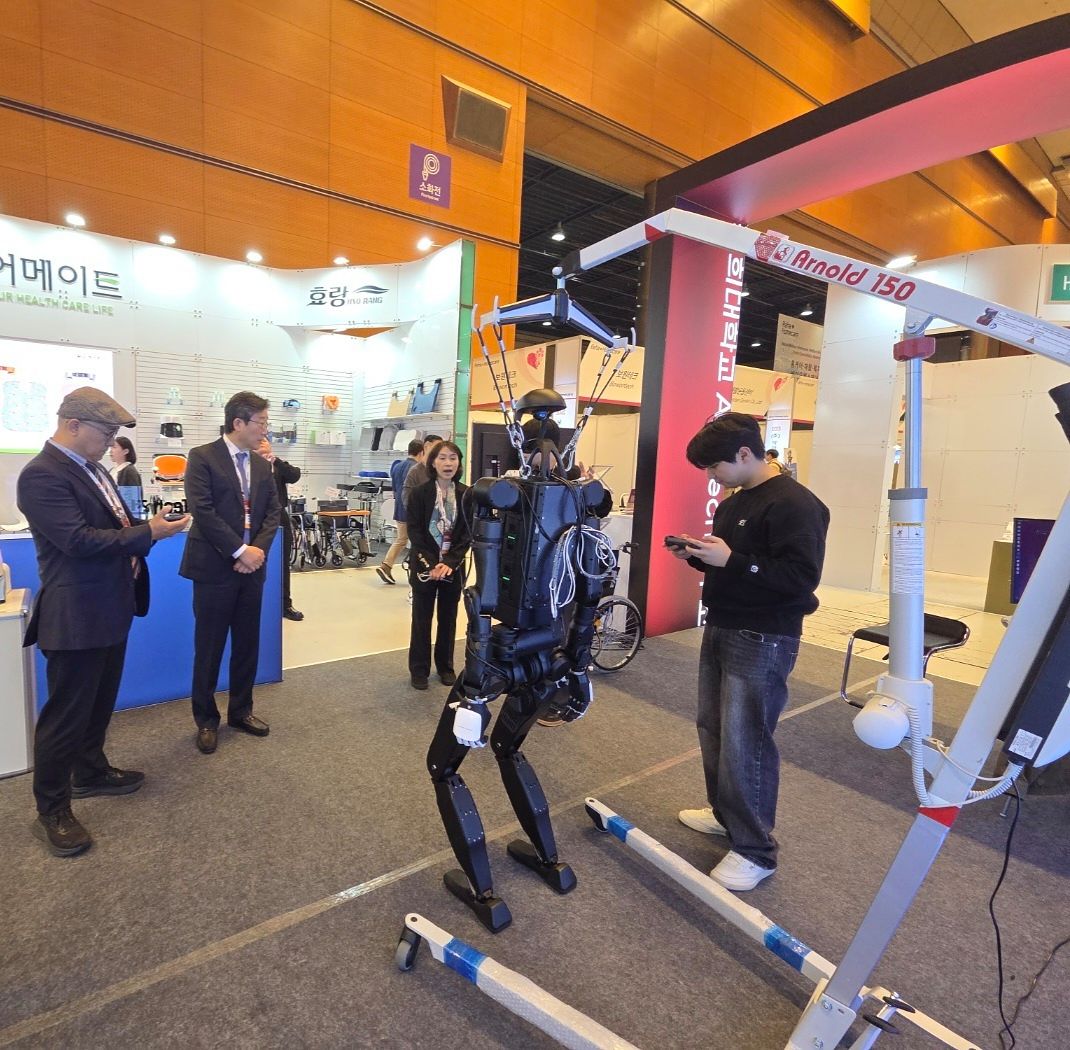
A robot that helps a single elderly person avoid falling while going to the bathroom at night, or safely transfers a mobility-impaired senior from a bed to a wheelchair. These are the roles of care robots expected by older adults and care workers. Research shows that seniors need robots most to protect their daily safety, while caregivers need them to ease physical burdens.
These discussions took place at the ‘2026 K-AgeTech Global Forum & Networking’ hosted by the Kyung Hee University AgeTech Research Institute on the 21st. The event explored how AgeTech—technology assisting the health and lives of older adults—combines with artificial intelligence and physical AI, while discussing growth strategies for the senior industry. Around 500 government, corporate, and research representatives from South Korea, the United States, and Japan attended to share overseas research achievements, government investment plans, and care site demands. Physical AI refers to artificial intelligence that perceives and judges surrounding situations to move physically.
Professor Kim Young-sun of the Kyung Hee University Department of Gerontology presented the results of a demand survey targeting older adults and care workers. According to a survey conducted by the institute in September targeting 104 seniors aged 65 and older living in the community, physical AI demand was highest in the emergency and safety sector. By detailed item, safety checks during bathroom use and bathing accounted for 32.7%, while nighttime bathroom movement and responses to cognitive decline such as gas, door locking, and wandering each accounted for 30.8%.
At care sites, technology assisting in moving human bodies took priority. According to a survey of 115 nursing home workers conducted between August and September, the field with the highest demand for physical AI was mobility and transferring, which refers to moving a body from a bed to a wheelchair or from a wheelchair to a bathing chair. Among detailed items, demand for a function to accompany walking and support individuals to prevent falls was the highest at 39.1%.
These demands appeared to be proportional to the work burden of care workers. The work burden evaluated by facility workers was highest for mobility and transferring at 72.3 points out of 100. In a separate survey on care robots, workers with musculoskeletal disorders and pain preferentially wanted robots that reduce physical burdens, such as pressure ulcer prevention, posture changes, position switching, bathing, and mobility assistance.
Subjects were found to have both expectations and concerns regarding the technology. In the survey of older adults, ‘thinking the usage method would be difficult’ was the highest concern at 41.3%. ‘Robots touching my body’ followed at 31.7%, and ‘worrying that people coming might decrease’ was 29.8%. Professor Kim suggested that the field effects of technology must be verified, and user education, maintenance, and public support must be prepared together. He emphasized that the senior industry can grow only when it extends beyond technology development to a care ecosystem connecting services, systems, and markets.
Overseas researchers also introduced technologies applied to real life and care sites. Professor Tapomayukh Bhattacharjee of Cornell University in the US presented a study where a feeding assistance robot was deployed in a home for a month. Professor Tamon Miyake of Waseda University in Japan shared research achievements where humanoid robots perform intimate care directly touching a person’s body, such as posture changes and dressing.
The government’s support direction was also presented. Sung-ho Eun, Director General for Population and Social Services Policy at the Ministry of Health and Welfare, stated that the government would expand step-by-step from smart home and smart facility pilot projects to the supply of physical AI care robots, and ensure that developed technologies lead to public support such as welfare equipment and vouchers. The subsequent networking event saw participation from about 150 companies and institutions discussing commercialization and investment cooperation plans across sectors such as insurance, finance, home appliances, data, and services.