China faced pressure to respond to North Korea’s dispatch of troops to Russia during the recently concluded Asia-Pacific Economic Cooperation (APEC) summit held in Lima, Peru, from Friday to Sunday.
South Korean President Yoon Suk Yeol, U.S. President Joe Biden and Japanese Prime Minister Shigeru Ishiba sent coordinated messages for China to influence North Korea and Russia during sideline summits with Chinese President Xi Jinping, as well as during meetings among themselves.
Xi’s posture appeared to change, too, with the Chinese leader seemingly warning his North Korean and Russian allies that he would not tolerate conflict on the Korean Peninsula.
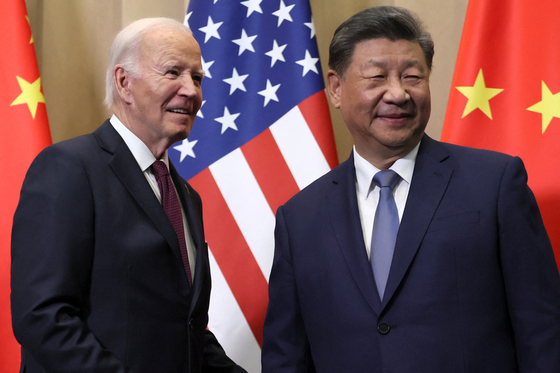
The White House said that during the U.S.-China summit held on Saturday, Biden criticized the deployment of thousands of North Korean troops to Russia as a “dangerous escalation that would have serious consequences for the security of both Europe and the Indo-Pacific.”
This was tantamount to asking Xi directly how much China can tolerate. North Korea’s provocations against South Korea will lead to an escalation of tensions on the Korean Peninsula, and concerns about intervention by Russia — which has a military treaty with North Korea — will inevitably increase. A seventh nuclear test could directly challenge China’s status as the “only nuclear power in East Asia.”
At the time, North Korean issues were not deeply discussed during U.S.-China talks due to other major agenda items, but the recklessness of sending troops to Russia has made the North a higher priority.
Even with the second Donald Trump administration set to begin in January, North Korea is likely to remain a priority issue. President-elect Trump has repeatedly expressed his will to end the war in Ukraine quickly, and breaking the link between North Korea and Russia is essential to do this.
Xi responded to Biden’s remarks in a meaningful way. Announcing the summit’s results, the Chinese side said Xi told Biden that “China cannot tolerate conflict and chaos on the Korean Peninsula, and will not sit idly by while China’s strategic security and core interests are threatened.”
Although Xi did not directly refer to North Korea or Russia, his mention of “conflict on the Korean Peninsula” could reflect concern that Pyongyang and Moscow’s behavior could cause problems in Beijing’s backyard.
This starkly contrasts with the statement released after the U.S-China summit two years ago, where Xi effectively supported North Korea, saying, “We must face the root cause of the Korean Peninsula issue and resolve North Korea’s reasonable concerns in a balanced manner.”
Yoon also raised the issue of North Korea’s troop dispatch to Russia during his bilateral summit with Xi on Friday, the first such summit in two years.
“I hope that South Korea and China will cooperate to promote stability and peace in the region in response to North Korea’s continued provocations, the war in Ukraine, and Russia-North Korea military cooperation,” Yoon told Xi during the summit, according to a presidential office official.
The official also said Yoon urged China to “play a constructive role in response to North Korea’s continued provocations and military cooperation with Russia.”
The South Korean and U.S. leaders thus met with Xi a day apart and sent almost identical messages.
According to a senior presidential official, Xi said, “China also hopes for an easing of the regional situation and does not want tensions on the Korean Peninsula, and we only hope that the parties concerned will peacefully resolve the issue through dialogue and negotiations in order to find a political solution.”
However, Xi reportedly made no specific mention of cooperation between North Korea and Russia.
The Chinese side only stated in an official announcement that “Yoon expressed his hope to work together to respond to common challenges and promote peace and stability in the region.”
International pressure rarely leads to direct action by China, but the diplomatic consensus is that the bilateral meetings with Xi on the sidelines of this year’s APEC summit would likely divorce China from North Korea and Russia’s illegal activities, preventing a worst-case scenario in which Pyongyang, Moscow and Beijing “go wild” in concert with one another.
The messaging from South Korea, the United States and Japan grew stronger when the three countries’ leaders met.
In the joint statement adopted during a trilateral summit on Friday, the South Korean, U.S. and Japanese leaders said they “strongly condemn the decisions by the leaders of the DPRK and Russia to dangerously expand Russia’s war of aggression against Ukraine,” referring to North Korea by the acronym of its official name, the Democratic People’s Republic of Korea.
The joint statement itself was unusual because the trilateral summit was held on the margins of a multilateral conference. It is highly symbolic that the institutionalization of cooperation by holding annual trilateral summits, as promised at Camp David in August last year, is on track. The three countries’ leaders also agreed to establish a South Korea-U.S.-Japan secretariat to promote cooperation.
BY HUH JIN, LEE YOO-JUNG, LIM JEONG-WON [lim.jeongwon@joongang.co.kr]