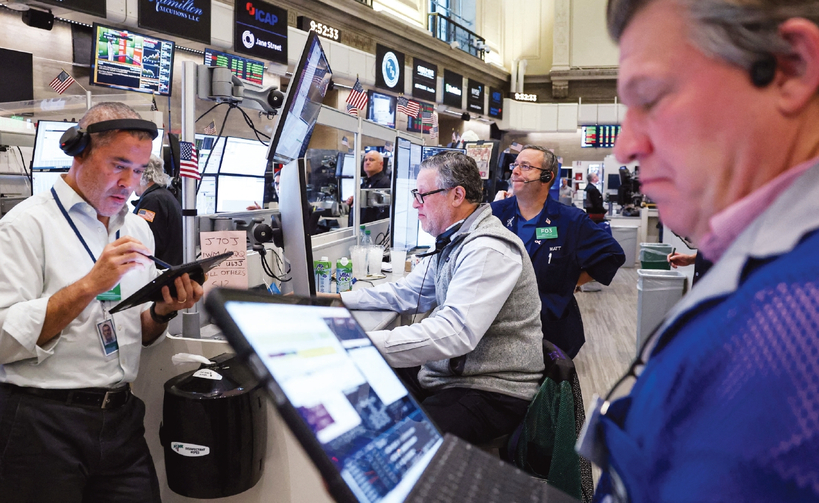
The month of November began with a surge in Wall Street as the midterm election results were finalized on November 4. The S&P 500 rose 1.6% in a single day, marking its best performance in three months, while the Dow Jones Industrial Average surged nearly 1,500 points intraday. Expectations spread across Wall Street that with election uncertainty removed, a bull market would continue through the end of the year. However, this sense of relief lasted barely a day. The very next day, heavy selling pressure focused on AI-related tech stocks led major indexes to experience one of their worst days since April 2025, pushing the Nasdaq into a correction phase.
The scorecard for the first week of November is clear. The S&P 500 dropped 2.7%, the Nasdaq Composite fell 3.4%, and the Cboe Volatility Index (VIX) spiked 32% to surpass the 25 level. The tech-heavy Nasdaq 100 once slumped about 15% from its October 6 peak. Is this downturn a temporary adjustment, or a signal that market direction is shifting? To find answers, we need to examine the changes unfolding beneath the surface of the indexes.
Sequential Peaks and Market Concentration
Market peaks do not happen all at once, and this year’s U.S. stock market is a classic example. The transportation index, which reflects economic flow, peaked on April 22, while the semiconductor index—the heart of the AI craze—reached its peak on June 22. The Dow followed on August 5, and the small-cap Russell 2000 peaked on August 14. While the S&P 500 and Nasdaq held on until October 6, this was likely the final sequence of a sequential peak procession.
Sector-wide trends tell a similar story. Seven of the eleven sectors making up the S&P 500 have already moved far from their record highs. Of the four sectors that recently hit new highs, two are consumer staples and healthcare, representing typical defensive sectors investors turn to during economic slowdowns. Even though indexes remained high, defensive positioning was already underway inside the market.
The reason the index managed to hold despite this narrowing market breadth lies in extreme concentration. As of early October, around 40 AI-related stocks accounted for nearly half of the S&P 500 market capitalization, leaving nearly 460 other companies to divide the remaining half. This level of concentration exceeds almost every bubble peak in history, save for the late 19th-century railroad bubble. The problem is that this concentration turns directly into a burden during downturns.
Good News Ignored and Credit Market Cracks
One of the most notable phenomena in the recent market is the repeated plunge of stock prices despite the release of strong earnings. A major tech company reporting doubled cloud revenue recorded its largest single-day drop in history, and companies posting better-than-expected revenue growth opened with gap-downs. Some semiconductor stocks tumbled around 40% in a single month. A market that fails to rise on good news is a classic sign of shifting investor sentiment.
More warning signs emerged from the credit market cracks before the stock market sounded the alarm. Many loans and high-yield bonds financing AI data center construction face double-digit interest rates, and new loans struggle to gather investor demand. Distressed leveraged loans trading below 60 cents on the dollar rose from $40 billion a year ago to $65 billion, reaching the highest level since the early days of the March 2020 pandemic. Corporate and personal bankruptcies are also steadily rising as households increasingly rely on high-interest credit to cover living expenses.
Portfolio Defense and Capital Preservation
As the S&P 500 attempts to find footing, investors should remain cautious about treating minor bounces as a full trend reversal. The broader trend remains downward, making any market rebound an opportunity to reorganize portfolios rather than aggressively chase risk assets.
First, verify your actual exposure to technology and AI themes across index funds, growth funds, and individual stocks. Bond allocations should be structured around high-credit sovereign and prime bonds, particularly medium-to-short term maturities less sensitive to interest rate volatility. For those nearing retirement or already withdrawing funds, securing necessary living expenses in cash-equivalent assets for the next one to two years is essential to avoid selling equities during market downturns.
With sequential peaks behind us, former market leaders turning into drags, and the credit market struggling to recover, the ultimate goal in this environment is capital preservation rather than high returns. Investors who successfully limit losses will be the ones who can fully seize opportunities in the next expansion cycle.