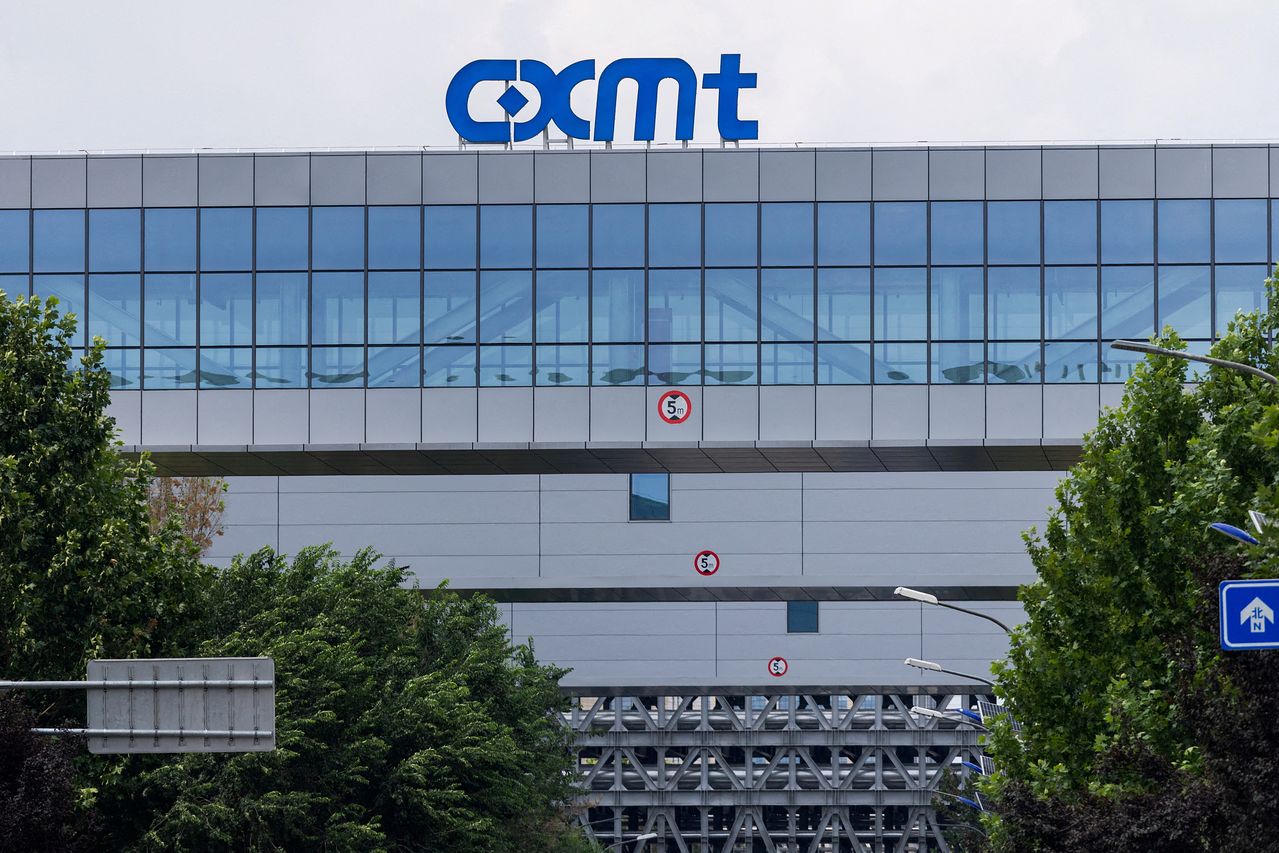
China’s largest memory semiconductor company, ChangXin Memory Technologies (CXMT), announced plans to release server products applying the next-gen 4F² (square) DRAM technology within the year, sending shockwaves through global semiconductor stocks on October 13.
According to Hong Kong’s South China Morning Post (SCMP) on October 12 (local time), CXMT President Cao Kunyi stated at a conference in Shanghai on the 10th that the company has made core progress in 4F² technology and aims to launch server-use DDR5 module (RDIMM) products applying it by the end of the year.
The market reacted immediately. On October 12, U.S. memory company Micron fell 3.88% in New York trading, while the Philadelphia Semiconductor Index dropped 2.67%. On the morning of October 13, domestic Korean stock markets saw Samsung Electronics and SK Hynix tumble by over 6% and 9% at one point, respectively. Concerns spread that CXMT might climb beyond general-purpose Drams into cutting-edge technologies and high-value server DRAMs currently developed by industry leaders.
Understanding 4F² Next-Gen Structure and Market Challenges
The 4F² structure is a next-generation architecture that reduces memory cell area compared to the 6F² structure mainly applied in current commercial DRAMs. Based on simple area calculations, it reduces cell size by about 33%, theoretically allowing 50% more cells to be placed in the same area. As micro-fabrication alone approaches limits in increasing integration density, the industry is shifting toward structural changes, such as standing transistors vertically and separating cells from peripheral circuits.
Samsung Electronics is also developing next-gen DRAM applying 4F² and Vertical Channel Transistors (VCT). Meanwhile, SK Hynix previously revealed a technology roadmap applying 4F² VG (vertical gate) to sub-10-nanometer-class DRAMs and utilizing wafer bonding.
However, experts evaluate that it is still premature to gauge CXMT’s actual mass-production competitiveness based solely on this announcement. CXMT did not disclose product specifications, yields, die sizes, power consumption, wafer input amounts, or customer certification results. Jung In-sung, a writer and former SK Hynix researcher, noted, "Even if CXMT develops 4F² products by the end of the year, it remains questionable whether mass volumes will hit the market in a scale sufficient to impact the industry."
Industry Response and Future Outlook
In the past, there has always been a time lag between the announcement of development plans and actual mass production. In 2022, Taiwanese media reported CXMT’s plan to target DDR5 mass production by the end of that year, but DDR5 products equipped with CXMT chips were only confirmed in the market by late 2024. Last year as well, industry insiders evaluated that CXMT took considerable time to expand mass production due to yields and stability issues concerning new DDR5 chips.
Meanwhile, Samsung Electronics, the world’s top memory manufacturer, is accelerating its technological competitiveness. At the ‘OCP Global Summit 2026’ held in Silicon Valley on October 13, Samsung unveiled HBM5 (the 8th-generation high-bandwidth memory), custom HBM, Compute Express Link (CXL)-based memory expansion technologies, and next-gen SSDs. The strategy aims to broaden technological competitiveness across the entire AI infrastructure, encompassing system memory and storage alongside HBM.
Voices also emphasize that South Korean memory companies must accelerate production capacity expansion to widen the gap against China. SK Group Chairman Chey Tae-won remarked on October 11 in Shanghai, "If China or America’s Micron expands production at a faster rate, our market share will inevitably shrink. We must expand facilities rapidly." Lee Jong-hwan, a systems semiconductor professor at Sangmyung University, added, "To maintain a global market share of around 80% through an overwhelming gap in production capacity and technology, prompt government execution of support measures alongside corporate investments is crucial."