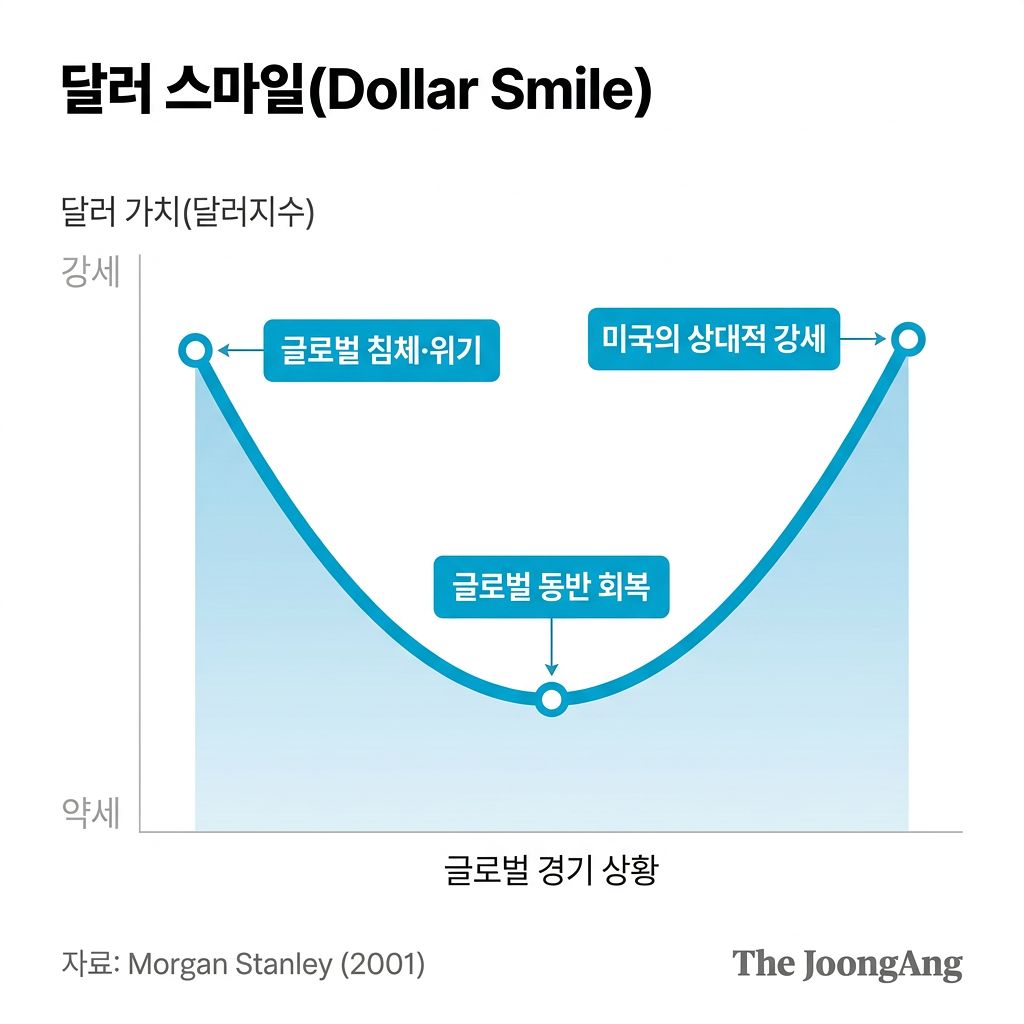
Whether stock prices plummet or surge, the U.S. dollar continues to rise. When the New York stock market collapsed last week due to concerns over an artificial intelligence (AI) bubble, investors sought refuge in the safe-haven dollar. Even when the U.S. stock market soared, expectations for American growth and interest rate hikes drove up the value of the dollar. This is the ‘Dollar Smile’ phenomenon, where the dollar strengthens regardless of whether the market is anxious or ecstatic.
The dollar index rose 2.5% from 101.81 on the 23rd of last month to 104.32 on the 23rd of this month. The upward trend steepened starting on the 10th of this month, and on the 23rd, it hit an intraday high of 104.53, the highest level since March of last year. On this day, the Nasdaq index surged 6.51% and the S&P 500 index jumped 4.73%, driven by a more than 30% spike in Nvidia shares following the return of CEO Jensen Huang.
The Mechanics Behind the Dollar Smile
Last week, skepticism regarding AI investment profitability and the stock market crash stimulated a preference for safe-haven assets. The movement to sell risky assets and secure cash fueled demand for the dollar. Then, the situation changed abruptly. Money flowed back into tech stocks, supporting the dollar’s value. Expectations for additional monetary tightening by the Federal Reserve (Fed) were also revived, further increasing the dollar’s worth. Carol Kong, a foreign exchange strategist at Commonwealth Bank of Australia (CBA), noted that “AI investment expectations are a core pillar explaining the relative superiority of the U.S. economy that has underpinned the dollar’s strength.”
Although the KOSPI rebounded (6.32%) on the 24th, shaking off the shock of the previous day’s ‘Black Monday’ (-3.31%), the won-dollar exchange rate closed at 1,342.8 won per dollar as of 3:30 p.m. that day, down a mere 3.1 won. While the stock market rebounded sharply, the global strong-dollar trend is interpreted as having limited the extent of the exchange rate’s decline.
Origins and Global Impact of the Phenomenon
The ‘Dollar Smile’ is a hypothesis proposed in 2001 by Morgan Stanley foreign exchange strategists Stephen Roach and Fatih Yilmaz. When the global economy falls into crisis, safe-haven demand drives up the dollar. When the U.S. economy outperforms other nations, investment funds flock to the U.S., strengthening the dollar. Conversely, when the global economy recovers together, funds may disperse outside the U.S., weakening the dollar. The dollar also shows weakness when the U.S. economy slows down moderately.
A curve that is high at both ends and low in the middle resembles a smiling mouth. In an analysis last year, Morgan Stanley stated that over the past 20 years, the dollar rose an average of 0.8% per month when both U.S. and global growth indicators fell short of expectations, and 1.1% when only the U.S. was relatively strong. When the global economy grew together, it fell by 0.1%.
The dollar’s ‘smile’ signifies the relative weakness of other currencies. However, the South Korean won is holding its ground firmly. Semiconductor dollars are the driving force supporting the value of the won. According to Korea Investment & Securities, while the dollar index rose 3.6% from 100.2 to 103.8 between September 17 and November 20, the won-dollar exchange rate fell 3.3% from 1,382 won to 1,336 won. Moon Da-woon, a researcher at Korea Investment & Securities, analyzed that “the dollars sold by exporting companies due to semiconductor export booms are exceeding the dollar-buying demand of other economic entities.”
The relationship between stock prices and exchange rates is also changing. In the past, when stock prices rose due to foreign buying, the won-dollar exchange rate tended to fall. Recently, however, when semiconductor stock prices rise, foreign investors sell to realize profits and adjust their holdings, which can increase upward pressure on the exchange rate. Conversely, even if stock prices fall, if foreign selling decreases, the upward pressure on the exchange rate may weaken.
Whether the strong dollar trend will persist remains uncertain. Tim Baker, a strategist at Deutsche Bank, stated, “Once the gap between economic indicators in the U.S. and other countries passes its peak, the dollar’s upward trend could also reach a short-term high.”