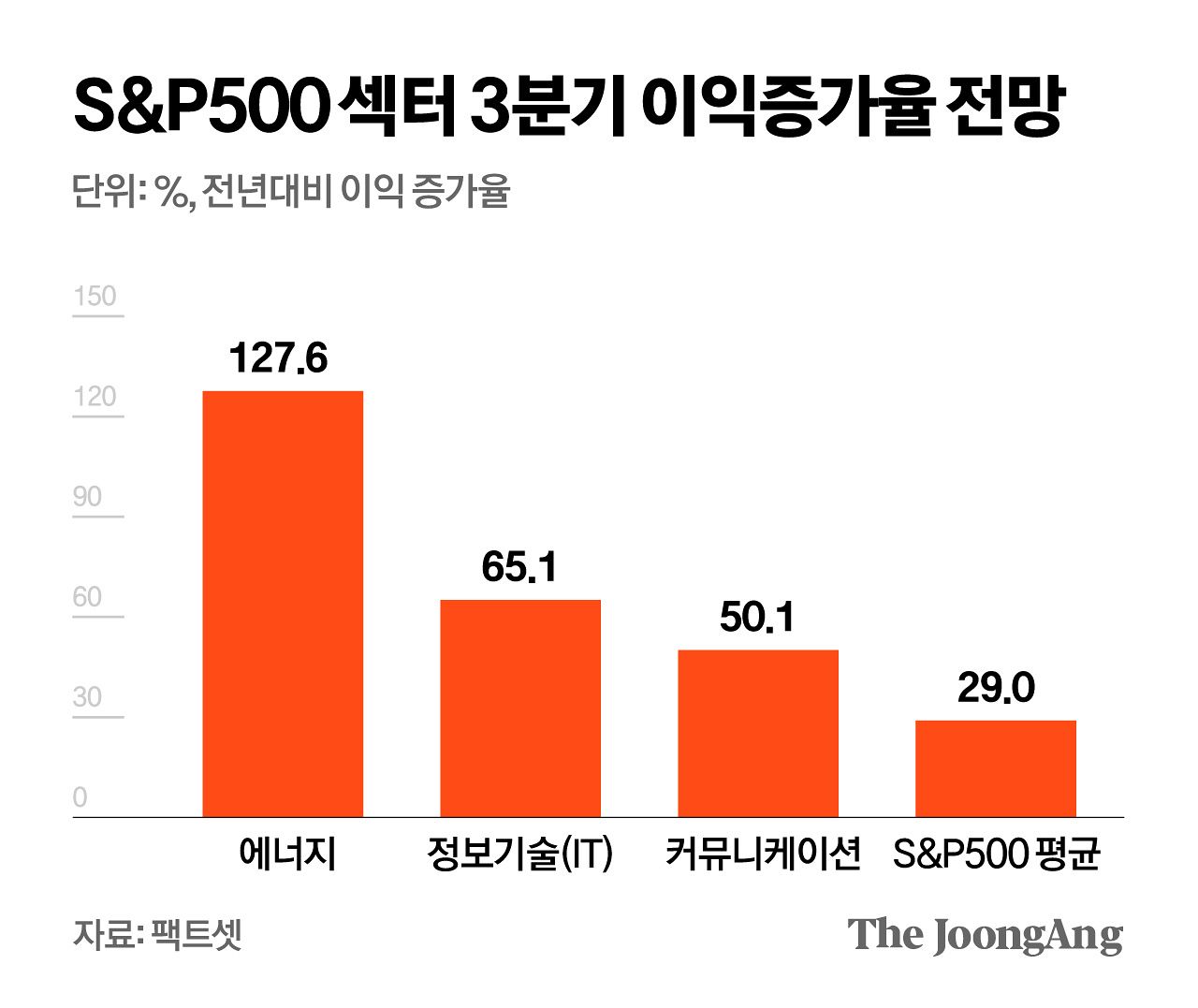
The standout stars of the US stock market’s third-quarter earnings season are not artificial intelligence companies, but rather the energy sector. According to FactSet on the 26th, the net profit of S&P 500 energy companies skyrocketed by 127.6% compared to the same period last year. This figure is expected to reach double the 65.1% growth rate of the technology sector, which has been driving the AI craze.
The upward trajectory of stock prices has even outpaced Wall Street’s predictive speed. The leading US energy ETF, the State Street Energy Select Sector SPDR (XLE), surged roughly 55% this year alone to hit an all-time high. This was driven by key stocks with heavy weightings, such as ExxonMobil and Chevron, which successively broke record highs. ExxonMobil’s stock price has already comfortably surpassed the average target price issued by 25 Wall Street analysts, while JPMorgan has revised Chevron’s target price six times this year.
This outcome was forged by soaring oil prices and exploding refining margins stemming from geopolitical risks. US petroleum companies, whose crude oil production costs have not increased significantly, were able to pocket substantially more profit. The refining margin, a barometer of profitability for the US refining industry, averaged about $71 per barrel in September, jumping nearly 60% from three months prior. ExxonMobil projected that its refining segment profit alone would increase by $4.5 billion in the third quarter compared to the previous quarter.
However, warnings of a market peak are also formidable. Cestrian Capital Research and others advised taking profits, stating that the current high level of earnings will not last long. Wall Street experts highlighted three key variables that investors must closely examine.
First is the undervalued ‘illusion’ phenomenon. The 12-month forward price-to-earnings ratio (PER) of S&P 500 refiners stands at 9.2x, which is half the 19.8x of transportation and storage companies. However, this may be a temporary phenomenon resulting from exploding refining margins. Given the uncertainty of sustaining high profitability, one should not blindly trust PER figures and assume the sector is undervalued.
Second, it is crucial whether oil companies will increase dividends or engage in share buybacks. This implies that strong shareholder-friendly policies must accompany the sector to secure additional upward stock momentum, such as the potential resumption of share buybacks by BP (British Petroleum), which has achieved its debt reduction targets early.
Additionally, the profitability of crude oil drilling equipment and technology suppliers like SLB and Halliburton remains a variable. Their stock prices have either remained stagnant or retreated over the past few months. Pickering Energy Partners projected that drilling and production costs will rise by 10 to 15% next year. US investment media outlet Barron’s advised, ‘While the energy sector will be the biggest winner of this earnings season, we must keep a close watch on where the earned cash is spent and how production volumes are managed.’