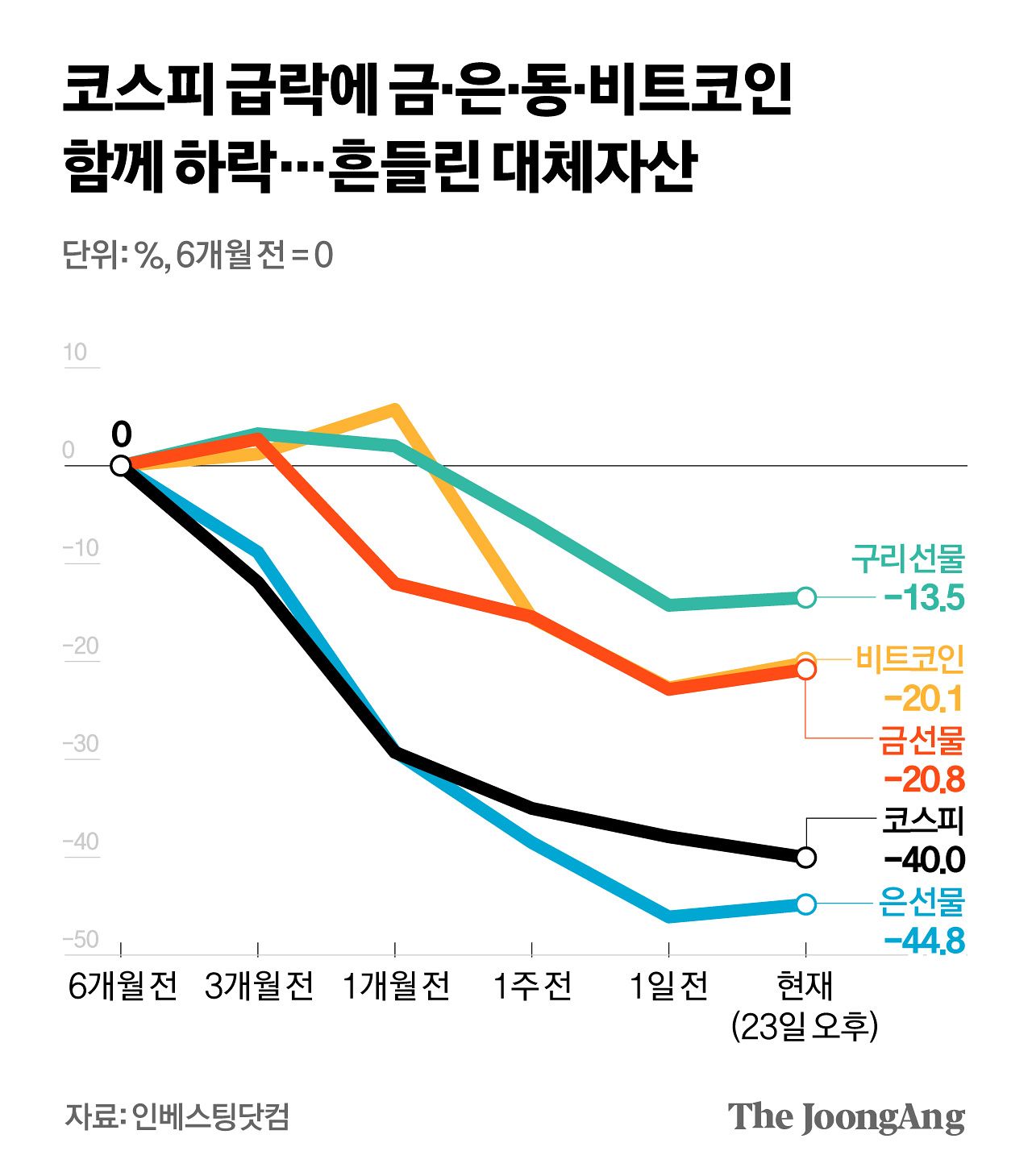
The classic investment principle of “not putting all your eggs in one basket” has been thrown into question. Amid a stock market plunge, alternative assets such as gold, silver, copper, and Bitcoin are experiencing a simultaneous downturn known as the Everything Crash, weakening the defensive power of diversified portfolios.
According to Investing.com, international gold futures stood at $3,608.25 per troy ounce as of the afternoon, down 6.35% from a week ago and 9.97% from a month ago. Silver futures fell to $42.033 per troy ounce, plunging 10.27% over the week and 22.07% over the month. Silver’s decline over the past three months reached 39.47%, wiping out nearly 40% of its value in a quarter.
Copper futures, widely used in power facilities for AI data centers, dropped to $5.5205 per pound, down 8.12% in a week and 15.18% in a month. This downward pressure hit everything from safe-haven gold to copper, which is highly sensitive to industrial demand.
Bitcoin, often referred to as “digital gold,” lost nearly a quarter of its value over the month. Trading at $6,138.70, Bitcoin fell 5.45% for the week and 24.47% for the month, recording a steeper drop than gold, silver, or copper. According to CoinDesk, the night of the 19th (local time) when Bitcoin dipped toward $6,1300 saw over $600 million in liquidations across the futures market within 24 hours.
Liquidity Squeezes and Margin Calls Drive Asset Sales
Even the prices of US 10-year and 30-year Treasuries, which served as safe havens in the stock market last week, turned downward (with bond yields rising) on this day. Typically, when risk assets like stocks plummet, funds flow into safe havens like gold or US Treasuries to hedge losses. The fact that even diversified assets collapsed consecutively means investors have fewer places left to hide from losses.
This trend is analyzed as the result of overlapping factors, including the push to secure cash amid the global stock market plunge, high-interest-rate pressures, and concerns over slowing physical demand.
When stock and cryptocurrency prices plunge and trigger calls for additional margin payments (margin calls), investors are forced to sell off liquid, high-quality assets like gold and silver first, rather than assets with heavier losses. Bruno Schneller, managing director at Erlen Capital Management, told Reuters that falling gold prices are a signal that investors are rushing to secure cash rather than moving into defensive assets. In fact, gold selling for cash liquidity also persisted during the 2008 financial crisis and in March 2020 when the stock market crashed due to COVID-19. Jason Hamlin, founder of Nicoya Research, analyzed that similar historical precedents saw gold prices rebound once market funds began circulating again and the pressure for urgent cash generation eased.
High Interest Rates and Cooling AI Demand
Fears of additional tightening by the US Federal Reserve and the resulting high-interest-rate burden are weighing down all asset classes simultaneously. On this day, the US 10-year Treasury yield rose 0.027 percentage points to 4.937%, and the 30-year yield rose 0.035 percentage points to 5.337%.
Compared to US Treasuries offering around 5% annual interest, non-yielding assets like gold, silver, and Bitcoin lose their holding appeal. The discount rate burden from rising interest rates is also a direct downward factor for overvalued tech stocks. An official from an asset management firm stated that risk-averse investors would likely choose a guaranteed 5% return from US Treasuries over other volatile investment products.
Furthermore, cooling growth expectations surrounding AI have morphed into a bubble debate, spreading sell-offs even to industrial metals like copper and silver. Park Sang-hyun, a researcher at iM Securities, analyzed that concerns over weakened industrial raw material demand due to China’s weaker-than-expected economy have also negatively impacted overall asset prices.