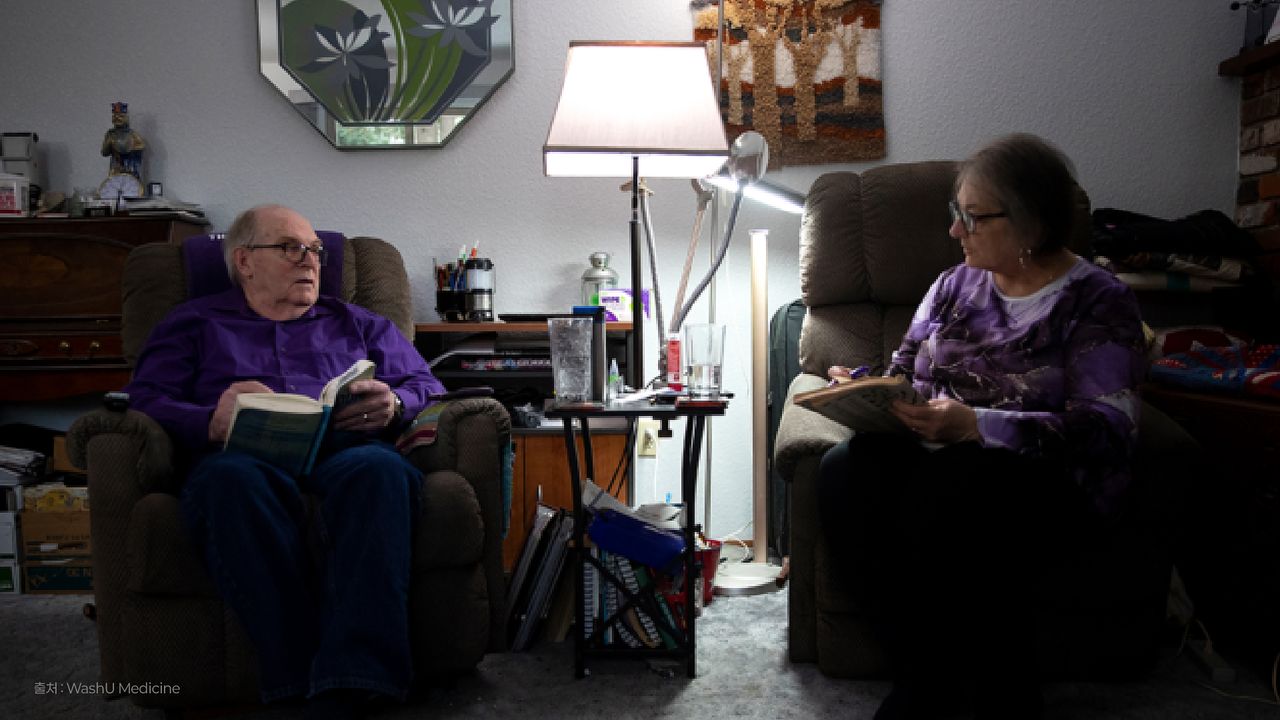
In 1971, during Thanksgiving, twenty-one-year-old Doug Whitney’s home fell silent. His mother, who could bake a pumpkin pie with her eyes closed, forgot how to make it that day. His wife, Aion, who was newly married and expecting their first child, initially attributed it to age-related forgetfulness. Doug and his family sensed right away that something was wrong. They had already witnessed the same changes in his aunts and uncles.
Doug’s family had a history of familial Alzheimer’s disease passed down through generations. His mother and nine siblings passed away before the age of 60 or in their early 60s due to early-onset Alzheimer’s disease. Symptoms in the family typically began between the ages of 48 and 50.
Doug always thought the same disease would eventually find him. Even so, he told his wife Aion that if there was nothing they could do, they would just wait until something genuinely worrying happened. When Doug approached his fifties, the family grew anxious over the smallest changes. Aion recalled that whenever the children called home when Doug was between 48 and 55, their first words were always the same: “How is dad?” If Doug forgot even a single key, the family wondered if “it was finally starting.”
Yet, after passing 50, 55, and even 60, Alzheimer’s disease did not strike Doug. The family felt relieved, assuming he had miraculously escaped the fatal familial Alzheimer’s disease gene.
The plot twist arrived in 2011 when Doug was 61 years old. His cousin was writing a book on familial Alzheimer’s disease and shared news that a research team at Washington University in St. Louis was looking for participants to track familial Alzheimer’s disease. Doug agreed to participate.
Initially, Doug thought he did not carry the mutation causing dementia. He had long surpassed the expected onset age and had no symptoms. That was a delusion. Doug also carried the ‘PSEN2 mutation’ responsible for familial Alzheimer’s disease. It was a shock for Doug, who had no symptoms long after passing the expected onset age.
Even so, he has preserved his memory intact at 76 years old. This is despite surpassing the family’s average onset age by more than 20 years.
How was he able to keep his memory completely intact?
Scientists discovered something unusual in Doug’s brain: even though protein debris had already accumulated, it did not spread to other parts of the brain.
When the research team retraced Doug’s life backward, one experience stood out: his time in the Navy. Doug enlisted at 18 and spent 12 years managing engine rooms across various warships.
“That engine room was like a giant steamer.”
Doug, who broke the family curse of generational ‘Alzheimer’s’ and protected his memory until age 76, had a working environment that was the single feature distinguishing him from others. Scientists focused on the warship’s engine room. Just how hot was it that the engine room he frequented for 12 years became a clue?
Doug’s case caused a stir overseas. Simultaneously, saunas drew attention. A 20-year tracking study of men who used saunas also yielded surprising results. What do the warship’s steaming engine room and saunas have to do with dementia?