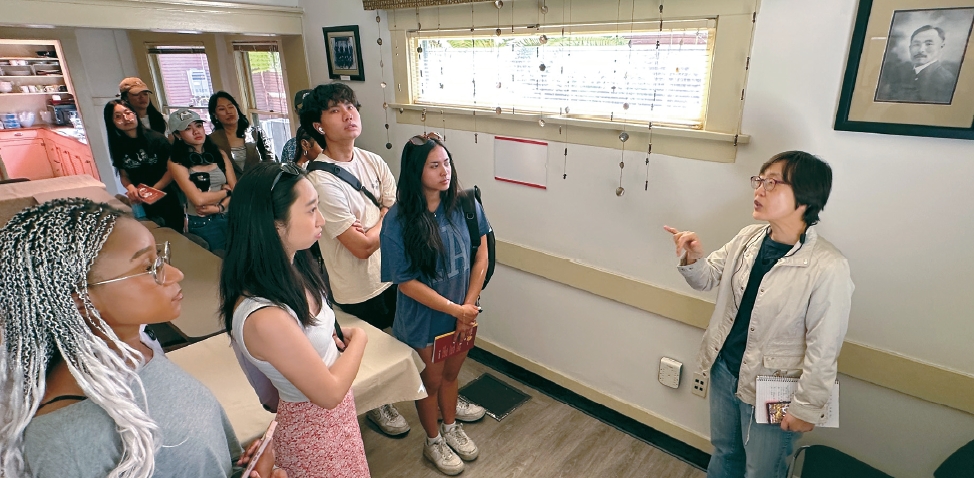
USC students retraced hidden traces of Korean immigration history on April 11, during a walking tour hosted by the university’s Korean Language Program faculty and Korean Heritage Library. The event, titled “Steps into History: An Immersive Walk Through USC’s Korean Heritage,” invited participants to explore historical Korean American landmarks within walking distance of campus.
Landmarks Reveal Korean Immigration History
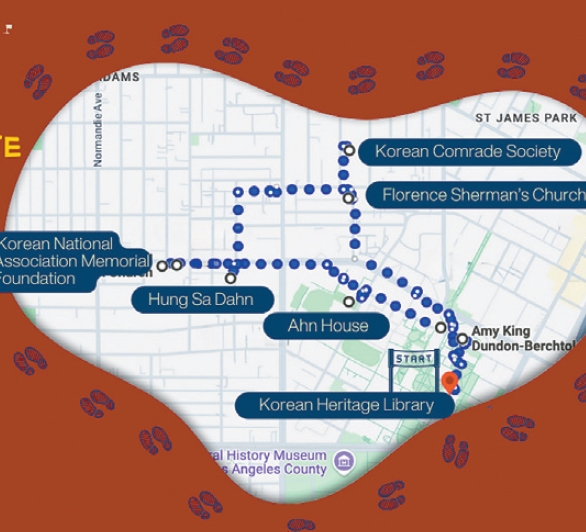
The tour began at the USC Korean Heritage Library, then continued through nine key sites:
-
Ahn Chang-Ho Family House
-
Dr. Sammy Lee Diving Tower
-
Former Headquarters of the Young Korean Academy (Heungsadan)
-
Korean National Association Memorial Hall
-
Dosan Ahn Chang-Ho Square
-
Na Sung Korean Presbyterian Church
-
Site of LA Korean Methodist Church
-
Korean Patriots Association Building
-
Exposition Park
At each site, students received explanations on its historical significance. At the Ahn Chang-Ho Family House, Park Sun-Young, Director of the USC Korean Studies Institute, shared stories about Ahn Chang-Ho and his children, Philip Ahn and Susan Ahn Cuddy, as well as the house’s relocation to campus.
Firsthand Accounts of Korean American Struggles
At the Korean National Association Memorial Hall, Clara Won, chairwoman of the foundation, explained the association’s origin and activism during Japan’s occupation of Korea. This perspective helped students connect present-day LA with Korean Americans’ early struggles for independence.
Hong Jung-Eun, Korean Heritage Library Librarian and the event organizer, said, “This was the first walking tour built using the library’s archival resources and USC’s proximity to historic sites.” She added, “We wanted students to learn and help preserve these pieces of Korean American immigration history.”
Students from Diverse Backgrounds Join
More than 20 participants, including USC undergraduates, graduate students, and faculty, joined the walk. The group included not only Korean American students but also others interested in learning about Korean American heritage.
Angela Liao, Director of the USC Chinese Language Program, joined to observe how cultural walking tours work. “Given the large Korean American community in LA, I wanted to better understand their history,” she said.
Event Leaves Lasting Impression
Students said the tour helped them move beyond K-pop and K-dramas to appreciate the history of Korean immigration. Clara Wu, a graduating senior, said, “I’ve passed the Ahn Chang-Ho house so many times without knowing what it was. Now I finally understand.”
Rebecca Sumaquial, a freshman, found the experience “really interesting” and said it helped her connect with the Korean community’s roots in LA. She expressed hope that the tour would continue in the future.
Organizers Plan to Make the Tour Permanent
Following positive feedback, organizers are now considering making the tour a regular program to raise awareness of Korean immigration history among USC students and the broader community.
BY KYEONGJUN KIM [kim.kyeongjun1@koreadaily.com]