Families grappling with the grief of losing a loved one are increasingly being driven into debt due to the heavy burden of funeral costs.
A long-term rise in funeral expenses significantly outpacing overall inflation, coupled with complex inheritance procedures and opaque funeral service pricing, continues to exacerbate the economic strain on grieving families.
USA Today recently cited a report from the economic policy research organization Groundwork, reporting that the proportion of respondents who went into debt due to the costs associated with a family member’s death surged from 14% in 2024 to 37% last year—a 2.6-fold increase in just one year.
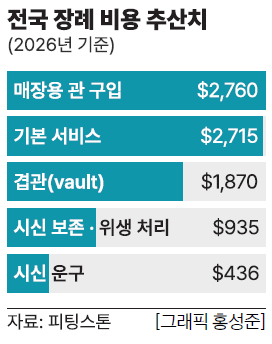
Funeral expenses are climbing at a steep rate. According to Parting Stone, a death-care service provider, this year’s funeral cost including a viewing and burial was estimated at $9,170. This reflects the median funeral cost for 2023 announced by the National Funeral Directors Association (NFDA) at $8,300, adjusted for inflation—marking a 10.5% increase over three years. Even the relatively cheaper cremation option reaches $6,940 when a viewing is included.
Basic funeral services ($2,715) and a burial casket ($2,760) alone total nearly $5,500. Including body transport, preservation, funeral facility usage fees, and an outer burial container (vault), expenses reach $11,040. Cemetery plots and headstones are extra.
Considering that a 2022 Federal Reserve survey showed the median transaction account balance, including savings, for American households was $8,000, a single funeral can easily wipe out a family’s entire bank balance and still fall short.
The Korean-American community is no exception. Facing steep cost burdens, more grieving families are opting for cremation over traditional burials.
A representative from a Korean funeral home stated, "Before COVID-19, cemetery plot costs were under $1,000, but recently they are approaching $2,000. While there are differences depending on the funeral method and selected items, combining funeral services and plot costs averages about $13,000." The representative added that an increasing number of Korean Americans are choosing cremation, which costs around $5,000 on average, followed by scattering the ashes in the ocean.
Structural issues within the industry are also driving up funeral prices. According to Groundwork, funeral costs have risen 310% since 1986, outpacing the overall inflation rate of 193% over the same period by 117 percentage points. The report pointed out that as large chains and private equity firms sequentially acquire small and medium-sized funeral homes, market competition has weakened and price hike pressures have intensified.
Complex inheritance procedures are another major hurdle. While funeral expenses must be covered within days of a death, court-administered estate settlement processes can take many months. Even when families are set to inherit assets, they often cannot access immediate cash, forcing them to rely on high-interest loans.
Under federal regulations, funeral homes are required to provide consumers with itemized price lists. However, a 2022 survey by the Consumer Federation of America (CFA) found that only 18% of providers published their prices online. Consequently, families are often forced to make critical funeral arrangements without adequate price comparison.
Groundwork emphasized that to alleviate the financial burden on grieving families, measures such as mandating online price transparency for funeral costs, streamlining inheritance procedures, and raising the current $255 Social Security lump-sum death benefit are urgently needed.