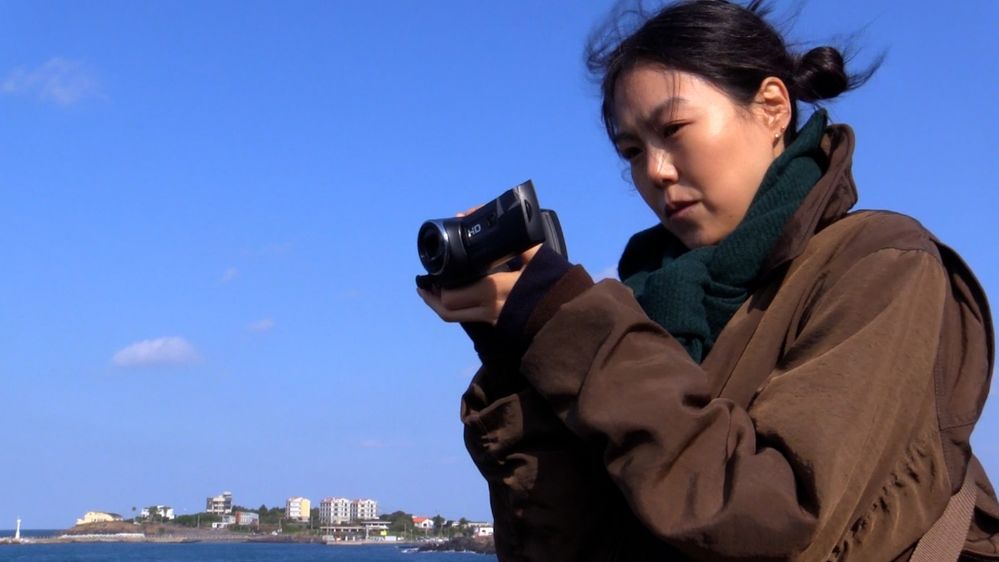
The video quality captured by the camcorder is muted, and the dialogue is muffled by the wind in Jeju. Without artificial lighting and relying solely on natural light and fluorescent bulbs, the awkward tension between blood relatives and non-blood relatives is raw and unfiltered. The film traces a 2-night, 3-day journey of a daughter, Sang-hee (Kim Min-hee), who visits her mother (Choi Myung-gil) in Jeju 10 years after her remarriage, unfolding like a video diary.
Director Hong Sang-soo‘s 35th feature film, ‘Where to Look’, opened on the 21st. Actress Kim Min-hee returns to the screen for the first time since giving birth. Uniquely for a Hong Sang-soo film, it is a work that naturally evokes the label of a ‘family film’.
Minimizing independent production methods even further, director Hong—who has handled production, direction, writing, cinematography, editing, and music since the 2021 film ‘Introduction’—once again picked up an ultra-light camera like a pencil. As the production conditions became simpler, the image and sound quality became rougher. Within a brief 72-minute runtime, the film captures complex family relationships, ranging from Sang-hee to her ‘mother’s husband’s daughter’, and moments where art purely penetrates tangled and twisted lives. Hong’s gaze, which has long praised fleeting romantic emotions reeking of the smell of soju and the wandering of transcendent artists, has now zoomed in closely on the bond between parents and children.
Last August, the Hong Sang-soo and Kim Min-hee couple swept three awards at the 79th Locarno Film Festival in Switzerland, including Best Director, Best Actress, and the Ecumenical Jury Prize, capturing center stage. Frequently compared to Anton Chekhov’s short stories in overseas film festivals, Hong’s film captivated international critics this time with a warmer perspective, delicate humor, and a deep exploration of human alienation.
It is a film that makes viewers ponder the gap between what is shown and what is hidden. For instance, events that could be called major incidents never once appear on screen. Sang-hee’s mother’s successful restaurant in Jeju, and the biological father’s affair that tore young Sanghee—once her mother’s ‘clingy’ shadow—away from her, are merely glossed over in dialogue. What the camera persistently shows is the awkward silence flowing alongside an untypical greeting: “Mother, it’s really nice to see you.” It portrays the disappointment, jealousy, and affection gradually seeping from Sanghee’s chest.
To her mother, Sanghee is also a difficult daughter. Having sent her abroad to an expensive art study program, only for her to fall into low-income experimental films, the pure and stubborn eldest daughter is both a source of frustration and someone her eyes constantly follow. Unlike her second son (Shin Seok-ho), who shares her quick calculation, Sanghee may be the face of an old love to whom her mother was always fascinated, yet ultimately broken by.
The short film by Sanghee that decorates the ending harmonizes a roadside dandelion she calmly captures with her confession: “I am gentle. I am quiet. I always like something.” This attitude of contemplation becomes the unexpected catalyst for Sanghee to connect with her stepfather (a documentary director), whom she previously called ‘that person’ as they seemed impossible to grow close to.
Resembling the narration and portrayal style of the entire film’s miniature version, it raises the thought: isn’t ‘Where to Look’ itself another film shot by Sanghee? The scene emphasizing the mother’s gaze, as she is the only one who attentively watches Sanghee’s short film twice, is therefore deeply meaningful. Perhaps the mother has been observing all along, carrying Sanghee’s inner thoughts whispered like a diary from the very beginning of the film. This is why the off-screen parental heart, though invisible, resonates even more strongly in a daughter’s first-person perspective film.
Slate Magazine highlighted it as “the most optimistic film in Hong Sang-soo’s filmography, offering the possibility of reconciliation among family members.” Actor Kwon Hae-hyo mentioned at the Busan International Film Festival on the 10th regarding director Hong, with whom he has worked for the 13th time through this film, “I’ve come to see him gradually transforming from a man who loved and liked certain women into someone’s father.”