
The Ultimate Charging Paradox: More Access, Less Speed
In the North American electric vehicle market, securing access to Tesla’s massive network of over 35,000 ultra-fast Superchargers was hailed as a monumental victory for non-Tesla manufacturers. For owners of Korean electric vehicles newly equipped with the North American Charging Standard (NACS) ports, it promised an end to range anxiety once and for all.
However, a harsh technical reality has emerged behind the hype. When it comes to raw charging efficiency, plugging a Hyundai or Kia EV into a Tesla Supercharger is actually a major step backward.
According to a recent investigative report by automotive media outlet InsideEVs, the award-winning electric lineups from Hyundai and Kia are fundamentally engineered in a way that causes their charging times to sharply increase when hooked up to a Tesla Supercharger stall. While the partnership drastically improves physical charger availability, it is proving to be far from the best choice for drivers in a hurry.
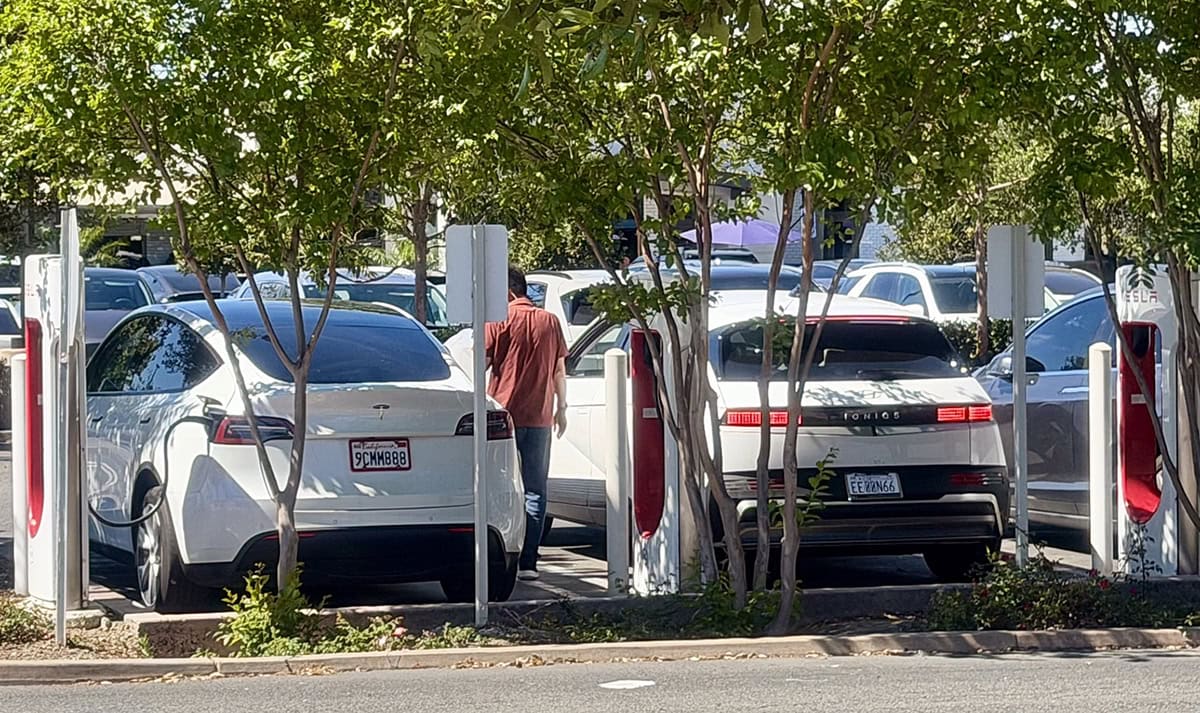
800V Monsters vs. 400V Infrastructure: The Root of the Problem
The core issue lies in a major mismatch of electrical engineering. Flagship models like the Hyundai Ioniq 5, Ioniq 6, and the three-row Ioniq 9, alongside Kia’s EV6 and EV9, are universally celebrated as some of the fastest-charging vehicles on the global market. Built on Hyundai Motor Group’s dedicated E-GMP (Electric-Global Modular Platform), these cars utilize an advanced 800-volt electrical architecture. When connected to a compatible high-voltage dispenser, they easily pull peak charging rates well north of 200 kW—with some Ioniq 5 models clocking in at a blistering 260 kW or more.
Tesla’s legacy Supercharger network, on the other hand, was natively engineered around a 400-volt to 500-volt system. While Tesla’s own fleet is optimized to pull a highly efficient 250 kW from this setup, 800V E-GMP vehicles cannot accept that lower native voltage directly into their battery packs.
To bridge this gap, the Hyundai or Kia vehicle must route the incoming power through its internal rear-motor inverter to “step up” the voltage to its native 800V level. This conversion process creates a strict technical bottleneck. Because the vehicle’s onboard inverter can only process so much power at once, it severely throttles the total charging output.
As a result of this internal hardware limitation, an older-generation Kia EV6 plugged into a Supercharger maxes out at a meager 97 kW. Even on refreshed models like the latest EV6, Ioniq 5, and Ioniq 9, the speed is rigidly capped around 120 kW to 126 kW. This effectively cuts the vehicles’ maximum engineered charging performance straight in half compared to what they can achieve on native high-voltage infrastructure.
The Clock and the Wallet: A Double Penalty for Drivers
When translated into real-world road-tripping scenarios, this engineering friction yields a stark disparity in wait times. Under ideal conditions at a high-output 800V station, a modern Hyundai Ioniq 5 with an 84 kWh battery can charge from 10% to 80% in just 20 minutes. Plugged into a Tesla Supercharger, that exact same charging session stretches out to 30 minutes, adding an extra 50% to your wait time. The penalty is even harsher for massive SUV platforms like the Hyundai Ioniq 9; its optimal charging time of 24 minutes balloons to nearly 40 minutes when forced to rely on Tesla’s network.
To add insult to injury, non-Tesla owners face an economic penalty as well. Unless they pay for an active monthly network subscription, third-party drivers are hit with inflated, non-member premium electricity rates at Supercharger stalls. For many frustrated owners, this creates a lose-lose scenario where you wait nearly twice as long at the pump, only to be handed a more expensive bill.
Industry experts note that for brief, casual top-offs during daily driving, this speed penalty may go largely unnoticed. However, for long-distance highway travelers or commercial drivers who rely on rapid turnarounds, the bottleneck is a major headache. For the fastest possible pit stops, E-GMP drivers should still actively hunt for high-voltage, 1,000V-capable networks like Electrify America or EVgo, saving the Tesla Supercharger network strictly as a reliable backup option.