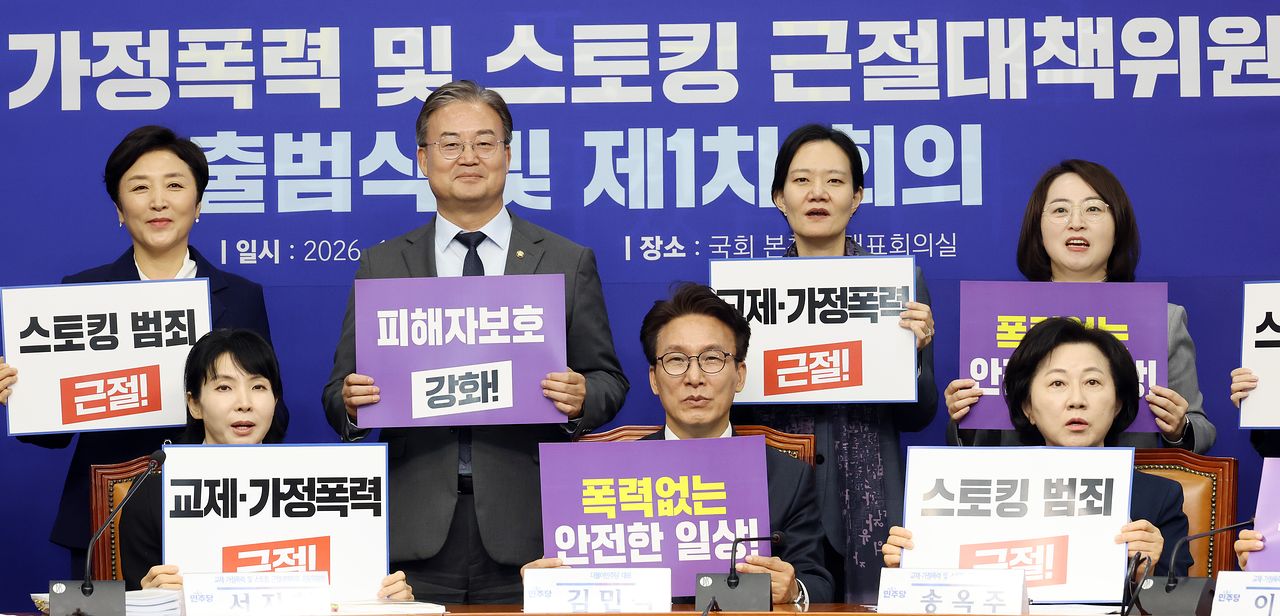
The ruling Democratic Party of Korea held a general meeting to intensively discuss relationship crime punishment bills, including the so-called Intimate Partner Violence Prevention Act. Relationship crimes refer to offenses occurring in situations involving emotional, physical, and sexual exchanges between parties, commonly designating domestic violence and dating violence.
Representative Lee Joo-hee introduced the ‘Intimate Partner Violence Prevention Act,’ which comprehensively amends the title of the Domestic Violence Punishment Special Act so that it can also encompass dating violence. While the current law defines former and current spouses and lineal family members as family members, the amendment expands this to include dating relationships or continuous private exchanges as ‘intimate relationships’ before bringing them under punishment targets. It also includes special provisions to expand the restricted access zone for violent offenders from the current 100 meters to 2 kilometers, and to abolish crimes subject to punishment upon the victim’s expressed will.
Representative Lee, who proposed the bill on the 3rd, explained during the general meeting, “While discussing further for the perfection of the bill, we intend to come up with an alternative as soon as possible without delay.” A key official from the floor leadership stated, “We plan to process those among the announced bills that can be agreed upon as quickly as possible.”
The party’s internal discussion on the bill gained rapid momentum as relationship crimes continued to occur, including the murder of a 15-year-old girl in Seongbuk-gu last month. Chief of Staff Lim Kwang-hyun also briefed on the ‘Government Protecting My Life, Citizen Safety Plus Project’ plan, stating, “To strongly respond to crimes targeting socially vulnerable groups such as relationship crimes and motiveless crimes, we are holding a ‘Super-Safe Society Response Meeting’ presided over by the President and preparing comprehensive measures.”
Inside the Democratic Party, attention is focused on whether legislation can win back the 2030 female sentiment. According to a wireless (100%) automated response survey conducted by Realmeter of 2,512 registered voters nationwide from the 9th to the 13th, the approval rating for the Democratic Party among those in their 20s and 30s stood at 28.4% each. The Democratic Party’s approval rating among women dropped 5.3 percentage points from the previous week (41.5%) to 36.2%, and was 12.8 percentage points lower than the 49.0% recorded in November of last year. A female lawmaker from the Democratic Party said, “Since the ruling party-led abolition of prosecutors’ supplementary investigation powers, the burden has been growing every time a violent incident occurs. To turn the hearts of the departed female supporters, we must actively step up to resolve relationship crimes.”
However, concerns about the contents of the bill have also been raised inside and outside the party. Han Min-kyung, a professor of police administration at the Korean National Police University, pointed out, “If the content of ‘peace and maintenance of the family’ specified in Article 1 of the Domestic Violence Punishment Act disappears as per the amendment, it will affect the interpretation of civil law concerning divorce and family, such as child custody and parental rights exercised on this basis. Since the legal system can get tangled up, the amendment of the Domestic Violence Punishment Act is an issue that requires time and careful discussion.” She also explained, “There is also the issue that friends and colleagues can be encompassed within the intimate relationship stipulated by the new law, which could make the application of the law ambiguous.”
An official from the Relationship Crime Eradication Special Committee also expressed concern, saying, “Because the scope of punishment can expand endlessly to friends or people met just once, it could rather face a backlash. It is content that completely changes the approach to intimate relationships in Korean society, so it is uncertain whether the Ministry of Justice will be able to accept it.”
There is also a view that abolishing the crime subject to punishment upon the victim’s expressed will could instead shrink reporting due to fear of retaliation and infringe on the victim’s self-determination rights. Shin Min-young, an attorney at Law Firm Hoam, stated, “If you abolish crimes subject to punishment upon the victim’s expressed will, there is nothing the victim can choose with agency. They lose the opportunity to lead the investigation procedure.”