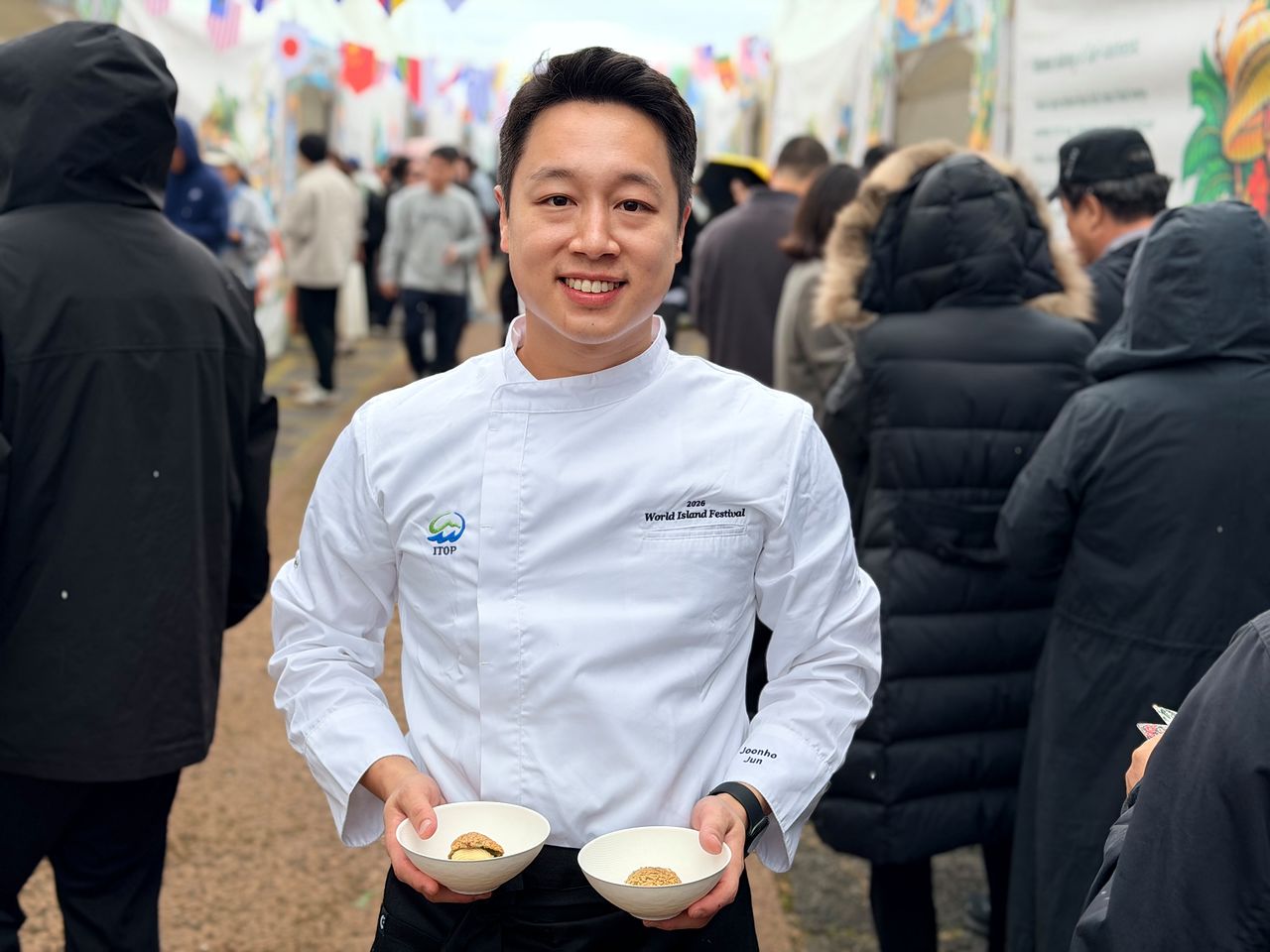
Jeju’s traditional omegi rice cake has been reimagined as a French choux pastry, while black pork and buckwheat have been transformed into French-style crepes. These creative dishes, alongside peanut tofu from Japan’s Okinawa and spicy stir-fried dishes from Thailand’s Phuket, were recently showcased in one location. Chefs from islands around the world utilized local Jeju ingredients to recreate the authentic flavors of their hometowns during a unique culinary event.
On the morning of October 29, visitors flocked to the outdoor special booths at the Jeju Stone Park to sample island delicacies from across the globe. Carrying palm-sized food passport booklets, attendees collected stamps as they traveled from booth to booth, receiving one dish at a time from 10 different global islands.
Tourist Kim, 46, from Seoul, shared her excitement, noting how special it was to taste exotic island dishes in a single hand while collecting festival passport stamps along the way.
This culinary event was part of the World Island Food Festival, a special program during the 27th Island Tourism Policy (ITOP) Forum hosted by Jeju Special Self-Governing Province and the Jeju Tourism Organization. Chefs representing their respective islands gathered from locations such as Bali in Indonesia, Hainan in China, Okinawa in Japan, and Hawaii in the United States.
Participating chefs successfully blended traditional cooking methods from their home islands with local Jeju ingredients. Chef Jun-ho Jeon of Petit Bouchon, a renowned French restaurant in Jeju, and Chef Yong-soon Kim of Jeju Shinhwa World co-directed the entire schedule. Chef Jeon introduced the Jeju Omegi French Choux, reinterpreting the famous Jeju specialty using the sweetness of red beans and the nutty flavor of millet. Meanwhile, Chef Kim presented a crepe wrap utilizing Jeju’s signature black pork and buckwheat.
Other islands also showcased highly distinctive culinary creations. Indonesia’s Bali prepared ‘Serombotan Klungkung,’ a local dish featuring vegetables tossed with spices and seasonings. China’s Hainan served ‘Golden Phoenix Tail Shrimp with Tropical Fruit,’ highlighting the region’s tropical food culture.
Japan’s Okinawa featured ‘Jimami Tofu,’ a traditional peanut-based dish known for its soft and chewy texture. Hawaii presented ‘Abalone Poke,’ a creative variation of its traditional marinated raw fish dish.
Cuisines from Southeast Asia, the Indian Ocean, and African island regions were also prominently featured. Sri Lanka’s Southern Province prepared ‘Chicken Kottu,’ while Tanzania’s Zanzibar served aromatic ‘Beef Cutlets.’ Thailand’s Phuket offered bite-sized ‘Pad Krapow,’ and the Philippines’ Cebu presented squid ink stew paired with puso, a traditional rice dish cooked inside woven young coconut leaves. Malaysia’s Penang offered chicken satay skewers accompanied by Asian pickle salad.
In addition to the food, the traditional cultures of each participating island were introduced through traditional dances and performances, transforming a political conference into an international cultural exchange festival.
This year’s ITOP Forum drew approximately 450 participants from 16 countries to discuss sustainable tourism and future cooperation. Founded in 1997 by Jeju, Hainan, Bali, and Okinawa, the forum expanded its reach this year by welcoming new members including the Galapagos Islands of Ecuador and Naxos, Greece, extending its collaborative network from the Asia-Pacific region to South America and Europe.