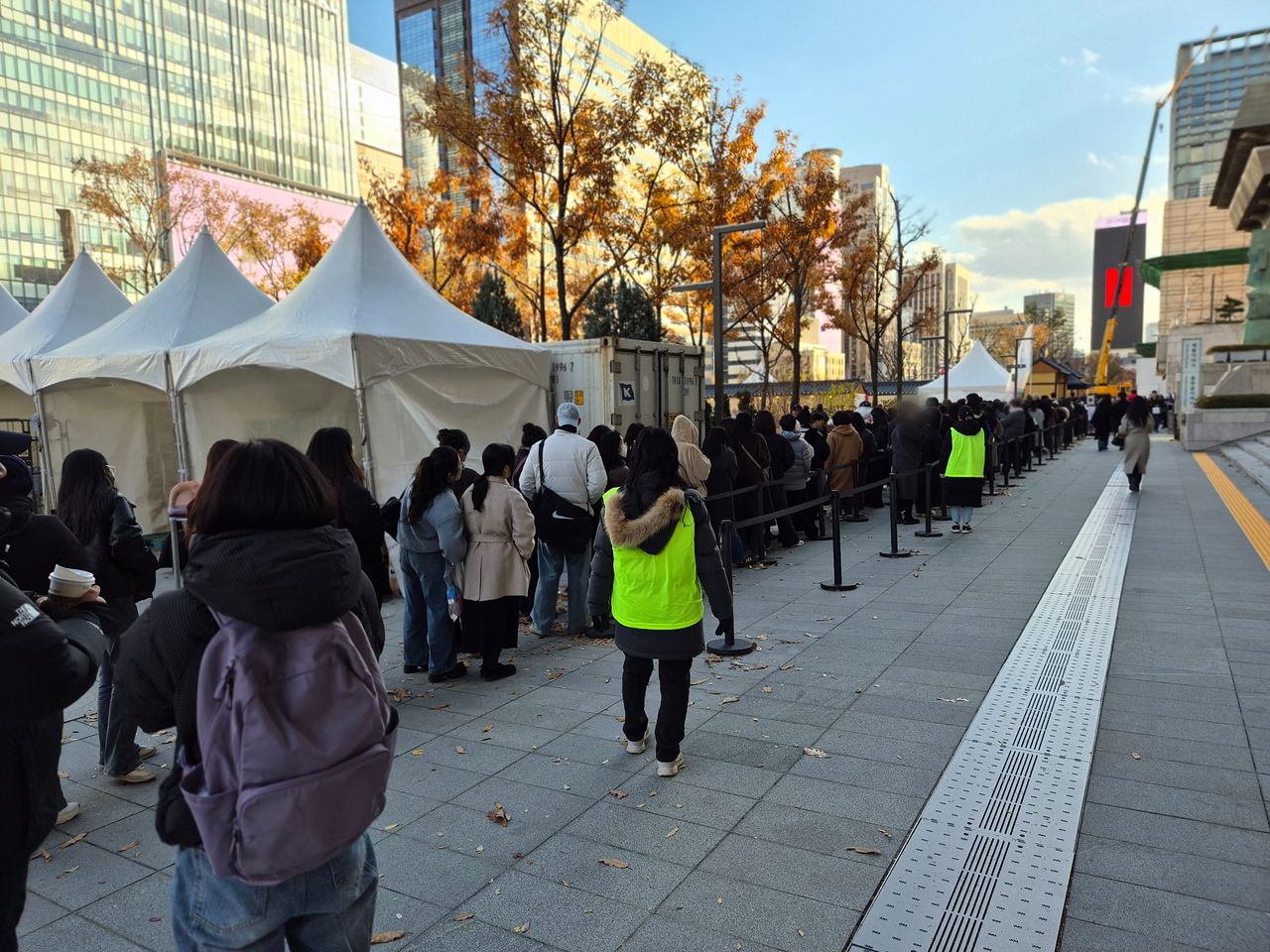
“Wow, that’s the bread from Daejeon! Let’s get in line quickly,” and “It’s rice bread! We have to buy this!”
On the 19th, Gwanghwamun Square in Jongno-gu, Seoul, transformed into a hotspot for “bread pilgrimage.” Spanning 40,300 square meters, the square hosted booths from 116 famous local bakeries nationwide, including Daejeon’s Sungsimdang, Jeonju’s Pungnyeonjegwa, and Busan’s Adela7. Despite a chilling drop in sensible temperatures to sub-zero levels, lines to buy bread stretched up to 700 meters, and crowds packed the booths with standing room only. This was the scene of the “K-Bakery Festival in Gwanghwamun” (Nov 18–20), hosted by the Ministry of SMEs and Startups and co-organized by the ministry and the Korea Confectionery Association.
The Rise of Local Bounded Bakeries
The era of the “local bakery golden age” has arrived. Regional independent bakeries are increasingly making their presence felt in a bakery market once dominated by large franchise chains. According to the Korea Confectionery Association on the 22nd, reflecting this explosive popularity, 370,000 people visited the inaugural festival over its three-day run.
The pilgrimage phenomenon of traveling far and wide across the country in search of famous regional bread is built on decades of rising domestic baking expertise and the continuous development of unique menus by local bakeries. The expansion of dessert culture has increased bread consumption, while social media has further fueled this popularity.
Neighborhood bakeries, which historically lacked marketing budgets and promotional channels, began gaining nationwide recognition by showcasing creative menus on social media. Consumer trends valuing unique experiences also played a vital role. Breads that can only be tasted by visiting specific bakeries have become unique experiences and consumer content in themselves.
Market Growth and Regional Ingredients
According to Samil PwC Consulting, the domestic bakery market size grew at an annual average of 8% over the past five years, surpassing 13 trillion won for the first time last year. Notably, the independent and local bakery market surpassed the franchise confectionery market for the first time in 2022, expanding to 4.74 trillion won last year. The gap with the franchise market size (4.1 trillion won) widened to 6400 billion won.
Local bakeries are boosting their uniqueness by actively utilizing regional specialties. At the Gwanghwamun festival, breads made with domestic wheat instead of imported wheat, and rice produced in Icheon, Gyeonggi Province, and Chungbuk stood out. Sandwiches containing red snow crab, a specialty of Sokcho, Gangwon Province, cookies made with mountain greens like gondre and Yeddo lousewort from Yeongwol, Gangwon Province, and rice cakes infused with Jeju Island mugwort also drew massive popularity.
Office worker Yoo Da-hye, 35, who purchased 100,000 won worth of bread at the event, said, “Eating breads that can only be tasted at specific bakeries gives me the feeling of having a new experience, so I frequently visit them.” Hong Mi-young, who runs Gangneung’s Pangpamiyu, which makes bread using domestic garlic and onions, noted, “Utilizing domestic ingredients helps greatly in developing diverse types of bread.”
Overcoming Market Saturation Through Global Expansion
However, concerns over domestic market saturation are also growing as bakeries multiply rapidly. Professional bakeries nationwide, combining independent shops and franchises, total about 28,000. There are 54 stores per 100,000 people, which is more than five times that of Japan. Consequently, voices are calling for the discovery of new growth engines overseas.
Major franchise corporations are already demonstrating the success potential of K-bakery in overseas markets. Paris Baguette and Tous les Jours, subject to domestic outlet regulations restricting new stores within 400 to 500 meters of neighborhood bakeries, turned their eyes abroad early on, operating approximately 750 and 580 stores respectively in the United States and other countries.
Woo Won-seok, president of the Korea Confectionery Association, stated, “We plan to grow next year’s festival in Gwanghwamun into a platform for domestic bakeries to explore opportunities to advance into the global market.” Lee Jong-woo, a professor of distribution and marketing at Namseoul University, suggested, “Government support for overseas online and offline platforms that aggregate and sell bread from small business owners is worth considering.”