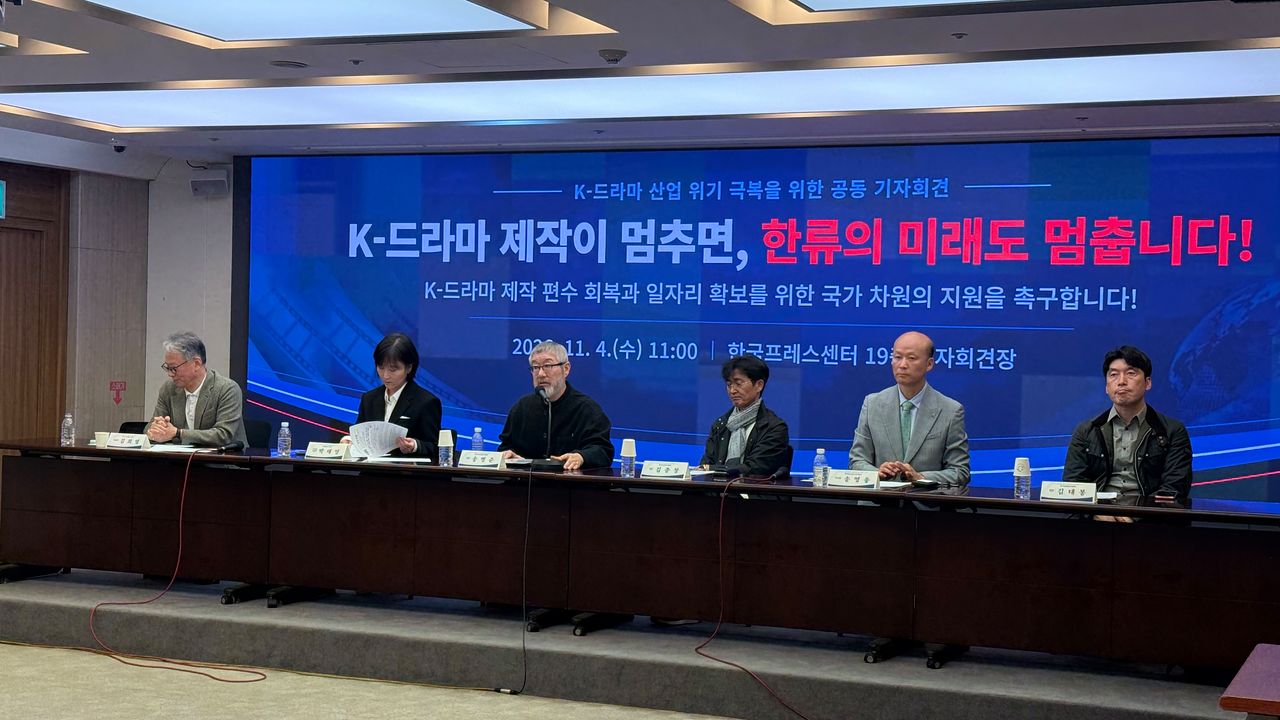
Representatives from 12 broadcasting and content creator associations gathered to declare that the K-drama industry, which spearheads the global Hallyu wave, is facing a crisis and urged a pan-governmental response.
The Crisis Facing K-Drama Production
During a press conference held at the Korea Press Center, the 12 related organizations, including the Korea Drama Production Association, Korea Producers Association, and Korea TV & Radio Writers Association, stated that the issues in the drama industry go beyond mere business difficulties and constitute a national challenge that Hallyu and the national economy must solve together.
Song Byung-joon, president of the Korea Drama Production Association, pointed out in the press statement that while interest in Korea generated through K-dramas expands into food, cosmetics, fashion, and tourism, increasing the economic value of Hallyu, the domestic drama production field itself is facing a severe crisis. He added that due to rising production costs and decreased investment capacity, a structure where investing in dramas leads to losses has formed, resulting in a decline in the number of productions.
Plummeting Production and Rising Costs
According to the associations, the number of domestic drama productions dropped by about 30% over a two-year period, falling from 141 in 2022. Over the past decade, the number of dramas scheduled by terrestrial broadcasters has shrunk to a third, dropping from 91 in 2012 to 32 in 2023.
The diagnosis is that production costs are rising while advertising revenue is shrinking. A drop in ad revenue reduces broadcasters’ capacity to invest in and schedule dramas. Furthermore, the organizations noted that the current platform environment makes it difficult for production companies to secure intellectual property rights and subsequent profits. In their press statement, the groups explicitly targeted global OTT giants like Netflix and Disney+, citing capital-heavy production methods as a primary driver of rising costs.
Threats to New Creators and Future Hallyu
The organizations pointed out that even when a project succeeds, creators cannot count on their next work, and jobs are disappearing. As production numbers fall, the foundation for cultivating rookie creators is also vanishing. Kim Jong-chang, president of the Korea Drama Producers Association, stated that there are no jobs, and with short-form content and AI joining the mix, the current situation is quite chaotic and distressing. Park Hae-young, copyright committee chair of the Korea TV & Radio Writers Association, noted that assistant writers are currently out of work and stressed that the industry must not become subjugated to foreign mega-capital.
Call for Government Intervention
The associations stressed that recovering the foundations of the drama industry is a national task. Last year, total Hallyu-related exports reached $18.975 billion (approx. 25.38 trillion KRW) according to the Ministry of Culture, Sports and Tourism and the Korean Foundation for International Cultural Exchange, with the influence of K-dramas playing a major role. The export scale of the broadcasting and video industry also reached approximately $1.25 billion (approx. 1.68 trillion KRW).
However, government support remains inadequate compared to this export volume and influence. In next year’s Ministry of Culture, Sports and Tourism budget bill, the broadcasting and video sector budget was cut by 4.5 billion KRW (from 91.8 billion to 87.3 billion KRW), and the Korea Communications Commission’s broadcasting content promotion budget decreased by 4.4 billion KRW (from 16.8 billion to 12.4 billion KRW). In contrast, Japan’s Ministry of Internal Affairs and Communications has set a goal to increase content exports to over 250 billion yen (approx. 2.25 trillion KRW) by 2033, requesting five times this year’s budget from the Ministry of Finance.
The associations suggested setting policy goals to restore annual drama production numbers based on the era when traditional broadcasters led the industry environment without relying solely on global OTT platforms. They also urged the establishment of a foundation utilizing a 1-trillion-KRW mid-to-long-term drama investment fund so that invested projects linked with domestic broadcasters and OTTs can be scheduled and distributed.