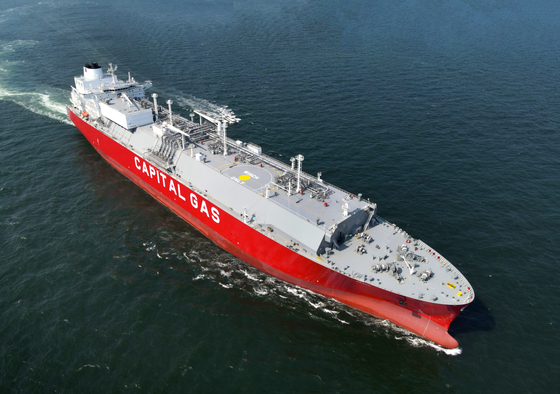
The domestic shipbuilding industry is continuing its strong performance, spearheaded by high-value-added liquefied natural gas (LNG) carriers. With labor conflicts that lasted for months also resolved, the burden on shipbuilders has eased. However, growing concerns over a ‘peak out’ driven by China’s aggressive push have caused stock prices to slide since the beginning of the year, dropping by half compared to their peaks.
HD Korea Shipbuilding & Offshore Engineering announced during its preliminary earnings report on the 28th that it recorded 8.2862 trillion KRW in revenue and 1.4472 trillion KRW in operating profit for the third quarter of this year. These figures increased by 9.3% and 37.3%, respectively, compared to the same period last year. Cumulative operating profit for the first three quarters reached 4.4483 trillion KRW, already surpassing last year’s record-high annual operating profit of 3.9045 trillion KRW.
The previous day, Hanwha Ocean also reported its third-quarter earnings, with revenue up 12.9% to 3.4139 trillion KRW and operating profit up 67.6% to 4857 billion KRW. Meanwhile, the consensus (average analyst forecast) for Samsung Heavy Industries, which is scheduled to announce earnings on the 29th, stands at a 46.9% increase to 3498 billion KRW.
The driving force behind these improved earnings is ‘high-priced ships.’ Because shipbuilding typically takes two to three years from order to construction and delivery, with a significant portion of the payment received upon delivery, vessels ordered at high prices during the boom period are belatedly reflecting in the financial results. High-value-added ships such as LNG carriers ordered from 2024 onward have fully begun reflecting in this year’s revenue, boosting profitability. An official from HD Korea Shipbuilding & Offshore Engineering explained, ‘Despite a decrease in working days and exchange rate issues, we achieved strong results driven by improved productivity and revenue growth resulting from higher vessel prices.’
Labor conflicts have also come to a close. Wage and collective agreement tentative deals for HD Hyundai Heavy Industries, a major subsidiary of HD Korea Shipbuilding & Offshore Engineering, were passed by union member votes on the 27th, concluding negotiations after 147 days. The conflict had run deep, involving 11 partial strikes and a crane sit-in by the union branch leader. The labor and management estimated that the latest agreement would provide an average payment effect of 41.36 million KRW per union member. Hanwha Ocean has also drawn up a tentative agreement featuring a 140,000 KRW increase in base pay, with a ratification vote scheduled for the 29th. Samsung Heavy Industries concluded its wage negotiations last month, the earliest among the big three shipbuilders.
The challenge lies in China. According to global shipbuilding and shipping market analysis firm Clarksons Research, China accounted for 76% and South Korea for 15% of global new vessel order shares from January to September this year. While Chinese orders have largely centered on lower-margin ships such as bulk carriers and small-to-medium container ships, they are accelerating their technological catch-up and eyeing South Korea’s stronghold in the LNG carrier market.
Stock prices have reflected these concerns. Based on the regular session closing prices on that day, the three major shipbuilders’ stock prices compared to their yearly highs stood at -49.8% for HD Korea Shipbuilding & Offshore Engineering, -52.1% for Samsung Heavy Industries, and -65% for Hanwha Ocean. Lee Han-gyeol, a researcher at Kiom Securities, stated, ‘There are concerns about a peak out in the merchant ship market due to the aggressive facility expansion of Chinese shipbuilders.’
Domestic shipbuilders are responding by diversifying their business portfolios. HD Hyundai Heavy Industries recently succeeded in constructing the world’s largest ammonia-fueled carrier, expanding its eco-friendly ship business. Hanwha Ocean and Samsung Heavy Industries are focusing on discovering new businesses, such as floating data centers (FDC).
Efforts to target the U.S. market are also in full swing. Hanwha Ocean is leveraging Philly Shipyard to tap into the U.S. Navy market, while HD Hyundai is building a joint shipyard with Kiewit in the U.S., accelerating South Korea-U.S. shipbuilding cooperation known as ‘MASGA.’
An official from the domestic shipbuilding industry remarked, ‘Since China has just entered the LNG carrier market, the quality and durability are not yet fully matured. While we remain vigilant, it is not at a stage where the playing field will be immediately overturned. Of course, the LNG carrier boom will eventually come to an end, which is why we are focusing on finding our next growth engine in preparation for the decarbonization era.’