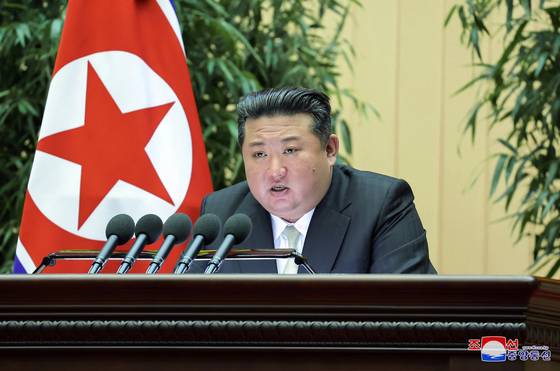
North Korean leader Kim Jong-un called on his officials to strengthen the regime’s nuclear forces “without limitation” and complete preparations for war, Pyongyang’s state media reported Monday.
According to the Korean Central News Agency (KCNA), Kim made the remarks on Friday at the 4th Conference of Battalion Commanders and Political Instructors of the Korean People’s Army, the first such gathering to take place in 10 years.
In his speech, Kim urged military officials to focus on completing preparations so that the North’s nuclear forces would be able to deter war.
“We will ceaselessly strengthen our nuclear-centered powers of self-defense without limitations,” Kim said in his speech, according to the KCNA.
The North Korean leader also claimed that trilateral cooperation between South Korea, the United States and Japan poses a “critical” threat to peace and stability on the Korean Peninsula.
“U.S.-led military alliances have been expanding into ever-larger areas, including Europe and the Asia-Pacific region,” Kim said.
The North Korean leader further argued that the United States and the wider West are waging a proxy war against Russia using Ukrainian forces to lay the groundwork for justifying and expanding Washington’s military involvement across the globe.
Although Seoul, Kyiv and other NATO members have recently confirmed that North Korean soldiers sent to Russia for training have engaged in combat against Ukraine, Kim did not mention the deployment.
The KCNA report on Kim’s speech was released after the leaders of South Korea, the United States and Japan met on the sidelines of the Asia-Pacific Economic Cooperation (APEC) summit in Peru on Friday (local time) and issued a joint statement criticizing North Korean military cooperation with Russia.
The three countries have upped security cooperation in response to the North’s numerous launches of short- and long-range missiles, including a Hwasong-19 intercontinental ballistic missile last month.
As a sign of its commitment to Seoul’s defense, Washington has increased the rotation of U.S. strategic assets to the region.
On Monday, the South Korean Navy announced that the 6,000-ton nuclear-powered submarine USS Columbia had arrived in Busan to replenish supplies and allow its crew to rest onshore.
The Navy said it plans to conduct friendly exchanges with the USS Columbia’s crewmembers during their stay in the country to strengthen the allies’ joint defense posture.
The growing risk posed by Kim’s nuclear ambitions was addressed by a Pentagon report issued on Friday, which argued that the U.S. nuclear weapons strategy should be able to simultaneously deter threats from North Korea, China and Russia in peacetime, crises and conflicts.
The updated strategy paper, which was submitted by Defense Secretary Lloyd Austin to Congress on Thursday, said the U.S. government should possess the capability to simultaneously address threats from all three countries in light of their “growing collaboration and collusion.”
While focusing on the “acute” threat posed by Russia’s large-scale and modern nuclear arsenal and its pursuit of new offensive systems, the report also noted that the North “continues to expand, diversify, and improve its nuclear, ballistic missile, and non-nuclear capabilities.”
BY MICHAEL LEE [lee.junhyuk@joongang.co.kr]