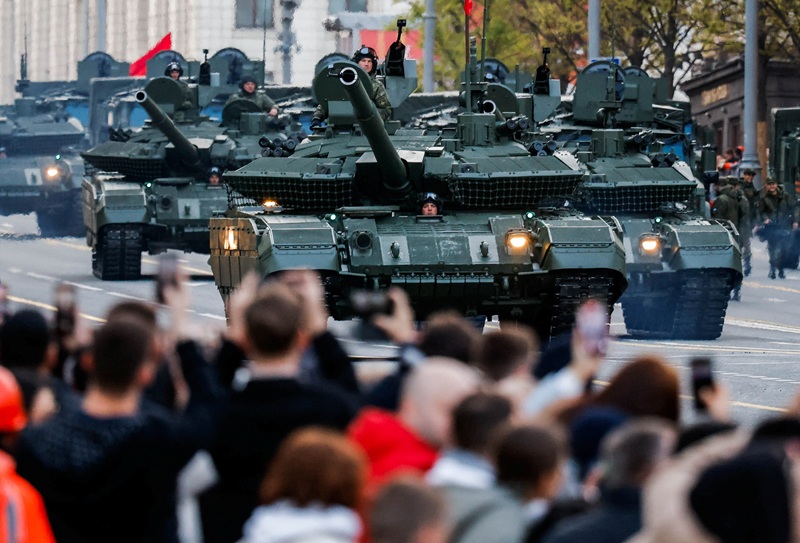
Chinese President Xi Jinping will attend Russia’s Victory Day celebrations in Moscow on May 3, a move expected to highlight growing anti-U.S. solidarity with Russian President Vladimir Putin.
North Korean leader Kim Jong-un plans to stay behind, but will send Supreme People’s Assembly Chairman Choe Ryong-hae in his place, in an apparent attempt to flaunt a trilateral alliance between North Korea, Russia and China.
Kim refuses to be “one of them”
Korea’s National Intelligence Service told lawmakers on April 30 that Kim was unlikely to attend the 80th anniversary of Russia’s Victory Day, citing a lack of telltale signs such as increased security preparations that would typically appear weeks in advance.
“If Kim were planning to attend, we would have seen security measures in place by now. The fact that we haven’t suggests someone else, like Choe Ryong-hae, will represent North Korea,” the agency said in a closed-door briefing to the National Assembly’s Intelligence Committee.
That assessment remains unchanged as of May 5, according to multiple sources familiar with North Korean affairs. Despite a personal invitation from Putin during last June’s North Korea-Russia summit in Pyongyang, Kim appears to be sticking to his longstanding aversion to multilateral diplomatic events.
“The key question was whether Xi, Putin and Kim would stand side by side, presenting a trio of strongmen confronting Trump. That picture ultimately didn’t materialize,” Nam Sung-wook, a professor at Sookmyung Women’s University and former head of the Institute for National Security Strategy, said.
“Kim doesn’t want to be just ‘one of them’ at a global event attended by over 20 world leaders. This typifies his diplomatic strategy under the Juche [self-reliance] ideology,” he added.
Nam said the focus now would likely shift to practical negotiations over what he called “the price of blood” in exchange for North Korea’s troop deployments.
North’s troop participation also noteworthy
Speculation is growing over whether North Korean troops will participate in the parade.
During a visit to Pyongyang in November, Russian Defense Minister Andrey Belousov invited Kim to send North Korean forces to the event. South Korean intelligence agencies are monitoring the situation closely.
A North Korean military delegation led by Pak Yong-il, deputy director of the General Political Bureau of the Korean People’s Army, traveled to Russia on April 28. Although the trip was publicly linked to an international anti-fascist conference, observers say the visit may have included discussions about the military parade.
No direct evidence has emerged of North Korean soldiers joining the parade, but intelligence authorities assess that there remains the possibility of highlighting Russia’s victory in the Battle of Kursk.
Russian and North Korean officials have recently exchanged statements praising North Korean troop deployments to the battlefield.
North Korea’s Central Military Commission noted that “the liberation operation in the Kursk region ended in victory” on April 28, while Russia’s chief of the general staff said on April 26 that North Korean forces “displayed heroic behavior.”
Analysts believe Pyongyang is leveraging the parade and its military support to Russia to gain greater influence in future negotiations with the United States, seeking to turn the North Korea-China-Russia trilateral relationship into a diplomatic bargaining chip.
During a military parade in Pyongyang in July 2023, held to mark the 70th anniversary of the Korean War armistice, Kim stood with China’s Li Hongzhong and Russia’s then-Defense Minister Sergei Shoigu — a symbol of deepening trilateral ties.
China and Russia cement bilateral ties
While it remains unclear whether North Korea will be fully integrated into an anti-U.S. axis, China and Russia have already taken concrete steps to deepen their bilateral alliance. China has pushed back against the Donald Trump administration’s U.S. tariffs and Russia has resisted U.S.-backed cease-fire proposals in Ukraine.
Both countries confirmed an upcoming summit in Moscow, where Xi and Putin are expected to sign a range of bilateral agreements and discuss “comprehensive strategic cooperation,” according to a Kremlin statement on May 4.
China’s Foreign Ministry echoed the announcement the same day, saying the two leaders will engage in “strategic communication on major international and regional issues under the new circumstances.”
Although a three-way summit among Kim, Xi and Putin now seems unlikely, Kim may still pursue a solo visit to Russia in the near future. Experts say the goal would be to secure more tangible returns for North Korea’s military support and reinforce the image of a blood-forged alliance based on a formal treaty with Russia.
As the Ukraine war approaches a potential conclusion, some observers suggest Kim may escalate North Korea’s involvement in the conflict to extract larger concessions.
Ukrainian media outlet Euromaidan Press reported on May 3 that North Korean troops could be “deployed to the eastern front soon,” citing assessments from Ukraine’s military command.
BY CHEONG YEONG-GYO, PARK HYUN-JU [kim.juyeon2@joongang.co.kr]