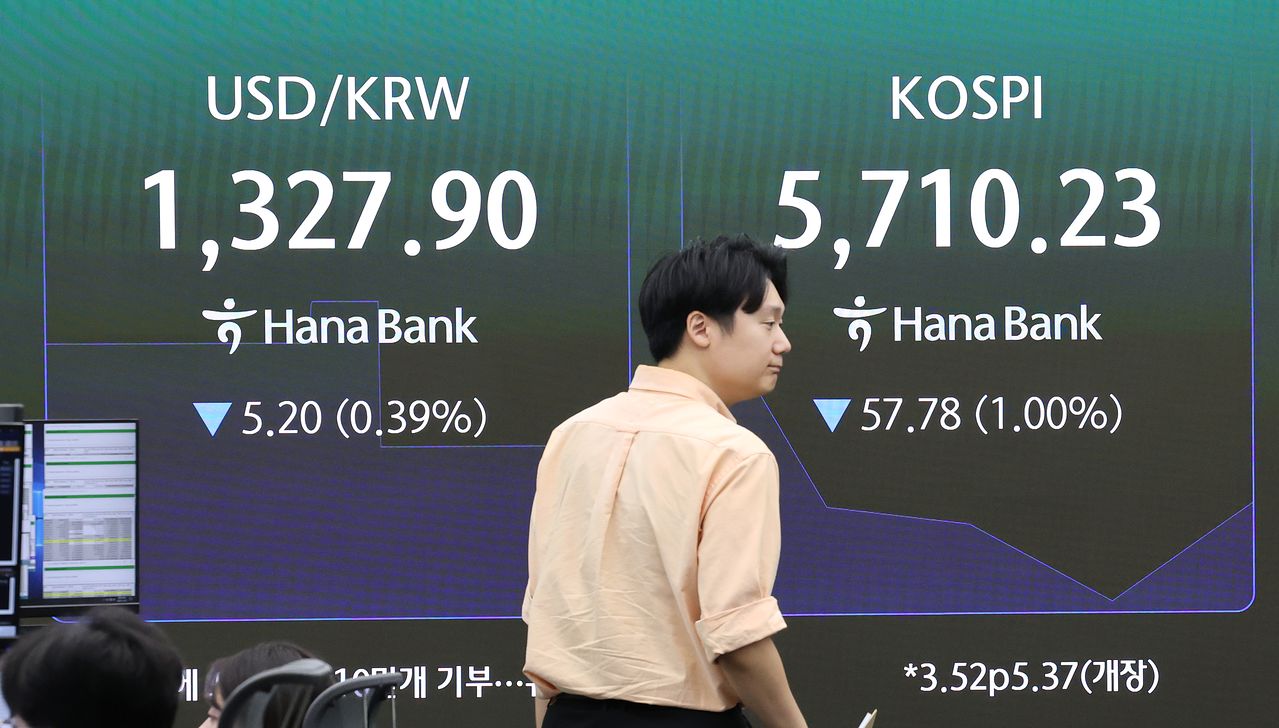
As the Korea Composite Stock Price Index (KOSPI) experiences a sharp decline, local securities firms are successively lowering their corporate target prices. In South Korea’s financial market, where issuing sell reports is rare, a downward revision of a target price is often interpreted by investors as a de facto sell signal and a serious warning. However, critics point out that these adjustments amount to lagging analyses, as brokerages tend to hype up optimism during bull markets and only lower their sights after stock prices have already plummeted.
KOSPI Plummets Amid Market Turmoil
On October 20, the KOSPI closed at 5,553.08, down 3.73% from the previous trading session. This level is even lower than the closing price on October 15, when a circuit breaker was triggered, marking the lowest point since April 7 (5,494.78). During the trading session, the index briefly dipped below the 5,500 mark. The Kosdaq index also finished 3.33% lower at 781.97.
Surge in Downgraded Research Reports
According to financial data firm FnGuide, target price downgrade reports reached 210 over the past week, outpacing upward revision reports (49) by 4.3 times. This contrasts sharply with the cumulative figures for the year, where upward revisions stood at 6,027—about double the 3,118 downward revisions. Focusing specifically on the KOSPI, downgrade reports exceeded 191, more than five times the 37 upward reports. By sector, retail, duty-free, and tourism led the downgrades with 33 reports, followed by defense and railways (27), and automobiles (22). Among individual stocks, Hyundai Rotem recorded the highest number of downward reports at 12. Meanwhile, SK Square, which had previously rallied on expectations of shareholder return expansion by SK Hynix, saw its target price reduced from 1.8 million won to 1.6 million won.
Shifting Regulatory Landscape and Future Outlook
Some cases saw previous target prices slashed by more than half. BNK Investment & Securities lowered Mirae Asset Securities’ target price by 51.5% from 68,000 won to 33,000 won on October 19. Daol Investment & Securities cut Hyundai Rotem’s target from 380,000 won to 210,000 won (44.7%), while Samsung Electronics’ investment arm slashed Shinsegae from 680,000 won to 430,000 won (36.8%). While forecast adjustments driven by corporate performance and macroeconomic changes are necessary, repeating a pattern of bullish predictions followed by delayed target cuts inevitably damages the credibility of these research reports.