The income of Korean American households in the United States shows significant differences depending on the birthplace and background of the householder.
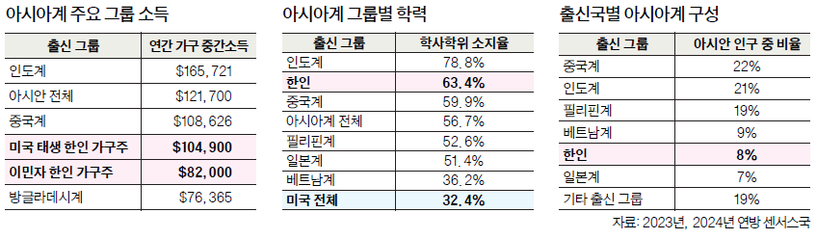
According to an analysis of minority income statistics released recently by the U.S. Census Bureau and the Federal Reserve based on 2023 data, the median income for Korean American households led by an immigrant is $82,000. In contrast, households where the householder was born in the U.S. recorded a median income of $104,900.
This indicates that the income of U.S.-born householders is about $22,900, or roughly 28%, higher than that of immigrant households. The overall median income for all Korean Americans was tallied at $93,600.
This demonstrates that beneath the high average income levels of Asian Americans as a whole, considerable disparities exist based on country of origin and immigration background. Data shows that the overall median income for Asian households is $121,700, the highest among all racial and ethnic groups. Among them, Indian Americans recorded the highest at $165,721, followed by Chinese Americans at $108,626, and Bangladeshi Americans at $76,365.
Korean American households also showed a stark difference from overall Asian figures in terms of wealth.
According to the Federal Reserve’s 2023 Survey of Consumer Finances, the median net worth of Asian households stood at $536,000. However, a separate 2016 study in the Los Angeles area revealed that the median net worth of Korean American households was only $23,400. In the same survey, Japanese American households recorded $592,000, showing about a 25-fold difference compared to Koreans. However, caution is required in direct comparisons as the two surveys differ in timing and target subjects.
Differences were also evident in homeownership. The overall Asian homeownership rate was 62.7%, close to the national average of 65%, but the Korean homeownership rate lagged at 56%. Conversely, Vietnamese Americans based in Houston, Texas, and Westminster, Southern California, recorded an average of 69.6%.
Regarding education levels, which serve as a critical foundation for income, 56.7% of all Asian Americans held a bachelor’s degree or higher, showing a high level overall, though disparities among detailed groups were also large. Notably, as of 2024, Indian Americans had the highest bachelor’s degree attainment rate at 78.8%, followed by Korean Americans (63.4%), Chinese Americans (59.9%), Filipino Americans (52.6%), and Vietnamese Americans (36.2%).
The data explained that differences in education levels and immigration pathways act as factors connecting to income disparities within the Asian community.
It is particularly noteworthy that in the case of the Korean American community, the income gap between U.S.-born households and immigrant households is distinct. Analysts noted that viewing all Asians simply as a high-income group fails to accurately reflect the economic realities faced by specific communities like Korean Americans.
Gil Patrick, a researcher at the statistical analysis institution Statista, analyzed, "It appears that various factors such as the economic situation of the home country, immigration timing, and conditions affect education and finances for immigrants. Beyond the statistical significance, we can see that immigrants’ efforts to establish living foundations and their passion for financial security are higher compared to other races."