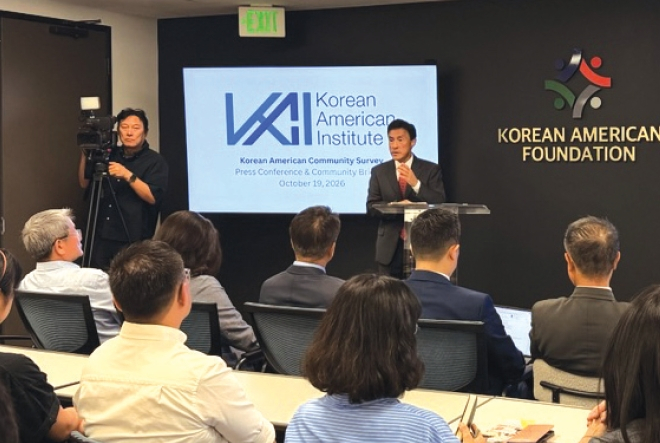
Mark Kim, CEO of KAI, explains the survey results on Korean Americans nationwide.
Two out of three Korean American intermarriage cases involve marrying outside their race for those born in the U.S., according to recent data. As attendance at multi-ethnic churches significantly increases beyond traditional Korean churches, the demographic landscape and cultural spectrum of the Korean American community are rapidly diversifying.
This data comes from a survey titled ‘Current Status and Future Directions of the Korean American Community,’ jointly released on the 19th by the Korean American Institute (KAI) and the Korean American Foundation (KAF).
The generation gap in marriage patterns was particularly prominent. Among married or cohabiting first-generation Koreans, the proportion with a non-Korean or multi-ethnic spouse stood at 24.6%. However, for the 1.5 generation, the intermarriage rate jumped to 46.1%, and soared to 66.2% for second-generation individuals born in the U.S. The rate of intermarriage increases steadily across generations.
The racial spectrum of spouses has also expanded significantly. The proportion of white spouses was 17.7% for the first generation, but more than doubled to 37.7% for the second generation. Marriages with other Asian groups surged from 2.7% in the first generation to 17.9% in the second generation and beyond. While Hispanic spouses accounted for 1.2% and Black spouses 0.5% among the first generation, they rose to 6.1% and 5.5% respectively among the second generation and beyond, demonstrating an acceleration toward multi-racial and multi-cultural households.
The decline in the influence of Korean churches, which have served as the focal point and network center of the immigrant community, was also confirmed by the statistics. Among Korean Protestant believers, 28% attend multi-ethnic churches, and 20% attend churches where white people are the majority.
This ‘exodus from Korean churches’ trend became even more pronounced among younger generations. By generation, 52% of first-generation Korean Protestants attended Korean churches, while the rate dropped sharply to 45% for the 1.5 generation and 38% for the second generation.
Lim So-jung, an associate professor of sociology and criminology at the University at Buffalo, analyzed, ‘In the Korean community, churches have played a core role in identity formation and community beyond simple religious spaces. Compared to previous surveys, the proportion of those identifying as traditional Christians has decreased, while younger respondents who answered ‘spiritual but not tied to traditional religious frameworks’ have noticeably increased.’
The practical language adaptability and level of assimilation into U.S. society among the first generation also broke conventional notions. Contrary to the stereotype that first-generation immigrants face major barriers to English use, a significant number use English daily and have successfully settled into mainstream society.
In fact, 69.5% of first-generation Korean Americans responded that they use English daily. Among them, 34.6% self-evaluated their English proficiency as ‘very fluent.’ The proportion of daily English users rose to 89% for the 1.5 generation and 96.8% for the second generation and beyond, showing that English usage effectively increases with each successive generation.
Although the outer appearance and lifestyle of the Korean American community have transformed significantly, a sense of identity regarding ethnic roots remains. Respondents who chose ‘Korean’ as their identity accounted to 46.5%, and ‘Korean-American’ to 41.7%. Conversely, the proportion selecting pure ‘American’ stopped at 18.5%, suggesting that a strong sense of solidarity as Koreans persists despite cultural assimilation.
Meanwhile, the survey was conducted from February 10 to April 1 targeting 1,500 adult Korean Americans nationwide, using both English and Korean. Among them, the response values of 1,466 individuals who identified as Korean were utilized for the final analysis. The overall sample error is ±2.48 percentage points at a 95% confidence level.
The publication will continue to publish additional results from the survey on the current status and future direction of the Korean American community.