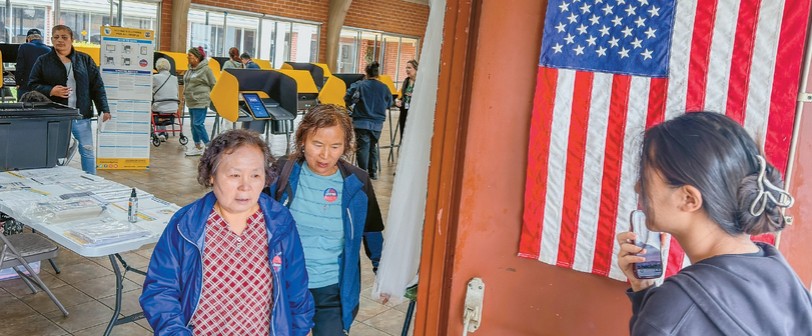
Korean American political influence remains relatively limited in the eyes of many community members, even as most believe it has grown over the past decade, according to a new Korea Daily survey.
The survey of 1,017 Korean Americans, conducted from Aug. 20 to Sept. 3, found that respondents see developing the next generation of political leaders and increasing voter participation as key priorities for expanding the community’s political presence.
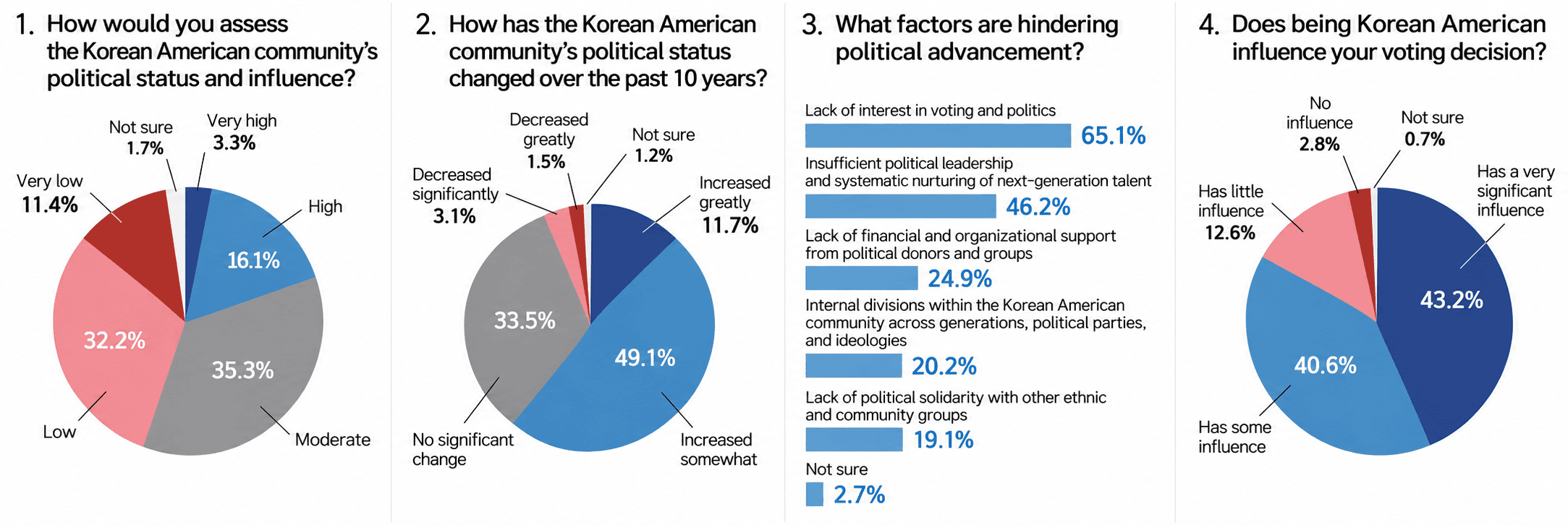
Despite those assessments of the present, respondents reported substantial progress over the past decade. A combined 60.8% said Korean American political standing and influence had increased either somewhat or significantly during the previous 10 years.
Low Voter Participation Tops List of Concerns
Asked what most hinders greater Korean American political influence, with multiple responses allowed, 65.1% cited low voter participation and insufficient interest in politics.
Another 46.2% pointed to the lack of a system for developing the next generation of political candidates and leaders. Other responses included insufficient political donations and organized candidate support at 24.9%, divisions within the Korean American community along generational, partisan or ideological lines at 20.2%, and insufficient political alliances with other racial and ethnic communities at 19.1%.
The findings suggest that many respondents see political participation and community infrastructure as major factors affecting Korean American political representation.
The survey also found a strong tendency to consider a candidate’s Korean heritage when choosing between otherwise comparable candidates.
When candidates had similar policies and qualifications, 43.2% said a candidate being Korean would have a “very significant” impact on their voting decision, while another 40.6% said it would have “some impact.”
Combined, 83.8% said Korean heritage would factor into their decision under those circumstances.
Political Donations Remain Limited
Political giving was far less common.
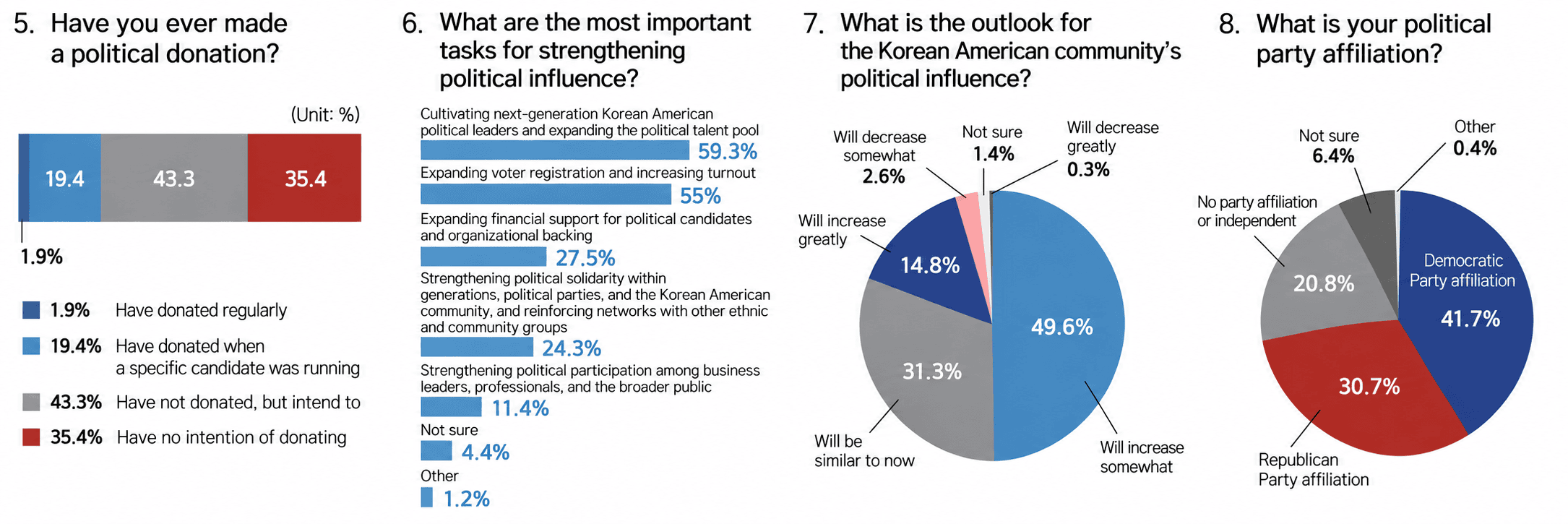
Only 1.9% said they regularly make political contributions, while 19.4% said they had donated during an election or in support of a particular candidate. Combined, 21.3% of respondents reported previous political donation experience.
However, another 43.3% said they had never donated but would consider doing so in the future. Together, respondents who had donated or expressed an interest in future contributions accounted for 64.6% of the survey.
When asked what should be prioritized to increase Korean American political influence, 59.3% selected developing the next generation of Korean American politicians, legislative staffers and other political professionals.
Expanding voter registration and turnout followed at 55%. Other responses included increasing political contributions and organized candidate support at 27.5%, strengthening alliances and networks with other communities at 24.3%, and increasing grassroots participation in redistricting, the census and public hearings at 11.4%. Respondents could select multiple answers.
64% Expect Greater Influence Over the Next Decade
Looking ahead, respondents were more optimistic about the community’s political trajectory.
Nearly half, 49.6%, said they expected Korean American political influence to increase somewhat over the next 10 years, while 14.8% expected it to increase significantly. Combined, 64.4% anticipated greater political influence over the coming decade.
The results show a contrast between respondents’ assessments of the community’s current influence and their views of its longer-term direction: many see room for improvement today while also reporting progress over the past decade and expecting further growth.
Among survey respondents, 41.7% identified themselves as leaning Democratic, 30.7% as leaning Republican and 20.8% as independent.