One in five Korean Americans has considered ‘reverse immigration’ back to South Korea, with healthcare and medical services emerging as the decisive factor for their potential return, according to a recent study. The Korean American reverse immigration trend is largely influenced by these medical considerations, as highlighted in a comprehensive report.
The Korean American Institute (KAI) released a report on the 19th showing that among 1,466 total survey participants, 21.7%—or 318 individuals—answered that they had ‘considered reverse immigration over the past year.’ Regarding the primary reasons, 44.2% of women and 41.8% of men cited ‘health or medical service issues’ as their top concern.
The report analyzed that South Korea’s affordable and accessible medical system, along with the emotional and physical support network of family or relatives, serves as a major background stimulating reverse immigration sentiment. In particular, unlike the U.S., which has a healthcare system tied to specific conditions such as full-time employment or military service, South Korea’s universal health insurance system operated by the state poses a burden for immigrants nearing retirement or facing unstable employment.
While recent observations suggest that the ladder of social mobility is weakening and social anxiety regarding immigrants is rising, causing the ‘American dream’ to lose its luster, a significant number of Koreans still reportedly trust in the possibility of success through hard work.
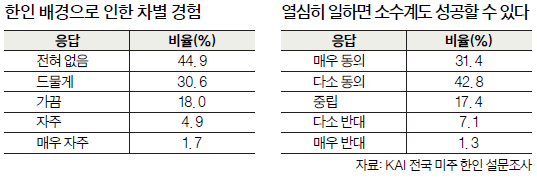
When asked whether ‘minorities can succeed in America if they work hard, regardless of background or origin,’ 74.2% of all respondents strongly agreed or agreed. However, generational differences were stark. The agreement rate among respondents aged 60 and older reached 83.7%, while it stopped at 68.7% for young adults aged 18 to 29. This is interpreted as a reflection of the differing perceptions between the first generation, who experienced self-made success, and the younger generation, who acutely feel structural entry barriers and realistic limitations.
Pride in the unique diligence of Korean society was also confirmed through statistics. To the statement ‘Koreans work harder than most other races,’ 62.3% of respondents agreed.
Regarding experiences with racial discrimination, contrary to common prejudices, the perceived level of actual damage appeared low. Responses indicated that 44.9% ‘never experienced’ unfair treatment because they were Korean, and 30.6% experienced it ‘rarely.’ This means more than 7 out of 10 people (75.5%) answered that they did not experience significant racial discrimination in their daily lives.
However, awareness of socio-structural issues was firm. A total of 60.8% of respondents agreed with the statement that ‘white privilege is a major issue in today’s American society.’ Regardless of individual personal discrimination experiences, they recognize the racial inequality inherent in American society.
In the employment type survey, the proportion of private company workers was the highest for both men and women. Over half of the men at 54.4% and 39.6% of women were found to be working in private companies. Unemployed individuals ranked second for both men and women, followed by self-employed individuals in third place. Notably, the proportion of unemployed women stood at 25.7%, about twice that of men (13.6%). This suggests that career interruption issues for women due to childcare and domestic labor burdens exist within the Korean American community as well.
Generational income polarization and asset formation gaps were also distinct. For the first generation, who have experienced longer settlement periods and steadily accumulated assets, the most common response for annual household income was ‘$200,000 or more’ at 22.1%. Conversely, among the 1.5 and second-and-higher generations, centered around young professionals and middle-aged groups, the middle-income bracket of ‘$50,000 to $100,000’ recorded the highest response rate.