A South Korean lawmaker has drawn widespread criticism after labeling five conservative U.S. figures—most of them Korean American—as the “anti-Korean five” during a July 17 confirmation hearing in the National Assembly.
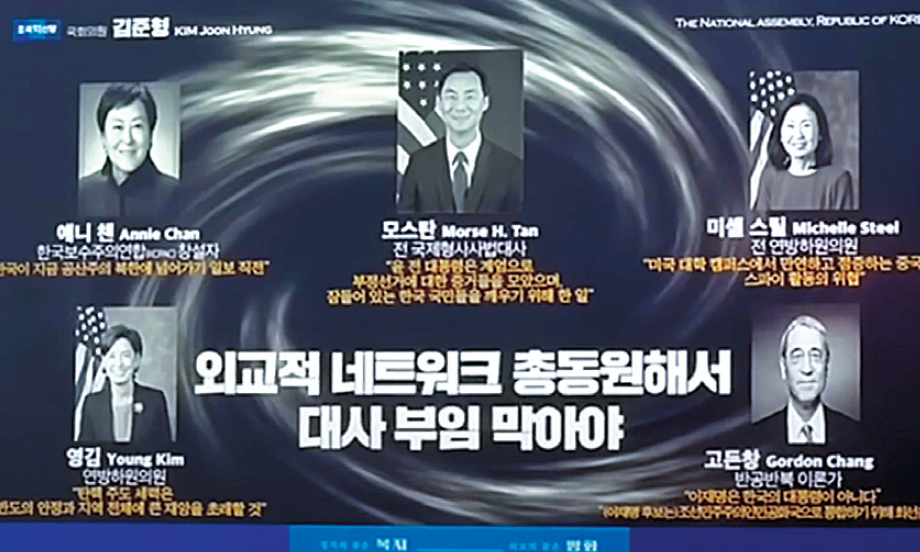
During the hearing for Hyun Cho, nominee for Foreign Minister, Jun-Hyung Kim, a member of the newly formed Cho Kuk Innovation Party, claimed that five individuals were harmful to South Korea’s national interests. Using a PowerPoint slide, Kim pointed to Young Kim (Republican, California’s 40th District), Michelle Steel (former U.S. Representative), Annie Chan (founder of the Korean Conservative Union), Gordon Chang (political commentator and attorney), and Morse Tan (former U.S. Ambassador for Global Criminal Justice). All but Chang, who is of Chinese descent, are Korean Americans. All five have ties to the U.S. conservative movement.
Kim accused them of “denying the legitimacy of South Korea’s Constitution and the administration of President Lee Jae-Myung” and warned they could be selected as the next U.S. Ambassador to South Korea. “Before it becomes a diplomatic showdown where we refuse to grant agrément (formal consent), we must communicate our stance to the U.S. through multiple channels,” he said. Cho did not object to the label “anti-Korean five” and responded, “I will consider what actions we can take.”
Before the hearing, Kim had used the same phrase during a National Assembly policy forum. He criticized the White House for not issuing a prompt congratulatory statement following President Lee’s election, noting instead “an unusual commentary” raising concerns about Chinese interference. “If President Trump remembers such things, we cannot rule out the possibility that one of them could be appointed ambassador to South Korea,” Kim said. He also claimed, “I believe these people would sell Korea out to China.”
Young Kim, however, has never questioned the legitimacy of South Korea’s new administration or promoted ties with China. On June 3, shortly after President Lee’s election, she posted on X (formerly Twitter), “The U.S.-Korea alliance has never been more important in pursuing peace in the Indo-Pacific. I look forward to working with Korea’s new democratic government to uphold our alliance.”
The remarks triggered strong reactions among Korean Americans and former officials. Critics said Kim’s statements were diplomatically reckless and politically damaging. Robert Ahn, President of the Korean American Federation of Los Angeles, said, “These individuals have worked hard in the U.S. for the benefit of Korea. For them to be publicly denounced like this is highly inappropriate. It’s jarring to remember how these same lawmakers used to greet and take photos with them during U.S. visits.”
Myunghyun Kim, 56, of La Palma, said, “Calling a sitting U.S. lawmaker an ‘enemy’ when they never even expressed interest in an ambassadorship is disrespectful. Even with political differences, criticizing them with charts in an official setting is not right.” Eunju Jang, 42, of Fullerton, added, “So if someone disagrees politically, they’re ‘anti-Korean’? If these five are enemies, who is the Korean government’s real adversary?”
A former Korean American politician, speaking anonymously, said, “While the lawmaker’s comments were already problematic, it’s even more troubling that a career diplomat responded without objection. That could damage future U.S.-Korea relations.”
Jun-Hyung Kim, originally from Gangwon Province, earned his B.A. in political science at Yonsei University and completed his M.A. and Ph.D. at George Washington University. He previously served as a professor in the Department of International Languages and Literature at Handong Global University. He was elected to the National Assembly through proportional representation in the 22nd general election as a member of the Cho Kuk Innovation Party.
BY BRIAN CHOI [choi.inseong@koreadaily.com]