Throughout the history, women have been subjects of body politics. Not to mention the cultural/religious garments worn to cover women’s bodies in public, body politics are present in inconspicuous forms as well, as the recent media are noticing the difference between men and women in the depths of their jean pockets. Such differences are imposed since childhood – even if size tags tell the same size, girl’s shirts are, in general, noticeably smaller than boy’s.
Talking about youth shirts, t-shirts for 7 years old children are made in measurements of 17” width and 22” length in average. How would you feel like if you have to spend eight hours a day wearing a shirt made in that size – to make it worse, not even in cotton or anything elastic? Surprisingly, such torture is a norm for female students in Korea.
On various social media platforms, increasing number of people are raising questions regarding the size and design of school uniforms for girls, which are made dramatically smaller than those for boys and designed to limit physical activities.
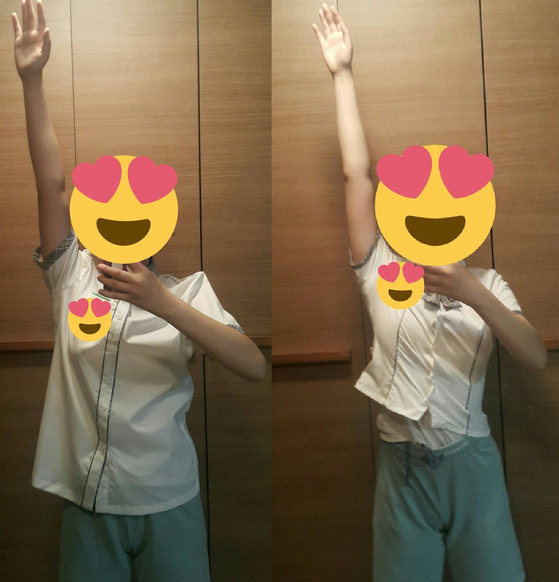
As the picture above shows, which displays the size difference between boy’s uniform in size 91 and girl’s uniform in size 94, school uniforms for girls are designed much smaller both in width and length. Although the boy’s uniform in the picture is actually smaller in size, it looks more comfortable while the girl’s uniform is so short that one can’t raise a hand without exposing waist, not to mention that it looks fitting.
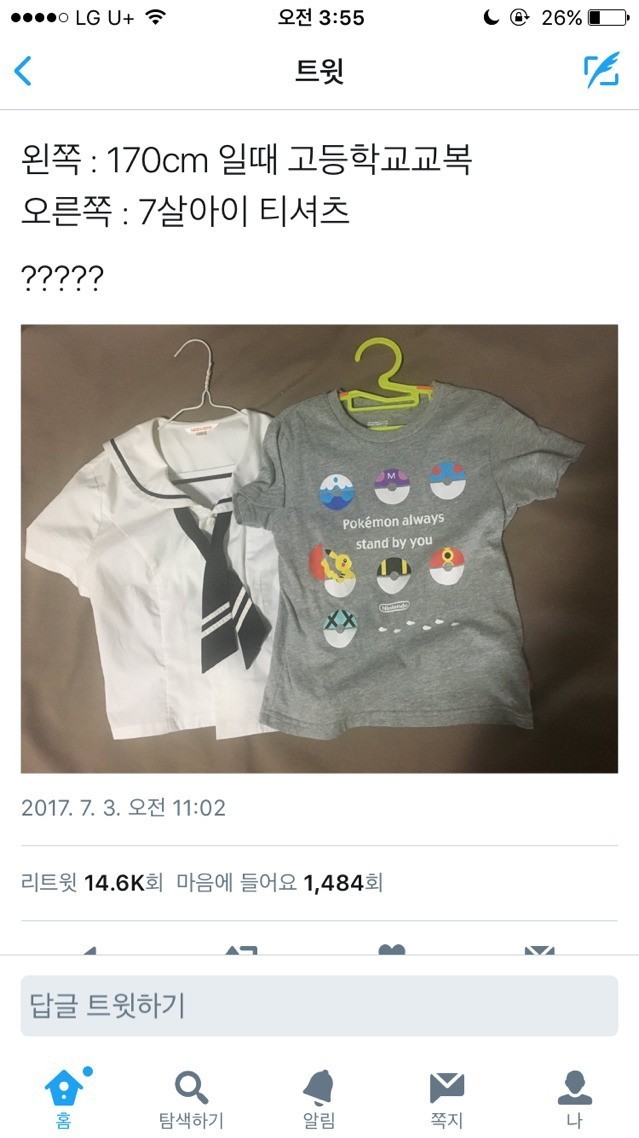
Another Twitter user compared the size of the school uniform she wore when her height was 5’6 to that of a t-shirt for a 7-year-old and the two look exactly the same.
Those from the school uniform industry comment that the size and design for girl’s school uniforms reflect trend and demand. Because of the “slim-fit” trend, according to what they claim, school uniform companies designed girl’s uniforms in ways that can emphasize curves.
However, many point out that those who design school uniforms don’t consider the variety of body types, imposing a rather small “standard” since early ages. Moreover, most schools regulate the way students wear their uniforms strictly, not allowing girls to wear boys’ shirts, active wears, or non-uniform sweaters because those are not “neat.”
Until schools in Korea realize that it is not curves or neatness one needs for studying, female students in Korea have to endure the torture everyday.
By Heewon Kim