Korean-language signs in LA’s Koreatown provide a sense of ethnic solidarity for many Korean Americans. However, for the homeless Koreans in the area, these signs hold a much deeper significance.
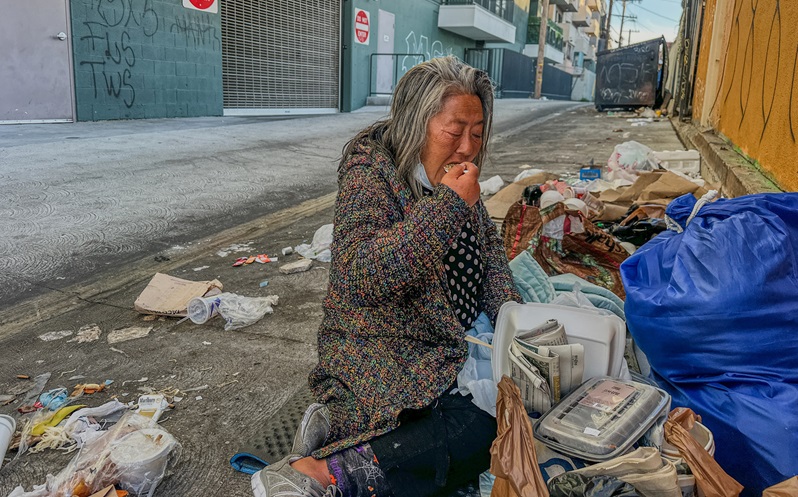
In a narrow alley near 8th Street and South Catalina Street, 65-year-old Yoon Ae-bok calls the bare ground her mattress. The alley, tucked away from sunlight, reeks of waste and is littered with discarded furniture, plastic bottles, and piles of trash. Feces dot the pavement, making each step a cautious endeavor. Paradoxically, this unsightly alley is where Yoon feels most at ease.
City officials have repeatedly urged her to relocate to a shelter. On one occasion, Yoon hesitantly agreed. The officials immediately began gathering her belongings, but just as they were ready to move her, Yoon asked a simple question:
“Where is the shelter located?”
“About six miles from here,” they replied.
Her demeanor changed instantly. With a raised voice, she declined the move. According to city regulations, homeless individuals cannot be forcibly relocated without consent. And so, Yoon remained alone in her trash-filled alley.
When asked why she refused to go, her response was simple:
“I just like it here. I don’t want to go anywhere else.”
For Yoon, leaving her familiar surroundings—even a squalid alley—is unthinkable. Perhaps it’s the fear of cultural and linguistic isolation outside Koreatown, where the presence of other ethnic groups feels alien.
Yet, the irony is stark. She is also an unwelcome presence in the alley where Yoon finds comfort. Nearby business owners express frustration over her presence. To them, a homeless individual is an unpleasant intruder.
One shop owner, seemingly at his wit’s end, shouted at her:
“Just leave! If you’re going to die, don’t die here—go somewhere else to do it!”
Her expression didn’t change. She kept her head down, staring at the ground. Such encounters are likely routine for her.
Behind the cold exterior of some, there lies reluctant compassion—a hallmark of Korean culture. Some restaurant patrons, after spotting Yoon, buy extra takeout meals to hand to her. Local business owners, despite their frustration, occasionally give her spare change.
December winds in LA are biting. One middle-aged Korean man passing by stopped and asked:
“Have you eaten dinner?”
Yoon, unable to lift her head fully, murmured,
“I haven’t eaten anything all day.”
When asked what she’d like to eat, she whispered, “Rice cake soup.” The man pulled a $20 bill from his wallet, purchased rice cake soup from a nearby restaurant, and handed it to her. The restaurant owner, upon hearing the food was for a homeless person, generously filled the container.
After receiving the soup, Yoon carefully spread a Korean-language newspaper on the ground—not just as a makeshift placemat, but for comfort. While eating, she pointed to the date on the newspaper and asked what day of the week it was, revealing how disconnected she is from the passage of time in her daily struggle to survive.
Korean newspapers seem to serve as her anchor, reminding her that she remains in Koreatown—a place that connects her to her heritage.
This story is part of an ongoing series by the Korea Daily on the homeless population in Koreatown.
Last month, we featured the life of Pastor Lee Kang-won, who fell from serving the homeless to becoming homeless himself, ultimately dying on the streets he once served. Through further reporting, we aim to explore why he—and others like him—feel compelled to remain in Koreatown, even in their final days.
For many homeless individuals, Koreatown represents a paradox. It offers emotional, cultural, and psychological comfort, yet simultaneously alienates and excludes them. They are caught between acceptance and rejection, a contradiction deeply embedded in the fabric of this community.
Pastor Lee, like many others, could not escape the cycle of homelessness and died within its grip. His story is a reminder that another “Lee Kang-won” could be among us, silently facing the same fate.
It’s time to face this reality. Only by acknowledging the truth of these lives can we begin to think of solutions. That’s why we continue to listen to their voices, walking the streets where they live.
By Yeol Jang [jang.yeol@koreadaily.com]