The Koreatown Los Angeles business shift is transforming the local commercial landscape, as rapid residential development fails to generate a corresponding economic boom for traditional Korean-owned small businesses.
Over the past decade, high-rise residential complexes have surged across the district, bringing in thousands of new residents and driving up total foot traffic. Yet, long-standing Korean merchants find their customer base shrinking. The long-held economic formula—where real estate development and population growth automatically fueled the expansion of local Korean businesses—has officially broken down.
New Demographic Realities and Evolving Consumer Habits
At the root of this commercial divide is a dramatic shift in local demographics and spending behavior. As established Korean residents move out toward suburban neighborhoods in Orange County and beyond, younger, multi-ethnic residents have moved into central Koreatown. However, these new residents interact with the local economy in an entirely different manner.
Rather than patronizing traditional Korean restaurants, groceries, and daily service providers, younger demographics direct their spending toward trendy cafes, dessert shops, and high-concept dining destinations. For this emerging consumer base, overall ambiance, interior architecture, and social-media-worthy experiences take priority over routine everyday transactions. Industry experts note that while total neighborhood population is rising, traditional Korean merchants are failing to capture these incoming dollars.
Beyond shifting demographics, external economic pressures are heavily burdening brick-and-mortar operations across the district:
The widespread adoption of remote and hybrid work models has dramatically lowered office occupancy throughout Wilshire Boulevard and surrounding commercial corridors. As a result, the steady stream of corporate lunch traffic that once sustained local eateries throughout the workweek has dwindled significantly, leaving many dining rooms underutilized during mid-day hours.
At the same time, rising commercial rents, higher minimum wage requirements, and elevated wholesale food costs continue to compress already thin profit margins. Merchants are forced to navigate higher overhead expenses at the exact moment customer foot traffic is shifting away from traditional business formats.
Furthermore, widespread e-commerce adoption has reduced the need for local shoppers to visit brick-and-mortar Korean retail stores for specialized household goods or Korean imports. Consumers can now easily order specialized products online, placing severe limits on traditional local retail operations that relied heavily on exclusive physical inventory.
Expert Panel Analysis: Structural Transition, Not Total Decline
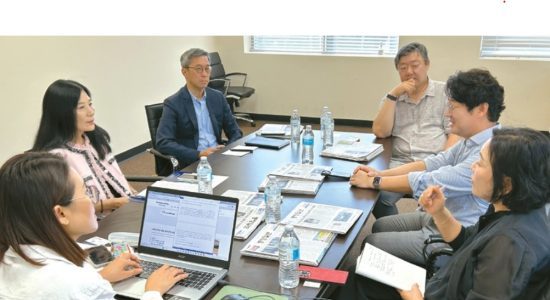
To evaluate the causes of this economic shift and explore sustainable strategies for the future, local industry leaders gathered for an in-depth panel discussion hosted by The Korea Daily.
The panel featured prominent local professionals across multiple sectors, including Sean Mo, Co-CEO of architecture firm Andmore; Albert Zhang, Managing Partner at Kim & Lee CPA; Joann Lee, CEO of Kabuki Group; David Kim, Chief Banking Officer at PCB Bank; and Cathy Lee, Real Estate Agent at Dream Realty.
Rather than viewing these developments as an absolute decline of the district, the panelists agreed that Koreatown is undergoing a structural transition. The neighborhood is evolving from a Korean-centric daily service hub into a multi-ethnic, experience-driven entertainment and dining destination.
During the session, panelists highlighted clear evidence of this ongoing shift. Japanese grocery markets and Taiwanese tea shops along Wilshire Boulevard and 6th Street draw long queues of young patrons late into the evening by curated specialty menus and inviting interior spaces. Conversely, traditional Korean establishments that cling to outdated dining formats or rely solely on past Korean customer loyalty are increasingly left out of this new spending activity.
Panelists also expressed concern over the culture of business replication in Koreatown. When a single concept succeeds, similar businesses and franchises rapidly open nearby, leading to market saturation, severe price competition, and mutual closures. This cycle prevents the growth of long-lasting, resilient local brands.
Generational Succession and Evolving Financial Realities
The ongoing transformation is further complicated by generational turnover challenges within family-owned enterprises. First-generation business founders are reaching retirement age, but second-generation family members frequently decline to take over labor-intensive dining or retail operations. When succession offers come with rigid, traditional management styles rather than operational freedom, younger generations opt for alternative professional careers.
Financial conditions present another immediate hurdle for local property and business owners. Commercial real estate loans executed in 2020 and 2021 at historic low interest rates are now approaching 5-year refinancing deadlines under significantly higher interest rate environments. Coupled with flat commercial revenues, securing loan extensions or re-financing has become increasingly difficult.
Additionally, conservative commercial loan underwriting standards by financial institutions mean that loan approvals are scrutinized far more strictly based on cash flow and debt repayment capabilities. Meanwhile, younger second-generation entrepreneurs are moving away from traditional reliance on local community banks, seeking initial capital through venture networks, private equity, and broader funding sources.
Adapting to the Koreatown Los Angeles Business Shift
Successfully navigating the Koreatown Los Angeles business shift requires commercial operators and property owners to look past historical business practices and adapt to modern market demands.
Industry experts emphasize that the long-term future of the district does not depend on preserving outdated business models, but rather on innovating to capture modern consumers. By creating unique brand identities, designing pedestrian-friendly urban environments, and offering distinct experiential value, Korean-owned businesses can establish long-term brand equity and ensure sustainable growth in central Los Angeles.
Bu Eunyoung Lee