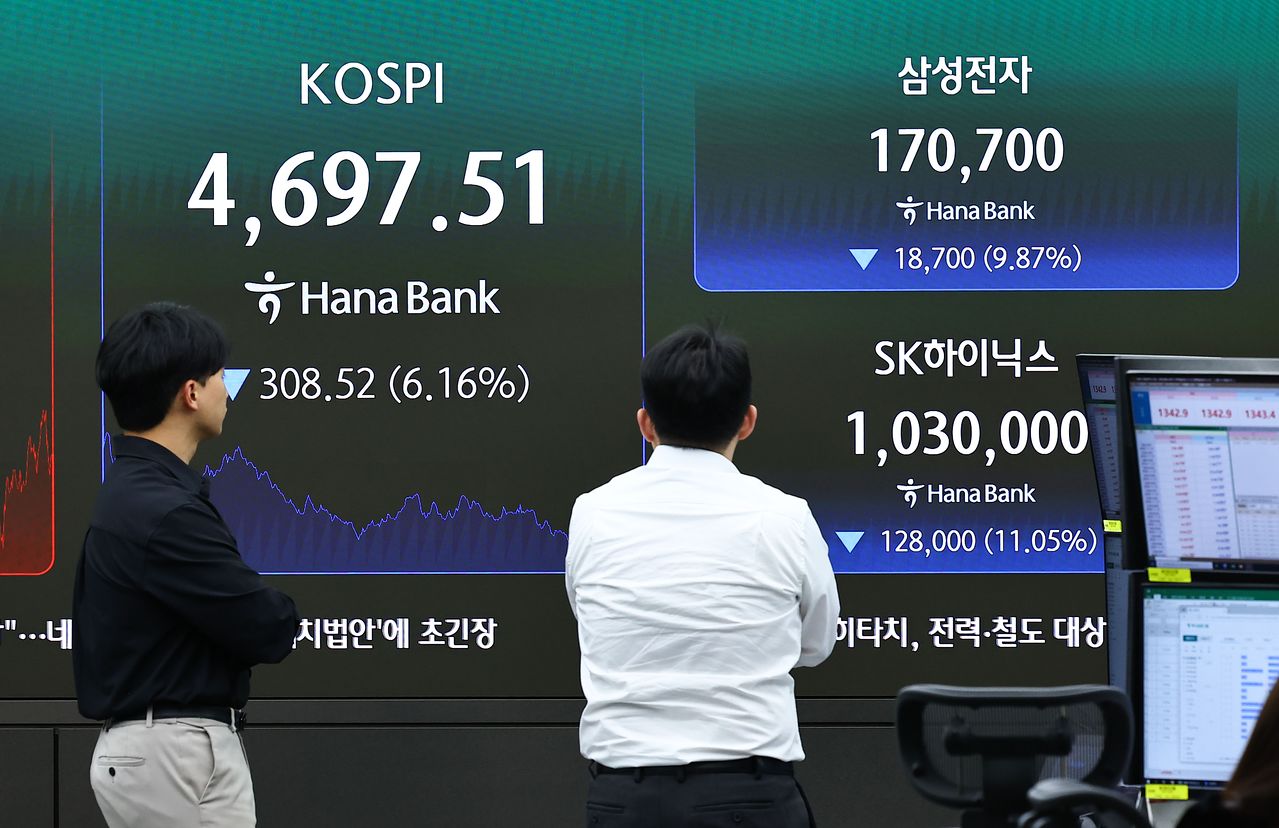
The Kospi index dropped back down to the 4,600 range in a single day on November 25, erasing the gains made after Jensen Huang, CEO of Nvidia, returned to the helm. This sharp reversal highlighted the structural vulnerability of the South Korean stock market, which remains heavily dependent on trends within the U.S. semiconductor sector.
According to the Korea Exchange, the Kospi fell 6.16% to close at 4,697.51, giving up all of its previous day’s gains. Samsung Electronics dropped 9.87% to 170,700 won, while SK Hynix plunged 11.05% to 1.03 million won. Samsung’s market capitalization fell to 998 trillion won, dipping below the 100 trillion-won mark for the first time in about eight months since March 31.
This downturn was the direct result of a shock wave from Wall Street. On November 24 (local time), while the S&P 500 and Nasdaq Composite indices fell 0.5% and 1.48% respectively, the Philadelphia Semiconductor Index plummeted 7.88%. Nvidia dropped 5.86% despite surging 31.5% in the previous session on Huang’s return, while Micron (-11.01%) and AMD (-8.86%) suffered even steeper losses.
Professor Byung-hoon Seok of Ewha Womans University analyzed, “If Huang had stepped down and a clear succession plan had been established, one layer of uncertainty would have been resolved. However, his return via abnormal decision-making, driven by pressure from U.S. President Donald Trump, instead heightened uncertainties surrounding the artificial intelligence (AI) industry, prompting Democrats to step up controls on semiconductor exports to China.” Compounding the investor sentiment, rumors spread that the Trump administration may push for additional tariffs against major trading partners, including South Korea.
Despite these adverse factors, the U.S. market managed to absorb some of the shock. The Dow Jones Industrial Average rose 0.85% as funds exiting AI-related stocks rotated into other sectors, cushioning the overall index drop. Taiwan’s Weighted Index (-4.8%) and Japan’s Nikkei 225 (-2.78%), both heavy in semiconductor weightings, also declined, though their losses were smaller than South Korea’s.
The particularly steep drop in South Korean semiconductor stocks was driven by the unique positions of Samsung Electronics and SK Hynix within the global AI supply chain. Unlike AI chip designers such as Nvidia, Broadcom, and AMD, memory semiconductor suppliers like Samsung and SK Hynix are highly vulnerable to concerns over oversupply. Investment bank BNP Paribas projected that memory semiconductors could face a 20% price drop by 2028 due to oversupply, subsequently lowering its investment rating on fellow HBM supplier Micron to ‘neutral’ and cutting its target price from $1,700 to $775.
Rolf Bulk, a semiconductor and infrastructure analyst at the Futurum Group, told CNBC, “Despite Jensen Huang’s return, uncertainties remain regarding whether AI demand will persist, whether the industry can secure the necessary capital to expand infrastructure, and whether sufficient power can be generated.”
Coupled with external shocks, this over-reliance on semiconductors has significantly increased market volatility in South Korea. A selling sidecar (temporary suspension of program trading orders) was triggered on the Kospi for the fourth consecutive trading day, following the buying sidecar activated the day before. The total number of sidecar triggers on the Kospi this year has reached 62, with more than half of the historical total (112) occurring in 2026 alone.
An official from the financial investment industry noted, “As Taiwan tightens its short-selling regulations, a balloon effect is occurring where short-selling demand spills over into Korea. To regain general market trust, the government needs to issue more aggressive messages demonstrating its commitment to market stabilization, beyond just the Market Stabilization Fund.”