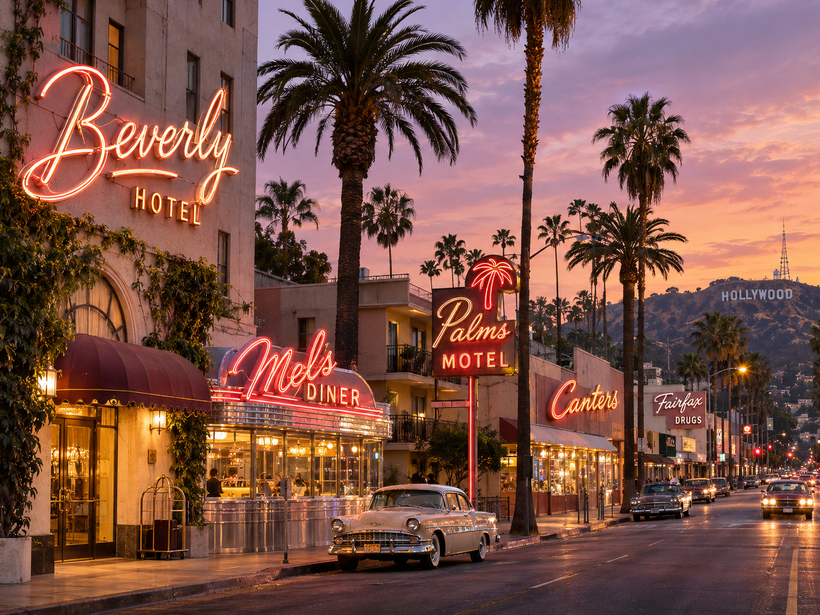
Cursive neon signs that have illuminated the nightscapes of Los Angeles since the mid-20th century are gradually disappearing amid the wave of urban development.
The Los Angeles Times recently reported on the history of script signage that colorfully adorned hotels, restaurants, and shops in LA during the 1950s and 1960s, highlighting local landmarks that still retain their vintage look.
The cursive signage popular at the time featured slanted or upward-stretching typography, projecting the post-war optimism of American society about the future. Kathy Kikert, author of Hollywood Signs, noted in an interview with the Times that cursive writing perfectly reflects the optimism of mid-century design, evoking images of a rocket flying toward the future right beneath the lettering.
According to the Times, such nostalgic cursive signs can still be found across various parts of the Los Angeles area. Notable examples include the Beverly Hills Hotel, Camera Obscura in Santa Monica, Patys Restaurant in Toluca Lake, and the Safari Inn in Burbank. In particular, the Beverly Hills Hotel sign was modeled after the actual handwriting of renowned architect Paul R. Williams, who oversaw the hotel’s reconstruction in the 1940s.
At the time, cursive signs served as a core element completing architectural aesthetics rather than merely being tools to announce business names. Urban historian Alan Hess evaluated that neon served as a flawless medium for script signs because it could freely express flowing curves.
However, as the urban landscape undergoes rapid transformation in the 21st century, these legacy signs symbolizing Los Angeles are losing their footing. A representative case is the large Sears cursive sign at the Valley Plaza Shopping Center in North Hollywood. Installed in 1951 and serving as a regional landmark for decades, it was demolished and relegated to history during the shopping center’s redevelopment last year.
Alex Mebane, who has tracked vintage LA signage, conducted a complete survey of signs in the Santa Monica area starting in 2004. When publishing Signs of Santa Monica in 2020, he revealed that a significant portion of the signs he had previously surveyed had already been dismantled and gone.
Cursive signage was widely used not only for famous hotels but also for neighborhood shops and working-class residential areas. Michael’s Liquor on Wilshire Boulevard and Bourget Bros. Building Materials on 11th Street are prime examples featuring script lettering for their business names.
Cursive signs also frequently appeared on dingbat apartments—the rectangular multi-family housing units built across Southern California during the 1950s and 1960s. Kikert explained that the flowing script added an elegant and warm atmosphere to otherwise monotonous rectangular buildings.
Even the cursive signs surviving to this day remain largely shrouded in mystery regarding who crafted them. Kikert mentioned that sometimes architectural firm employees and other times sign-making company workers designed them directly, noting that unfortunately, records of their creators have been lost to history in many cases.