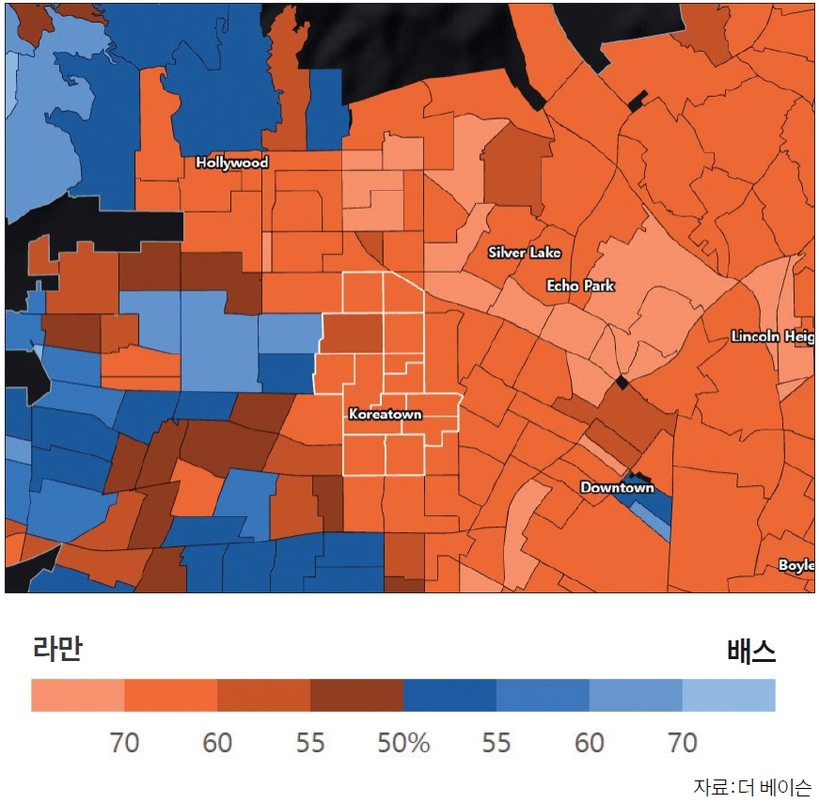
In the recent LA mayoral election, the sentiment in Koreatown leaned heavily toward Nithya Raman rather than incumbent Karen Bass.
Raman secured overwhelming support in eastern Los Angeles, near university districts, and in areas with high renter populations, laying the foundation for her victory in this mayoral race.
According to data cited by the data journalism media outlet ‘The Basin’ from the Los Angeles County Registrar-Recorder/County Clerk’s office (as of the 4th), Raman earned 51.1% of the vote in District 10, which includes Koreatown, outpacing Bass at 48.9%.
Focusing solely on Koreatown, Raman’s dominance was even more pronounced. In Wilshire Center-Koreatown, Raman’s vote share reached 66.7%, double that of Bass (33.3%). This figure is 15.6 percentage points higher than the overall percentage Raman received across District 10.
Regardless of their political affiliations, voters dissatisfied with Mayor Bass’s administration appear to have chosen a change in leadership.
Joshua Kim, a 43-year-old who operates a Korean BBQ restaurant in Koreatown, supports the Republican Party and Donald Trump, but cast his vote for the progressive Raman in this election.
Kim stated, “Bass promised to improve public safety and the homelessness crisis, but failed to achieve any tangible results,” adding, “We need a fresh face to step in and drive real change.”
Lee Jeong, a 67-year-old working in the legal profession, also shared that she chose Raman after comparing the platforms of both candidates.
Lee stated, “Bass failed to fully deliver on the promises she made during her mayoral term,” and expressed hope that “Raman will effectively resolve the housing and real estate issues she has consistently emphasized.”
Raman’s strength was particularly notable in neighborhoods that have struggled with housing issues. In Echo Park, where homeless encampments previously formed, Raman recorded her highest vote share at 71.5%. Historically a stronghold for working-class and Latino residents, Echo Park has long faced issues of gentrification, soaring rents, and displacement.
Raman also led by wide margins in neighboring East Hollywood (69.9%) and Silver Lake (67.4%). In District 13, which encompasses both areas, renter-occupied households exceed 80%. Analysts suggest that Raman’s policy focus on expanding housing supply and strengthening tenant protections successfully captured the ballots of voters sensitive to housing instability.
Conversely, Bass showed strong momentum in affluent West LA neighborhoods. Bass secured 73.5% in Bel-Air-Beverly Crest and 68% in Westwood.
Even within West LA, however, younger demographics and tenant-heavy areas favored Raman. In Palms, located southeast of Westwood, Raman garnered 68% of the vote. Renter households in Palms account for 86.6%, significantly higher than the LA city average of 64.0%.
Raman also captured 62.5% of the vote in Northwest Westwood, home to the UCLA campus. Even within the same West LA region, voter sentiment diverged sharply based on age group and housing type.
On the other hand, Bass maintained her traditional support base in South LA, where Black residents are heavily concentrated. Notably, in the Empowerment Congress Southwest area, Bass secured 74.4%, the highest vote share among all neighborhood council jurisdictions. Having lived in South LA for a long time, Bass previously served as a state assembly member and a U.S. representative, building close political ties with the local community.