LAPD VR Training Puts Officers in Split-Second Scenarios
LAPD VR Training puts officers face-to-face with armed suspects in realistic scenarios where a split-second decision can determine how an encounter ends.
The moment an armed suspect appeared in front of me, my mind went blank.
As the suspect closed in, there was hardly any time to decide whether to reach for a Taser or draw a handgun. While keeping an eye on the caller’s safety, I repeatedly shouted, “Drop the weapon and put your hands up.”
The suspect eventually dropped the weapon and was handcuffed, but the tension gripping my body was slow to fade.
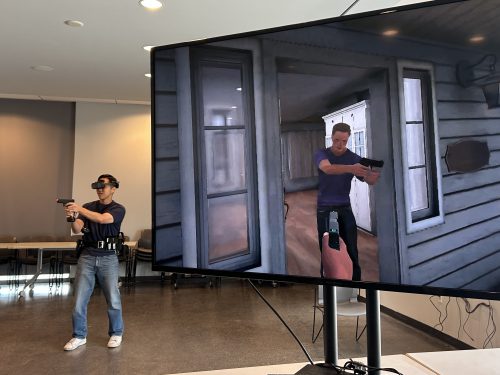
The Los Angeles Police Department’s Olympic Community Police Station held a demonstration of its virtual reality-based tactical training system on Aug. 11. The station, which had previously used monitor-based simulators, became the first LAPD station to introduce a VR training system.
The program was built with about $60,000 in funding from the Olympic Booster Association. The Korea Daily reporters also put on the equipment and participated in realistic scenarios modeled after police calls for service.
LAPD VR Training Recreates the Pressure of Real Calls
Once stepping into the virtual scene, the pressure to make the right decision was relentless.
In one scenario, a suspect standing only a short distance away began reaching for a handgun. The instinct to protect myself took over.
The suspect ignored repeated commands to drop the gun and continued moving closer. Eventually, the use of deadly force became unavoidable. The training firearm was powered with gas, producing recoil similar to that of a real gun when fired.
Officers participating in the demonstration noted that even when they receive information about a call before arriving, it can be extremely difficult to immediately understand how the situation will unfold once they reach the scene.
That uncertainty is at the heart of the VR training.
The goal is to repeatedly expose officers to unpredictable situations that resemble real encounters, while helping prevent officer-involved shootings(OIS) and minimizing injuries or deaths among civilians.
Captain Rachel Rodriguez of the Olympic Community Police Station said officers cannot control everything that happens in the field.
“What we can do is provide the best tools and training so officers can respond more quickly and accurately in the field,” she said.
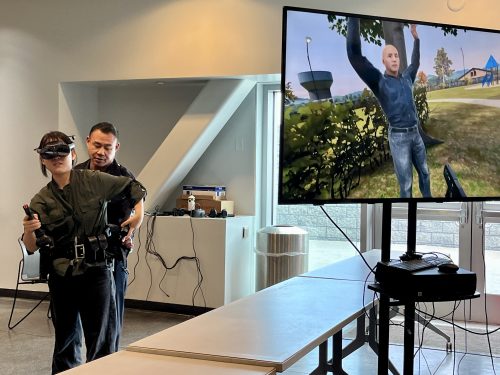
Scenarios Based on Real LAPD Incidents
The LAPD Training Division develops and manages the scenarios, using actual incidents and field cases from police stations across the department to create numerous virtual situations.
The system can simulate everything from routine traffic stops to responses involving people in a suicidal crisis.
The outcome can also change in real time depending on the participant’s decisions and actions.
During the demonstration, Officer Julian Robinson operated the scenarios. He controlled what suspects said and did inside the VR environment and changed the situation based on how the participant responded.
Officer Robinson said officers refine and build the scenarios using their own field experience and actively incorporate them into training.
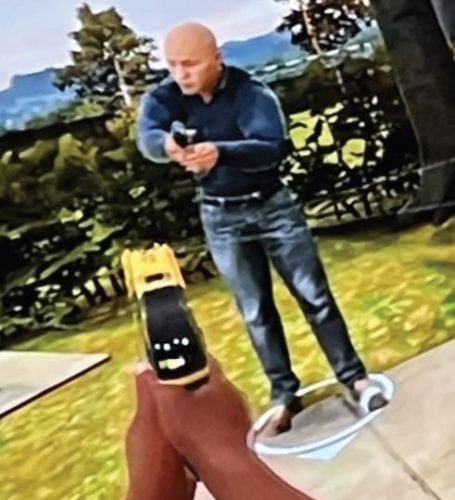
Testing Communication and Awareness Under Pressure
The exercises evaluate more than whether an officer chooses a Taser or firearm.
Participants are assessed on whether they maintain a safe distance from suspects, check on victims and bystanders, request additional officers when needed and communicate effectively with their partners.
What the participant sees is displayed in real time on an external monitor. After each exercise, officers review the decisions that were made and exchange feedback with colleagues.
Officers said maintaining broad situational awareness is particularly important in Koreatown, where heavy vehicle and pedestrian traffic means police must monitor not only suspects but also nearby civilians and surrounding traffic conditions.
The equipment was supplied by InVeris Training Solutions, a major firearms and tactical training company that provides simulation systems to military branches and agencies around the world.
The Olympic Community Police Station plans to make extensive use of the system for officer training. The LAPD VR Training system will also be available to officers from four other stations within the department’s West Bureau.