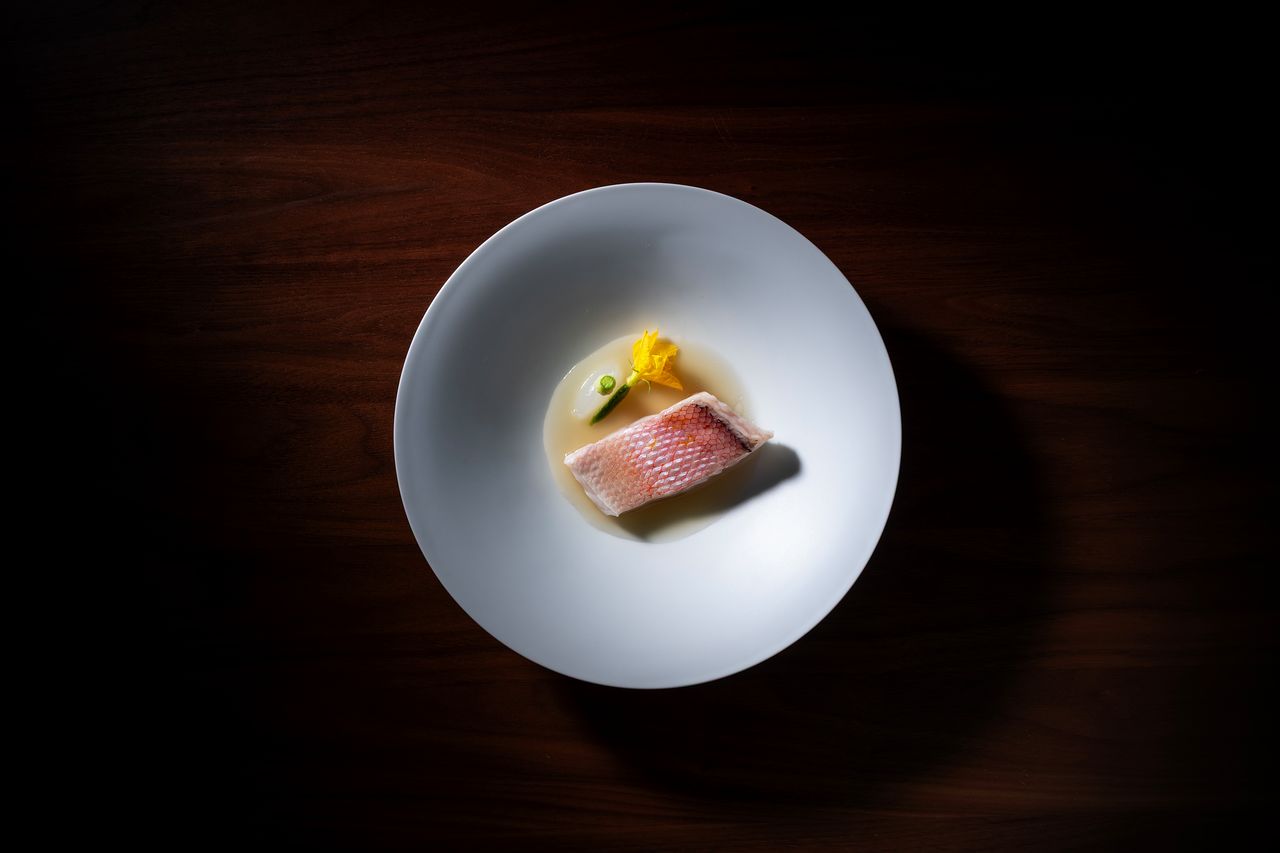
One of the most impressive restaurants I visited last year was Logy Taipei, located in Taipei. It was there that I encountered the most delicious fish dish I have ever tasted, and perhaps one I will only ever experience at Logy.
The menu at Logy lists only the main ingredients without detailed descriptions. A dish marked as ‘Red Tilefish/Mushroom/Hazelnut’ featured fish gently steamed at a low temperature with a finished surface that left the translucent flesh visible. It was my first time seeing fish flesh this translucent, so I initially wondered if it was undercooked, but the moment I took a bite, an exclamation burst out. The cooking was stopped at the exact point the chef intended. A subtle, savory mushroom broth seeped through the tender fish flesh, which retained its springy elasticity, and a few drops of hazelnut oil added a rich nutfulness. It was a red tilefish with a subtle flavor that made me crave another bite with every swallow.
Chef Ryogo Tahara of Logy was born in a small fishing village in Hokkaido. Growing up in a neighborhood where his friends’ fathers were fishermen, he learned how to cook fish. Of course, growing up in a fishing village alone does not guarantee the creation of superb fish dishes; the single bite I tasted was the culmination of all the time he has spent perfecting his craft.
Chef Tahara moved to Taipei after working as a sous chef at Tokyo’s Michelin two-star restaurant ‘Florilège.’ Even after initial plans to open a branch of Florilège fell through, he decided to stay in Taiwan. He spent three months traveling across Taiwan, learning about local ingredients and pondering what kind of cuisine he could create there. During this process, he focused on Taiwanese fish, which often faced unfair comparisons to Japanese catches. He believed that they were not inferior, simply different.
Chef Tahara scales and guts the fish, wraps them in salt-water-drenched cloths and paper, and ages them in an ice-water bath, changing the wrappings daily. After ten days, he cooks the fish at a low temperature of 42 degrees Celsius and finishes the surface by pouring hot oil over it. Without expensive equipment, he found a way to draw out deep umami flavors simply through careful observation of ingredients and the investment of time.
The small restaurant, consisting solely of a 13-seat L-shaped counter, earned its first Michelin star in 2019, just about five months after opening. It was promoted to two stars the following year, a rating it maintains today, and ranked 22nd in the 2026 Asia’s 50 Best Restaurants list, the highest position for a restaurant in Taiwan. Chef Tahara vowed not to return to Japan until he earned a star, welcoming guests every day with the mindset of someone facing a daily evaluation. On the day he received his first Michelin star, he stayed behind in the kitchen instead of attending the celebratory banquet to serve that evening’s guests.
He is likely the kind of person who constantly hears, ‘There is no need to go to such lengths, why push yourself?’ and yet decides to do so anyway. He strives for the pinnacle of excellence not out of competition with others, but because he cannot settle for his own standards and cannot forgive himself for falling short. The food tasted at Logy is thoroughly imbued with this personality. He first deconstructs the ingredients that make up Taiwanese cuisine to truly understand them, then rebuilds them with a unique combination that no one else could imagine.
Speaking of fish, I would like to introduce another fish dish: the eel fry. Thinly fried Taiwanese eel is coated with burnt brown sugar so that the exterior shatters like glass, served over a base of mushroom broth infused with sansho pepper and Taiwanese dark chocolate. It is a reimagined version of the Japanese grilled eel dish kabayaki, crafted without soy sauce and built entirely on his own unique flavor profile.
The cast-iron pot ‘tea rice,’ served alongside the main course in place of bread, is another unmissable highlight. Cooked using rice from the chef’s native Hokkaido infused with Taiwanese high-mountain oolong tea and topped with an abundance of tea leaves, the tea’s aroma washes away the rich aftertaste of the meat. This rice, bringing together Taiwanese tea and Japanese rice in a single pot, perfectly encapsulates Logy: a dish bridging the experience of a chef raised in Japan with flavors discovered in Taiwan.
This effort to blend Taiwan and Japan extends into the restaurant’s physical space. When moving from the original 13-seat location to the current venue, Chef Tahara was deeply involved in the interior design. Materials forming the space, such as bricks, deliberately mix Taiwanese and Japanese origins. The furniture was commissioned exclusively from a Japanese designer to create a custom ‘Logy Taipei Collection,’ featuring round tables tailored to Taiwan’s dining culture. The spatial design seamlessly mirrors his culinary philosophy of adding Japanese technique and sensibility onto Taiwanese ingredients and culture.
Finally, the beverage pairing deserves as much attention as the food because the quality of a pairing reflects a restaurant’s structural integrity. True pairing harmony means that the wine and food enhance and enrich one another, whether tasted separately or together. In this regard, Logy’s pairings are an essential part of the dining experience. It is no surprise that sommelier Kevin Lu received the ‘Sommelier Award’ at the 2023 Michelin Guide and became the first person in Taiwan to achieve Master Sommelier certification in 2024.
Chef Tahara noted, ‘As my responsibilities grow, I do not want to lose the sensitivity gained by directly touching ingredients and observing their subtle daily changes. My rule is to remain a chef.’ He also expressed his hope that ‘Logy becomes a reason for travelers to choose Taiwan.’ For me, it certainly is. After all, I am already planning a trip to Taipei just to visit Logy.