〈SERIES〉
- Employment, Income & Business Trends
- Housing & Home Equity
- Investment & Retirement Planning
- Inflation & Living Costs
- Korean American Bank Usage
Major National Banks Capture Korean American Market Share Despite High Trust in Community Institutions
Korean American community banks continue to enjoy high overall trust among local consumers, yet major mainstream financial institutions remain the dominant choice for primary banking relationships.
According to the 2026 Korean American Economic Life Survey sponsored by Bank of Hope, Bank of America ranked as the top primary bank among Korean American respondents at 23.5 percent, followed closely by Chase at 22.8 percent. Combined, the two financial giants account for 46.3 percent of the total market share, capturing nearly half of all Korean American consumers.
Among Korean American community banks, Bank of Hope led the segment with an 18.4 percent share of primary banking relationships, while Hanmi Bank secured 8.9 percent.
The division reflects shifting consumer priorities when selecting a financial institution. When asked to identify the single most critical factor in choosing a primary bank, 36.2 percent of respondents cited physical accessibility, including branch density and ATM network convenience. Customer service ranked second at 17.6 percent, followed by online banking convenience at 9.7 percent, product variety at 6.8 percent, and brand image at 6.6 percent.
Language Convenience Remains Key Strength While Accessibility Gap Persists
The competitive advantage of Korean American banks remains heavily concentrated in language accessibility and culturally tailored services. Nearly half of respondents—46.0 percent—identified Korean-language capability as their primary reason for preferring community banks, reflecting a 9.1 percentage point increase from 36.9 percent in 2020. Branch location convenience followed as a secondary preference driver at 18.9 percent, while support for local Korean American commercial ecosystems accounted for 9.3 percent.
In contrast, staff friendliness as a primary preference factor dropped from 12.8 percent in 2020 to 5.4 percent this year, while processing speed fell from 11.8 percent to 3.2 percent over the same period. Industry analysts note that while personalized service previously distinguished community institutions, language convenience now serves as the primary unique selling proposition for Korean American banks handling complex financial transactions.
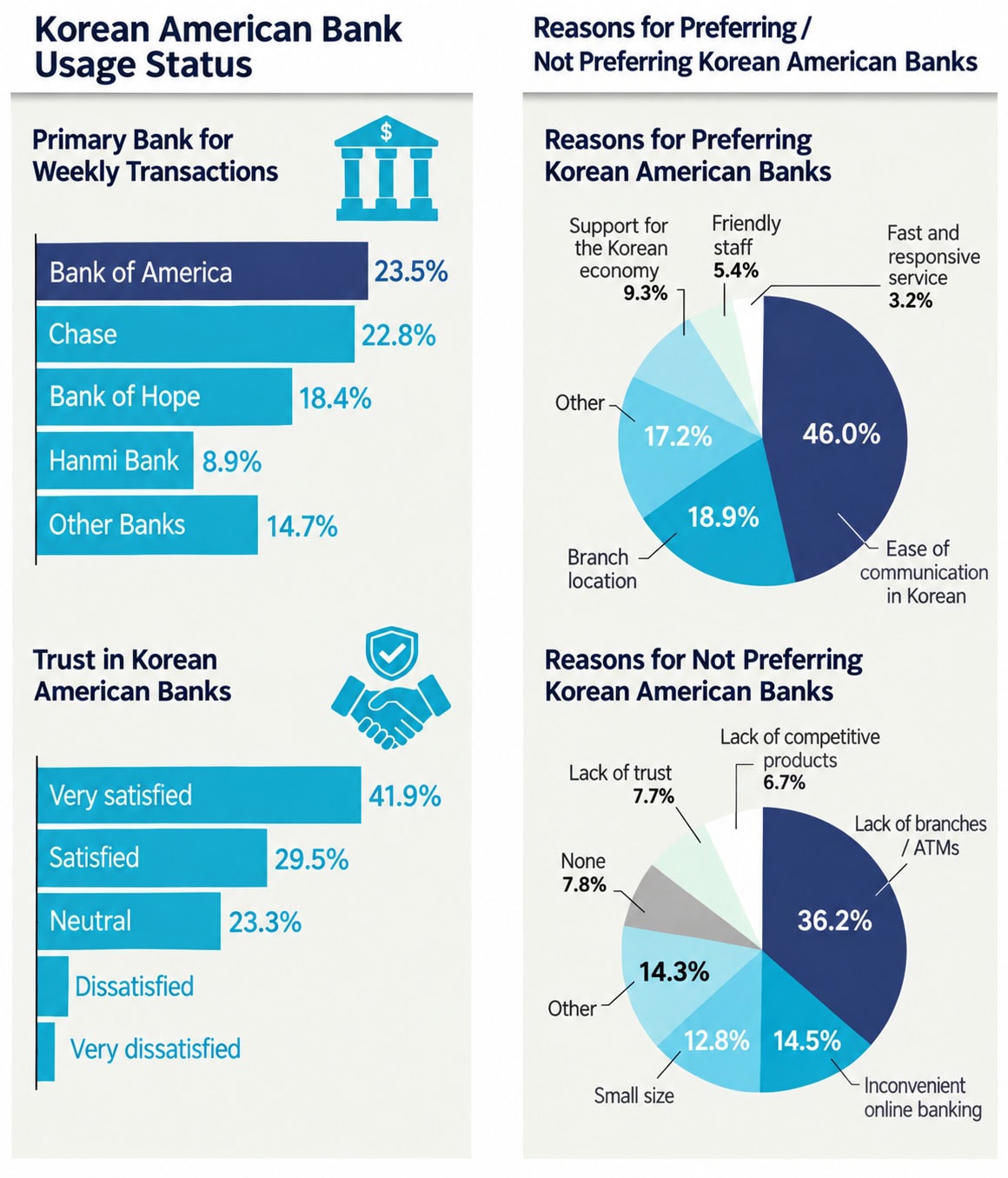
Conversely, physical and digital accessibility limitations represented the main deterrents preventing consumers from choosing Korean American financial institutions. Among respondents who avoided community banks, 36.2 percent cited a shortage of physical branches and ATMs as their primary reason, up 3.8 percentage points from 32.4 percent in 2020. A lack of digital banking features accounted for 14.5 percent of non-preference, while smaller institution size was cited by 12.8 percent.
The data indicates that operational reach rather than institutional trust restricts customer acquisition for community banks. Overall customer trust in Korean American banks remained exceptionally strong, with 71.4 percent of respondents expressing positive evaluations, including 41.9 percent who reported being very satisfied. Dissatisfaction levels stood at a low 5.2 percent combined. Similarly, consumer satisfaction with personal deposit accounts at Korean American banks reached 59.7 percent positive evaluations against 9.4 percent negative responses.
Small Business Products and Commercial Lending Face Low Satisfaction Ratings
While personal banking relationships yielded favorable ratings, commercial banking services—traditionally the strategic core of Korean American financial institutions—faced notable headwinds.
Satisfaction with small business financial products reached just 20.6 percent positive evaluations, while dissatisfaction reached 27.3 percent. A majority of business owners—52.2 percent—rated small business banking products as neutral.
Commercial lending services recorded similarly low satisfaction metrics, with positive evaluations standing at 20.0 percent compared to 28.9 percent negative responses. Crucially, 17.6 percent of business respondents expressed severe dissatisfaction with commercial loan offerings.
Given the prominent role of small business operators and self-employed professionals within the Korean American economy, low satisfaction across commercial products represents a vital strategic challenge for community banks seeking to preserve their core client base.
While Korean-language capabilities and brand trust remain strong assets, future competitiveness for Korean American banks will increasingly depend on expanding digital platform capabilities to overcome branch limitations while restructuring commercial lending and business banking services.