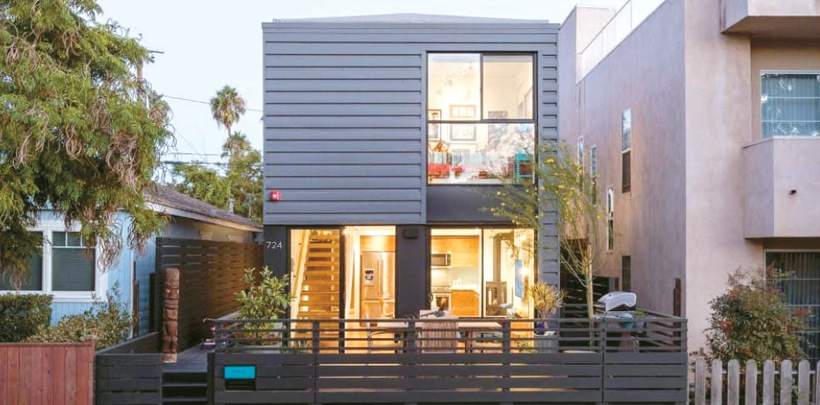
Although the federal government is actively stepping up efforts to expand the supply of manufactured housing to tackle the housing crisis and rising home prices, stringent local zoning regulations are throwing a wrench into the plans.
Manufactured housing involves prefabricating various parts of a home in a factory and assembling them on-site, making it a spotlight solution for addressing housing shortages in terms of cost and time. With advanced manufacturing technology, these homes now boast quality comparable to traditional houses.
The federal government’s moves are more aggressive than ever. The ’21st Century Road to Housing Act,’ enacted this year, abolished the requirement for permanent chassis installations, which had long been a symbol of manufactured housing. Given that most manufactured homes are not moved after installation, removing the unnecessary chassis can save about $10,000 in construction costs per home, according to industry analysis.
The U.S. Department of Housing and Urban Development (HUD) has also prepared a ‘Next Generation Manufactured Housing Action Plan’ in line with this. HUD plans to revise federal building and safety standards as well as foundation and installation standards to permit chassis-free homes, while also expanding construction methods that assemble multiple modules on-site.
In particular, the agency is pushing to expand manufactured housing from traditional single-family homes to multi-family housing of five or more units. The vision is to develop a new performance-based federal building code that includes hallways, stairs, fire safety facilities, emergency exits, and shared utilities, thereby making it possible to build even apartment complexes using mass-produced modules from factories.
As chassis regulations disappear, the designs of manufactured homes can also be diversified into forms similar to general houses. Applying new construction methods, such as transporting homes via truck for immediate on-site installation or utilizing 3D printing technology, is expected to become easier. This is why expectations are rising that manufactured housing could become a new low-cost housing source for first-time homebuyers struggling with high construction costs and a lack of starter homes.
However, the problem lies in local regulations.
According to a report released on the 26th by real estate portal Realtor.com, only 17% of all regions explicitly permit the construction of manufactured housing communities nationwide. Even if the federal government drastically relaxes building standards for manufactured homes, actual building locations depend entirely on local government land use and zoning regulations, leaving significant constraints on supply expansion.
Joel Berner, senior economist at Realtor.com, pointed out that while the federal government can establish new standards and financial systems, the final authority to permit home construction rests with local governments.
He specifically pointed to Hartford, Denver, Allentown, Albuquerque, and Colorado Springs as regions where the impact of expanding manufactured housing would be greatest. These are areas suffering from a shortage of starter homes, high land prices, and large premiums for new construction.
Some states have already begun easing local regulations. Virginia has allowed manufactured homes in areas zoned for general single-family houses, while New York State has decided to invest $20 million into factory-built housing development.
Ultimately, no matter how much the federal government relaxes design and production regulations for manufactured housing, it is difficult to translate this into actual housing supply unless local governments open the door to zoning.
Experts analyze that the success or failure of manufactured housing innovations aimed at lowering home prices now depends more on the relaxation of local government land use regulations than on federal rules.
Meanwhile, California mandates that local governments must generally permit manufactured housing meeting federal standards and installed on permanent foundations in zones where regular single-family homes are allowed. Development standards are also largely applied identically to regular single-family houses. Currently, manufactured homes in California account for about 562,000 units (about 56,246 units in LA County), representing 3.9% of total housing. As of 2022, their average selling price was $153,400, significantly lower than the $823,080 average for general single-family homes.