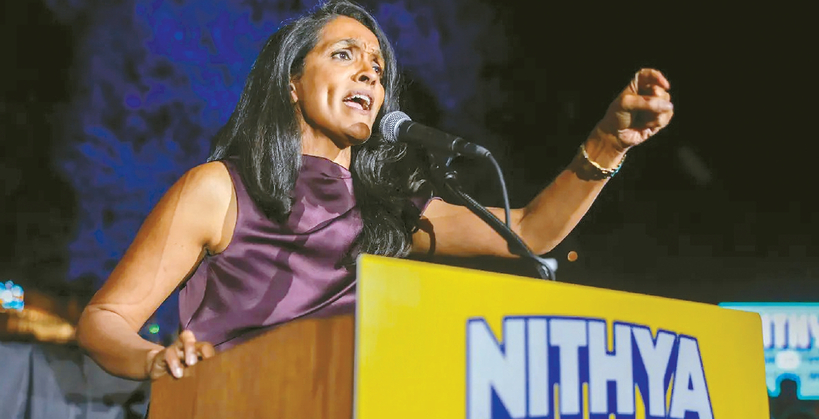
The election of Nithya Raman as Los Angeles City Councilmember-turned-mayor marks a new turning point in local politics. Public distrust in existing political leadership and city government has sparked a wave of voter demand for change, drawing renewed attention to historic elections that reshaped LA’s political landscape over the past century.
During her victory speech on the 3rd, Mayor-elect Raman stated that a cynicism has begun to dominate the city, making people believe that LA’s problems are not just severe, but permanently unsolvable.
As a democratic socialist, Raman mobilized young progressive voters and citizens disappointed with the current administration to secure her historic victory. This election is evaluated as a voter choice demanding transformation in Los Angeles’ political power and policy direction, far beyond a simple change of leadership.
The Los Angeles Times compares Raman’s victory to four historic mayoral races that shifted LA’s political order over the past century. These elections share a common thread: growing dissatisfaction with the existing political system formed new political coalitions, resulting in unexpected outcomes.
In the 1930s, Los Angeles was plagued by deep corruption under Mayor Frank Shaw, with widespread bribery in city contracts and collusion between police and criminal organizations. Public outrage exploded after police bombed the homes and vehicles of anti-corruption activists.
Ultimately, a recall election was held against Shaw, and reform candidate Fletcher Bowron was elected mayor. While Bowron reformed civil service and dismantled corruption structures, his legacy carried dark shadows, including the rise of police brutality and his support for the forced internment of Japanese Americans.
Sam Yorty capitalized on this frustration, criticizing the downtown establishment as a political machine and focusing on everyday issues like air pollution and trash collection. Though initially considered an underdog, Yorty utilized television to defeat incumbent Norris Poulson, though his later tenure was criticized for exacerbating racial tensions.
The 1973 election of Tom Bradley marked another crucial turning point. A former police officer and councilman, Bradley built a broad coalition across Black, Latino, Jewish, labor, and business communities, eventually becoming LA’s first Black mayor.
Under Bradley, LA grew into an international economic and cultural hub, highlighted by the successful 1984 Olympic Games. However, his final terms were marred by turmoil, including the 1991 Rodney King beating and the 1992 LA riots, revealing persistent structural and racial divides.
His victory was featured on Newsweek’s cover under the title ‘Latino Power,’ paving the way for Latino politicians to expand influence across major public offices. However, power-sharing conflicts among ethnic groups persisted, highlighted by the 2022 city council leaked audio scandal.
Raman’s mayoral victory shares similarities with these past turning points, driven by voter frustration with the status quo. However, history shows that election victories alone cannot solve systemic urban problems. Reformers like Bowron faced police brutality issues, Yorty saw deepening racial friction, and leaders like Bradley and Villaraigosa could not completely eradicate inequality.
As Raman takes office this December 14, she faces immense challenges, including the homeless crisis, affordable housing shortages, and improving daily administrative services. Balancing the demands of progressive supporters with cautious citizens will be critical.
Whether Raman can successfully channel voter dissatisfaction into meaningful municipal reform will be the core variable determining the future direction of Los Angeles politics, proving once again that a new leader’s success depends entirely on problem-solving capability.