A new U.S. intelligence assessment warns that North Korea already has ballistic missiles capable of striking the U.S. mainland—and that these 10 or fewer U.S.-range weapons could grow to as many as 50 by 2035 according to Newsweek.
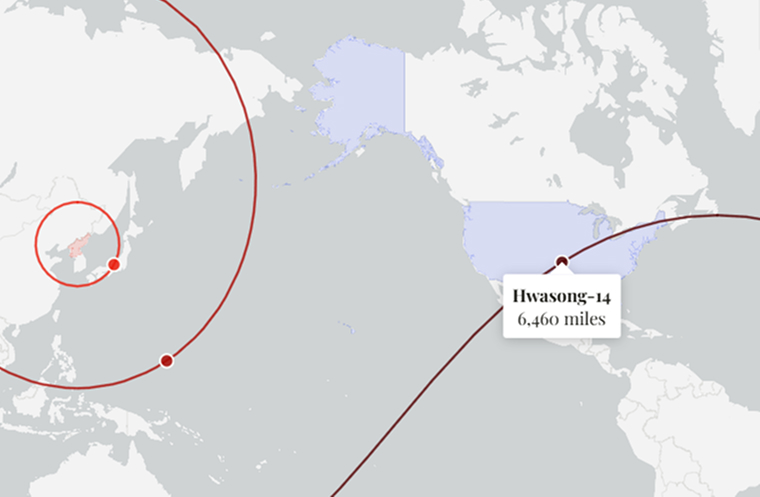
A map published by Newsweek shows that Pyongyang’s expanding arsenal can now threaten U.S. forces across the Pacific and, in several scenarios, reach much of the continental United States.
The Kim Jong Un regime continues developing its United Nations-sanctioned ballistic missile program, intensifying tensions with South Korea and Japan. Many of the latest systems are newer, harder to detect, and designed for extended ranges—including models believed capable of targeting most of the contiguous 48 states. Pyongyang argues that its missile and nuclear programs are necessary for self-defense, pointing to joint military exercises conducted by the United States, South Korea, and Japan, all of which host thousands of American troops.
North Korea is believed to operate an unspecified number of medium-range missiles, including the Hwasong-9 (Scud-ER), which the Center for Strategic and International Studies estimates can travel up to 620 miles. This range allows the missile to deliver a high-explosive, chemical, or potentially miniaturized nuclear warhead anywhere in South Korea and into southwestern Japan, including the joint U.S. Marine Corps–Japanese Air Station Iwakuni.
Pyongyang’s inventory also includes the intermediate-range Hwasong-10 (BM-25 Musudan), believed capable of delivering a conventional or nuclear payload of about 2,600 pounds as far as 2,490 miles. That distance is enough to threaten American military targets throughout the Western Pacific, including the U.S. territory of Guam.
First tested in 2017, North Korea’s initial intercontinental ballistic missile (ICBM), the Hwasong-14 (KN-20), is estimated—depending on payload—to travel up to 6,460 miles. That puts Hawaii, Alaska, and large portions of the U.S. mainland within reach.
In May, state-run Korean Central News Agency quoted Kim Jong Un as saying that “the DPRK should continue to direct efforts to steadily improving the long-range precision striking capability and efficiency of weapons systems.” The Democratic People’s Republic of Korea (DPRK) is North Korea’s official name.
The U.S. Director of National Intelligence, in its 2025 threat assessment, wrote:
“Kim will continue to prioritize efforts to build a more capable missile force—from cruise missiles to ICBMs and hypersonic glide vehicles—designed to evade U.S. and regional missile defenses, improve the North’s precision-strike capabilities, and put U.S. and allied forces at risk.”
An unclassified report released earlier this year by the U.S. Defense Intelligence Agency assessed that North Korea currently possesses “10 or fewer ballistic missiles capable of reaching the U.S.” and “speculated that this number could rise to as many as 50 by 2035.”
BY YEOL JANG [jang.yeol@koreadaily.com]