South Korea’s indigenous space launch vehicle, Nuri, has successfully completed its fifth space flight. With this launch, South Korea has officially opened the era of the ‘satellite constellation,’ deploying multiple satellites performing the same mission into orbit at once using a domestic launch vehicle.
Nuri lifted off with a roar and a plume of fire from Pad No. 2 at the Naro Space Center in Goheung, Jeollanam-do, at 12:25 p.m. on the 7th. About 12 minutes after liftoff, at 12:37 p.m., it reached its target orbit at an altitude of 575 km, specifically a Sun-synchronous orbit designed for satellites to pass over specific points at the same time every day.
Nuri carried 15 satellites in total, including the main payload—micro-satellite constellation ‘Neonsat’ Nos. 2 through 6—along with 10 cube satellites developed by universities, corporations, and local governments. Upon reaching orbit, Nuri released the five Neonsat units one by one at 35 to 40-second intervals. To prevent collisions, the launch vehicle adjusted its posture to release each satellite in a different direction. Afterward, it deployed 10 cube satellites designed for missions such as domestic component verification, fine dust observation, and pharmaceutical experiments in pairs at 10-second intervals. Except for the quaternion’s ‘Porsat-02,’ which failed to deploy, nine of them successfully entered orbit. Nuri concluded its flight approximately 20 minutes after liftoff. Deputy Prime Minister and Minister of Science and ICT, Bae Kyung-hoon, who visited the launch site that day, stated, “We have successfully launched five micro-satellites simultaneously for the first time in Korea, opening the door to the era of satellite mass production and constellation operation.”
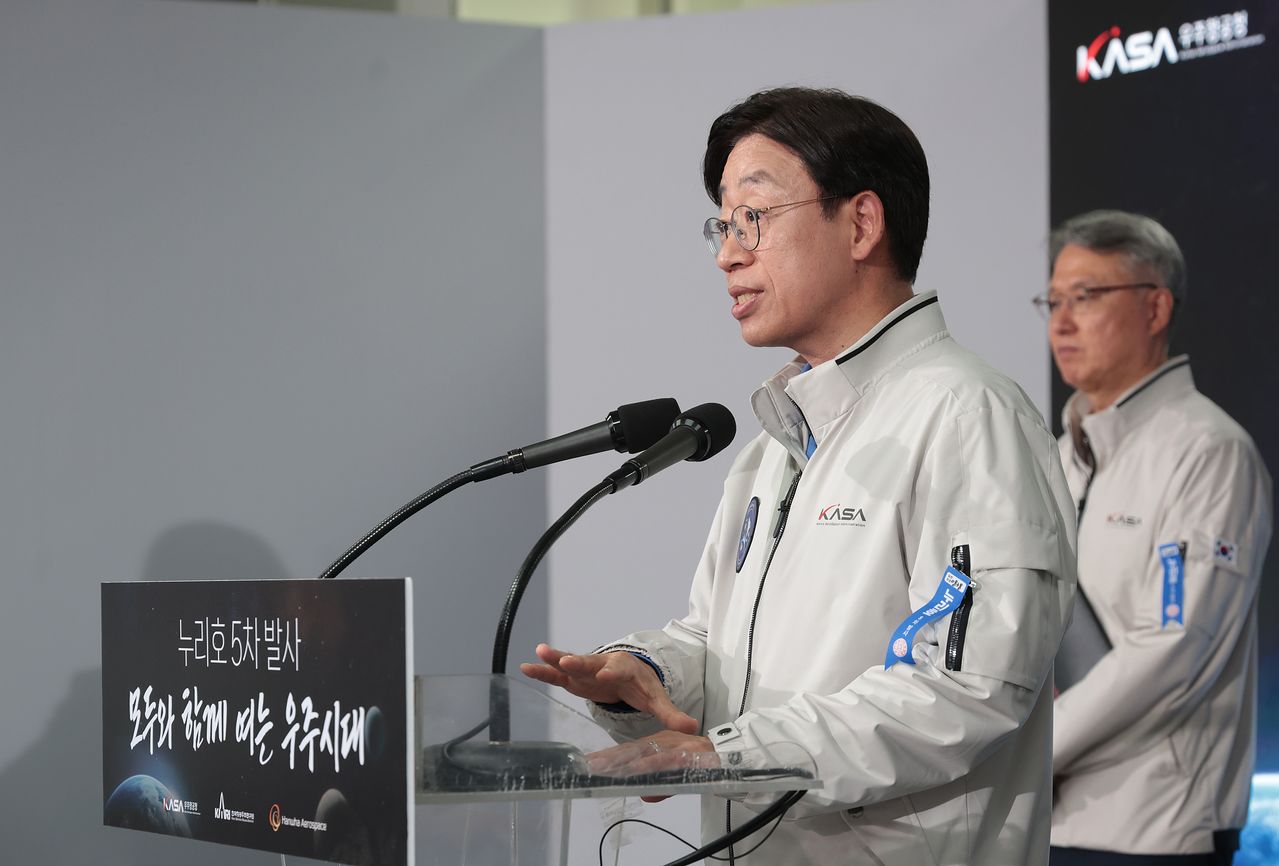
Having headed into space carrying the largest number of satellites in its history, Nuri performed the intricate task of precisely separating multiple main payloads. Its operational capabilities also proved more stable. Liftoff took place precisely at the launch time scheduled by the Launch Management Committee in the morning, and every phase proceeded as anticipated. It was the first-ever on-time launch for Nuri. Tae-seok Oh, Minister of the Korea AeroSpace Administration (KASA), noted, “This demonstrates our space transportation capability to perform various missions tailored to the orbits and times desired by customers.”
The main payload, Neonsat Nos. 2 through 6, consists of ultra-small satellite constellations weighing under 100 kg each. A micro-satellite constellation refers to a fleet of small satellites operating in an organic network like a single system, replacing a single large satellite. Neonsat Nos. 2 through 6 all succeeded in their initial communications with domestic and foreign ground stations, including the Antarctic Sejong Station, on the day of launch. Equipped with 1m black-and-white and 4m color cameras, the orbiting Neonsat units will observe national security, disasters, and emergencies. The government plans to launch an additional five units (Nos. 7 through 11) during the 6th launch in 2027 to complete a constellation of 10 satellites. This will enable imaging of the Korean Peninsula more than three times a day and rapid re-imaging of the same location within 24 hours during critical situations such as disasters. Kang Sung-joo, a former senior researcher at the Korea Astronomy and Space Science Institute, remarked, “In disaster and security fields, the ability to quickly verify how situations change over time through multiple observations is just as crucial as having a single high-resolution image.”
President Lee Jae-myung watched the real-time broadcast of the Nuri-5 launch with his aides from his office at the Blue House. Expressing his joy after the successful launch, President Lee requested, “This is the achievement of the government’s active support for space launches. Please spur the development of satellite technologies by further shortening future launch cycles.”
This launch saw increased participation in launch preparation and operations by the private company Hanwha Aerospace compared to the 4th launch. Hanwha Aerospace oversaw the manufacturing and overall assembly of Nuri. Out of 22 consoles in the launch control center, 23 personnel from Hanwha participated in 20 consoles, with 18 of them directly operating the consoles. Kim Sun, head of Hanwha Aerospace’s Space Business Division, stated, “We will continue to take over core tasks in the launch preparation and operation process to internalize the technology.”