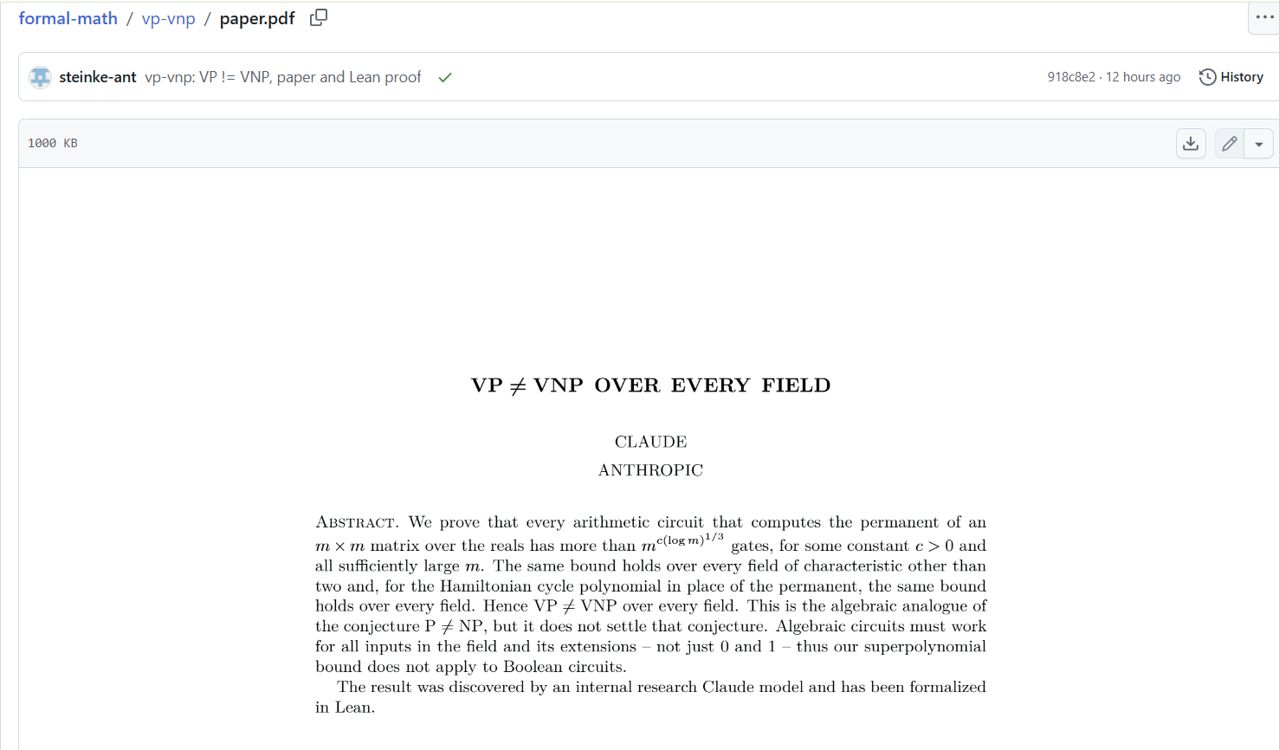
Anthropic’s artificial intelligence model, Claude, claimed on the 23rd (local time) that it has solved the ‘Valiant problem,’ which is considered a twin problem to the ‘P vs. NP hypothesis,’ one of the seven Millennium Prize Problems in mathematics. This comes just three days after claiming to have proven the Riemann hypothesis, another one of the seven Millennium Prize Problems.
Anthropic posted a 70-page paper authored solely by Claude on the developer platform GitHub on the 23rd, titled ‘VP is not VNP over every field (VP≠VNP).’ Proposed by mathematician Leslie Valiant in 1979, the VP=VNP problem is a simplified, analogous version created because the Millennium Prize’s ‘P vs. NP’ hypothesis is overly complex.
The P vs. NP hypothesis asks whether ‘if checking a solution (NP) is easy, finding the solution is also easy (P).’ The consensus in the academic community is that ‘essentially, solving a problem is harder than checking it (P≠NP).’ This hypothesis also underpins the premise of modern cryptographic systems, which states that encryption is easy, but decrypting without the key is difficult.
The Valiant problem simplifies this into the realm of formula calculation, asking whether ‘even if a formula looks extremely complex, finding a clever shortcut allows answers to be found quickly using only addition and multiplication.’ Claude argued in its paper that as the scale of a problem grows, there are formulas for which shortcuts can never be found (VP≠VNP), publishing this in a 73,000-line Lean code. Although the P vs. NP hypothesis itself was not directly solved, the academic community suggests that ‘if the core stepping stone VP≠VNP is proven, the possibility of P≠NP is also high.’
Anthropic’s claim comes just three days after claims emerged that Claude had proven the ‘Riemann hypothesis’ among the 7대 난제. Claude emphasized in the paper that ‘the proof in this paper was discovered and written by AI, and has not been reviewed by any human mathematician.’ Previously, on the 20th (local time), Anthropic claimed Claude solved the Riemann hypothesis, and in September, OpenAI claimed GPT 6.2-Astra was used to solve the ‘Navier-Stokes problem.’
However, pointing out that validation of the hard-problem proofs generated by AI remains another bottleneck, Lance Fortnow, an expert in computational complexity theory and former computer science professor at the Illinois Institute of Technology, wrote on his blog that day, ‘While amazing new theorems proven by AI are pouring in, frankly I don’t have the stomach to read those proofs.’ Levent Alfoget, an Anthropic researcher who previously claimed to have proven the Riemann hypothesis by presenting 17.4 million lines of Lean code, said on his X that day, ‘It is an obvious fact that my Lean code is filled with all sorts of garbage code,’ adding that verification and simplification are necessary.