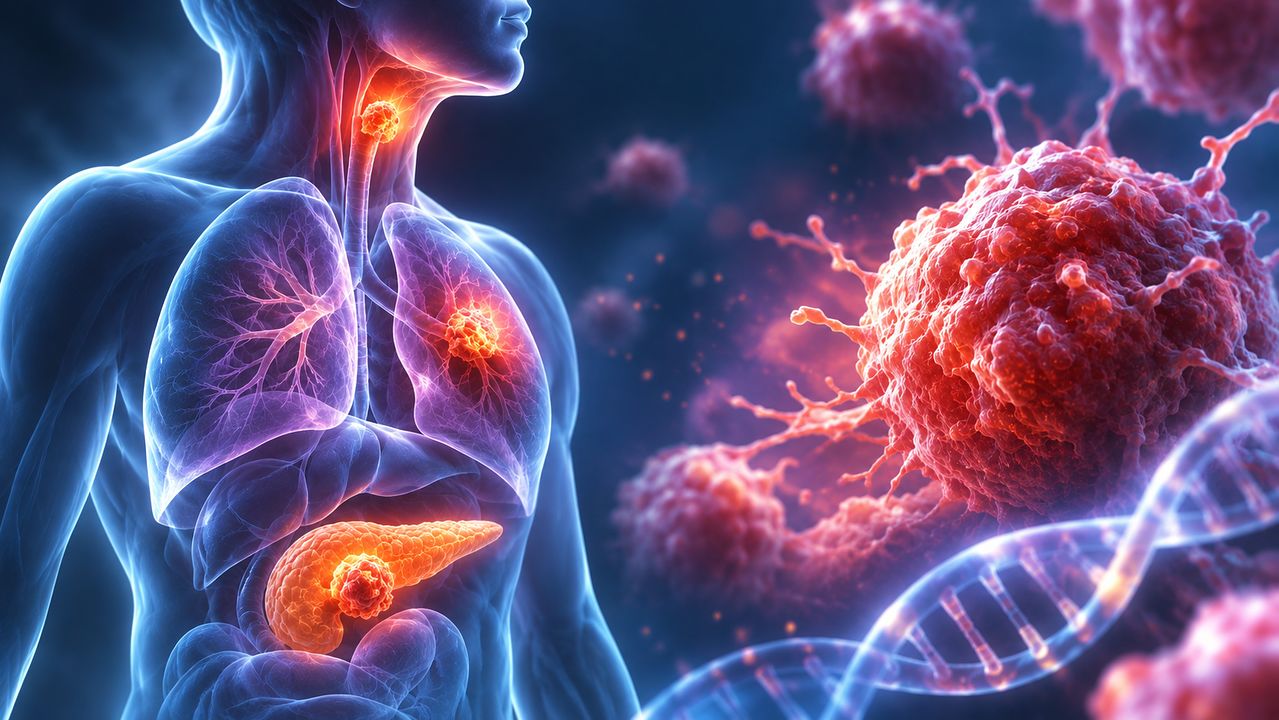
Recent clinical trials and approvals for new therapies are bringing promising breakthroughs in treating difficult cancers such as pancreatic cancer treatment, head and neck cancer, and lung cancer.
Revolution Medicines, a U.S. biotechnology company, released phase 1 and 2 clinical trial results on November 19 (local time) for its new drug ‘Rasonk’ involving 61 metastatic pancreatic cancer patients. Rasonk works by inhibiting ‘RAS’, a protein that promotes cancer cell growth.
When Rasonk, an oral pancreatic cancer treatment, was combined with chemotherapy in patients who had not previously received anti-cancer treatment, the objective response rate was 60.7% and the disease control rate was 90.2%. This means that in 6 in 10 patients, tumors shrank or disappeared beyond a certain threshold, while in 9 patients, tumors shrank or did not grow further.
The median progression-free survival—the time it takes for cancer to worsen or for a patient to pass away—was 12.8 months. This is a striking figure compared to the 5 to 7 months recorded in previous pancreatic cancer treatment clinical trials, though direct comparison is difficult due to differing patient groups and trial conditions.
Following an initial interim analysis in April involving 40 patients observed for over four months with a 58% response rate, Revolution Medicines announced these updated results after expanding the patient pool and extending the follow-up period to 18.3 months.
Pancreatic cancer often presents symptoms late and is frequently detected after metastasizing to other organs, making high effectiveness in initial anti-cancer treatments crucial. This clinical trial was conducted to verify whether Rasonk yields effective outcomes when used as a first-line treatment.
In August, the U.S. Food and Drug Administration (FDA) approved the drug for metastatic pancreatic cancer patients who had previously received anti-cancer treatment or had difficulty using multiple therapies concurrently. On November 16, it was also approved in the European Union for metastatic pancreatic cancer patients who underwent at least one round of anti-cancer therapy.
Meanwhile, new therapeutics are also emerging for head and neck cancer, which affects areas such as the mouth, throat, and vocal cords. On November 5, the FDA granted accelerated approval to ‘Rybrevant Faspro’ for recurrent or metastatic head and neck squamous cell carcinoma that progressed after chemotherapy and immunotherapy. Developed by Johnson & Johnson, this drug achieved a response rate of 42%.
Additionally, U.S.-based Pyxis Oncology announced on November 18 that its antibody-drug conjugate (ADC) candidate ‘Micvotabart Pelidotin (MICVO)’ demonstrated tumor reduction in 39% of 33 patients during a phase 1 clinical trial. In the lung cancer sector, the FDA granted accelerated approval to ‘Nelkarmi’ on November 17 for advanced non-small cell lung cancer with ALK gene abnormalities, showing tumor reduction in 49% of 67 patients previously treated with ‘Alectinib’.