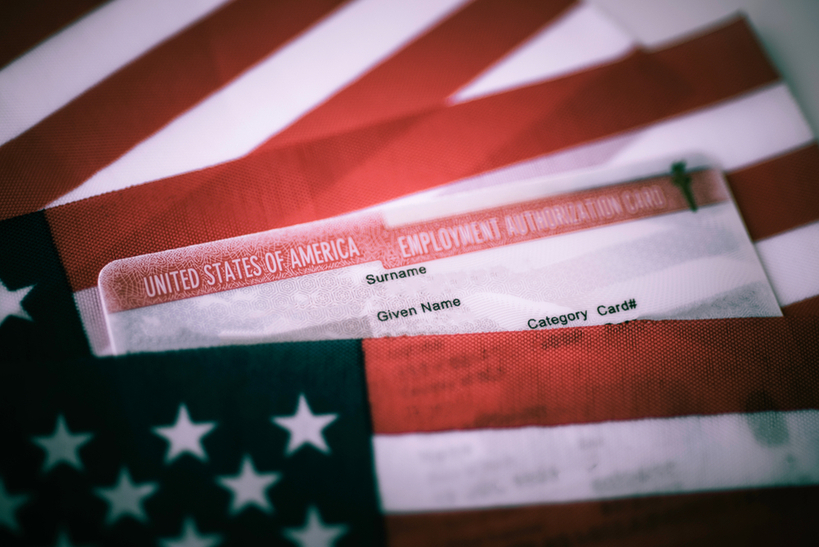
The Trump administration is significantly tightening the process for foreign nationals to obtain employment-based green cards.
The U.S. Department of Labor announced a proposed rule on the 16th to overhaul the PERM labor certification system, which is a core step in employment-based green card applications. The core of the reform is to restrict companies that have laid off American workers from hiring foreign nationals and to strengthen the obligation of green card sponsor companies to prioritize American hiring. The proposed rule was published in the Federal Register on the 17th, with a 60-day public comment period.
According to the proposed rule, companies that have laid off U.S. workers will be prohibited under certain conditions from applying for labor certifications for foreign workers in the same or similar occupations for up to two years. In addition, the recruitment period for American job seekers prior to hiring foreign workers will be extended to a minimum of 90 days, and special exemption systems previously applied to professions such as physical therapists and nurses are set to be eliminated.
The most prominent feature is the strengthening of restrictions on foreign hiring by companies that have laid off U.S. workers. While current regulations review layoff history for the six months prior to a labor certification application, the new proposed rule expands this period to two years. However, the rule does not impose a blanket ban on foreign hiring for all companies that have conducted layoffs. Actual restrictions will be determined based on the duties of the laid-off workers, the work location, and the application requirements set forth in the regulation.
The procedures for recruiting U.S. job seekers before hiring foreign nationals are also being reinforced. The Department of Labor plans to mandate that companies conduct recruitment activities for at least 90 days for the relevant occupation. Furthermore, regulations are shifting away from traditional newspaper-centric recruitment advertising toward utilizing company websites, online job boards, social media, job fairs, and university recruitment programs.
In addition, the Schedule A exemption system—which has provided labor market test exemptions for specific occupations such as registered nurses and physical therapists—will be abolished. Under the current system, professional nurses, physical therapists, and certain foreign nationals with extraordinary ability in the sciences or arts are exempt from standard PERM procedures. Moving forward, however, these occupations will also be required to undergo the same verification process as general procedures.
These proposed changes will impact South Korean companies operating in the U.S., Korean-owned businesses, and Korean nationals preparing for employment-based green cards. For example, a Korean company expanding into Georgia that downsizes U.S. staff and wishes to sponsor a Korean employee in the same occupation must carefully review the new layoff restriction rules.
Similarly, Korean businesses or medical institutions sponsoring foreign employees for green cards must meet the enhanced recruitment requirements. In particular, foreign employees already working in the U.S. on employment visas like H-1B while preparing for green card procedures must pay close attention to their employer’s layoff history and labor certification application timelines.
PERM is the labor certification process that U.S. companies must go through when sponsoring foreign nationals for employment-based green cards. Employers must prove that there are no qualified U.S. workers available for the position and that hiring a foreign national will not negatively affect the wages and working conditions of U.S. workers. To satisfy this, companies must conduct recruitment ads, review applicants, and then file a labor certification with the Department of Labor. Once approved, employers typically proceed to the next step of filing an immigrant petition for alien worker (Form I-140).