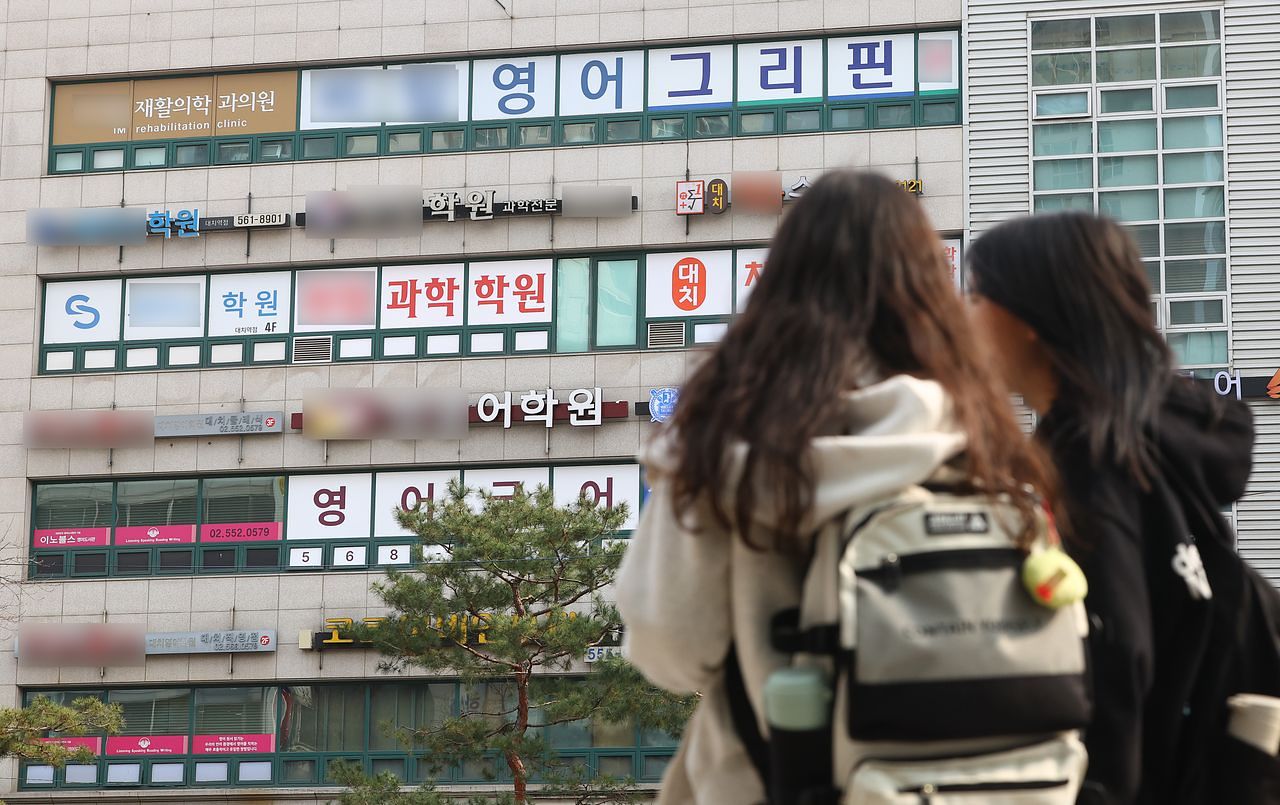
Couples with unmarried children in South Korea have seen their household incomes decline, yet their spending on private education spending surged by over 7% during the third quarter.
As housing and transportation costs also increased, the proportion of income remaining after consumption for these households dropped to its lowest level in seven years for a third quarter.
According to data from the National Statistics Portal on November 29, the average monthly income of married couples with unmarried children stood at 8.379 million won ($6,000+) in the third quarter of this year, marking a 0.3% decrease compared to a year earlier.
Disposable income—calculated by subtracting taxes and interest expenses from total earnings—dropped 2.9% to 6.471 million won per month.
Conversely, monthly expenditures on student academy and tutoring education averaged 442,000 won, representing a 7.1% increase from the previous year.
This expenditure indicator includes supplementary and advanced learning costs not only for elementary, middle, and high school students, but also for infants, toddlers, and repeat test-takers known as N-sue-saeng.
While private education spending for households with unmarried children had stagnated since last year, it returned to an upward trajectory beginning in the second quarter of this year.
The growth rate was 0.3% in the second quarter of last year, followed by a 0.7% decline in the third quarter. It rose 0.9% in the fourth quarter before dropping 0.5% again in the first quarter of this year.
Subsequently, academy tuition spending climbed 5.2% to 429,000 won in the second quarter, with the growth rate expanding further to 7.1% in the third quarter.
Categorized by the number of children, households with a single unmarried child saw their student academy spending rise 5.3% to 185,000 won.
Meanwhile, households with two or more unmarried children spent 653,000 won, a 6.9% increase.
Total private education expenses for elementary, middle, and high school students fell 5.7% to 27.5 trillion won last year—the first decline in five years since 2020—but renewed household academy spending this year raises concerns that private education costs are rebounding.
Surging Tuition and Living Costs Squeeze Household Budgets
The mounting burden of private education has further diminished household financial capacity.
In the third quarter of this year, the surplus rate for married couple households with unmarried children stood at 26.9%, down 5.1 percentage points from 32.0% during the same period last year.
Based on third-quarter figures, this represents the lowest level since 2019, when the rate was 26.6%.
Beyond tutoring costs, housing, water, electricity, and fuel expenses climbed 11.6%, while transportation and transit costs jumped 13.9%, compounding financial pressures on families.
Private Education Costs Threaten South Korea’s Birth Rate Recovery
The rise in private education expenses is also being singled out as a major stumbling block to recovering birth rates.
During a joint conference hosted by the Bank of Korea, the Center for Economic Policy Research, and the OECD last September, Sejong University economics professor Kim Sung-hoon and other researchers estimated that if intense private education competition had been absent, women born between 1970 and 1975 would have had an average of 2.45 children—28% higher than their actual average of 1.92 children.
Although the fertility rate has shown recent signs of a rebound, experts warn that sustained burdens from child-rearing costs, such as private tutoring and housing, could constrain continuous recovery.
Park Nam-ki, a professor emeritus at Gwangju National University of Education, emphasized, “It is crucial for the state to signal that it cares about education budgets and policies. We must also consider measures like issuing vouchers to ensure children are not disadvantaged in their education due to parental economic status.”/>