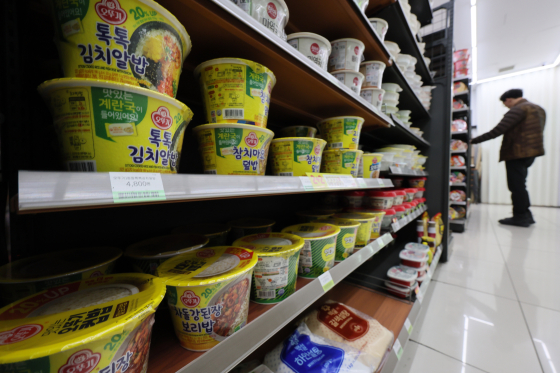
Processed food prices in South Korea are on a sharp upward trend, increasing the burden on household grocery budgets. Following last year’s high exchange rates and rising costs for raw materials and packaging, this year has brought additional pressures from logistics expenses, raising concerns that more companies may join the price hikes.
According to the August price trend report released on the 4th by the Korea Consumer Agency’s price information portal ‘T-Price,’ 24 out of 26 heavily consumed processed food items showed price increases compared to a year ago.
Soup and stew products saw the highest surge, with an increase rate reaching 39.2%. They were followed by cupbap (24.9%), red pepper paste (19.8%), soybean paste (19.1%), cola (16.8%), and noodles (16.1%). However, due to sample reorganization in January that changed the product composition for soups/stews and red pepper paste, the price increases for identical products stand at 15.7% and 4.2% respectively.
Recently, food manufacturers have raised their factory-gate prices, a trend that is trickling down to actual retail prices at large supermarkets and convenience stores. Instant rice prices rose 5.7% from the previous month, while cola increased by 6.7%, ketchup by 4.3%, curry by 4.1%, and canned tuna by 3.9%.
The Korea Consumer Agency analyzed that these figures reflect CJ CheilJedang’s mid-July announcement to raise ‘Hetbahn’ prices by 12%, as well as Ottogi’s average 6.1% factory-gate price hikes for curry and ketchup products. Lotte Chilsung Beverage also raised Pepsi-Cola factory-gate prices by 5% in the latter half of June, and Coca-Cola increased product prices by 100 to 300 won starting in August.
This upward trajectory is likely to continue for the time being. According to Statistics Korea, the processed food price inflation rate for September was 2.1%, expanding its upward span compared to August (1.5%). A statistical official explained that this was due to the reflection of factory-gate price hikes for certain processed foods such as bread and frozen foods.
A ‘domino price increase,’ where one company’s price hike spreads to its competitors, is also a growing concern. In August, a research team from the Bank of Korea noted that since recent core inflation rates are hovering in the mid-2% range, it is necessary to pay attention to the possibility that future price uptrends will spread to other items and further strengthen overall upward pressure on core inflation.
Meanwhile, the government plans to consult with the processed food industry to stagger the timing of price hikes and expand items included in proprietary discount events. Last September, as part of the Chuseok livelihood stabilization measures, discounts of up to 64% were induced for 4,765 items, including ramen. A government official stated that companies which did not fully reflect last year’s rising exchange rates and this year’s oil price increases stemming from the Middle East war seem to be sequentially implementing price hikes, adding that the government will continuously consult with the industry to minimize price increases and expand discount items.